



Kartogenin sodium
Based on 33 publication(s) in Google Scholar
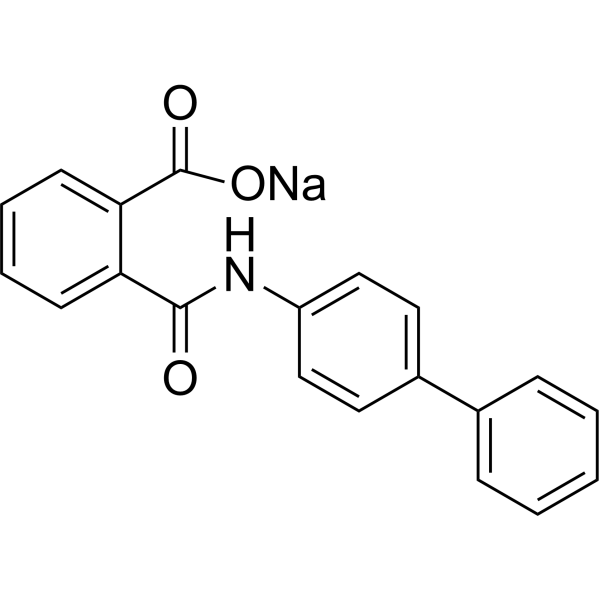
Kartogenin (KGN) sodium is an inducer of chondrogenic tissue formation (EC50: 100 nM). Kartogenin sodium induces chondrogenesis by binding to fibrin A, disrupting its interaction with the transcription factor core binding factor beta subunit (CBFβ), and by modulating the CBFβ-RUNX1 transcriptional program. Kartogenin sodium also promotes tendon-bone junction (TBJ) wound healing by stimulating collagen synthesis. Kartogenin sodium is widely used in cell-free therapy in the field of regeneration for cartilage regeneration and protection, tendon-bone healing, wound healing and limb development. Kartogenin sodium promotes cartilage repair, coordinates limb development, and is also used in osteoarthritis (OA) research.
For research use only. We do not sell to patients.
- Purity : 99.84%
- CAS No.: 1401168-39-5
- Formula: C20H14NNaO3
- Molecular Weight:339.32
-
Storage:
4°C, sealed storage, away from moisture and light
* In solvent : -80°C, 6 months; -20°C, 1 month (sealed storage, away from moisture and light)

To place orders, for customer services and technical support, please contact: MedChemExpress USA
Tel: 609-228-6898 E-mail: [email protected] [email protected]


-
 Biological Activity
-
Chemical Information
-
Solvent & Solubility
- Protocols
- Purity & Documentation
- References
-
 Help & FAQs


Publications Citing Use of MedChemExpress (MCE) Kartogenin sodium
More- Sci Bull. 2023 Sep 15;68(17):1904-1917. [Abstract]
- Adv Funct Mater. 2026 Feb 3.
- Adv Funct Mater. 2025 Dec 22.
- ACS Nano. 2025 Jun 10;19(22):20502-20515. [Abstract]
- J Mater Sci Technol. 2023 Sep 1.
- Theranostics. 2019 Sep 21;9(24):7108-7121. [Abstract]
- Biomaterials. 2022 Jun;285:121530. [Abstract]
- Biomaterials. 2021 Dec:279:121216. [Abstract]
- Chem Eng J. 2024 Aug 1.
- Chem Eng J. 1 March 2022, 133861.
- Chem Eng J. 400 (2020) 126004.
- Small. 2025 Sep 18:e07138. [Abstract]
- Small. 2022 Sep 3;e2202156. [Abstract]
- Adv Healthc Mater. 2023 Jul;12(18):e2203236. [Abstract]
- Sustainable Mater Technol. 2026 Mar 14.
- Mater Design. 2023 May 16, 112007.
- J Mater Chem B. 2026 Jul 1;14(25):7951-7968. [Abstract]
- Colloids Surf B Biointerfaces. 2020 Aug:192:111059. [Abstract]
- Int Immunopharmacol. 2026 Apr 15:175:116450. [Abstract]
- Int Immunopharmacol. 2025 Oct 10:163:115296. [Abstract]
- Stem Cell Rev Rep. 2022 Aug;18(6):2074-2087. [Abstract]
- Biomed Mater. 2026 May 28;21(3). [Abstract]
- Osteoarthr Cartil Open. 2023 May 12;5(3):100369. [Abstract]
- Anim Reprod Sci. 2021 Jun:229:106750. [Abstract]
- Orthop Surg. 2020 Jun;12(3):938-945. [Abstract]
- Res Sq. 2025 Jul 21.
- Res Sq. 2024 May 17.
- University of Oklahoma. 2024 May 10.
- Research Square Preprint. 2023 Apr 21.
- Authorea. 2023 Jan 27.
- Dis Markers. 2022 Aug 29:2022:6943630. [Abstract]
- Research Square Preprint. 2021 Sep.
- Patent. US20180263995A1.
 Customer Validation & Images

-
RT-PCR
-
WB
-
IHC


Biological Activity
Description
In Vitro
Kartogenin sodium (100 nM; 72 h) induces chondrocyte nodule formation in primary hMSCs[1].
Kartogenin sodium (10 nM-10 μM; 72 h) increases chondrocyte-specific gene expression in hMSCs[1].
Kartogenin sodium (0.12-10 μM; 48 h) inhibits nitric oxide (NO) and glycosaminoglycan (GAG) release induced by cytokines in primary bovine articular chondrocytes[1].
Kartogenin sodium (50-5000 nM; 2 weeks) induces the chondrogenetic differentiation of the BMSCs in a concentration-dependent manner[2].
MedChemExpress (MCE) has not independently confirmed the accuracy of these methods. They are for reference only. Further protocols information, click here.
In Vivo
MedChemExpress (MCE) has not independently confirmed the accuracy of these methods. They are for reference only.


Chemical Information
-
CAS No. 1401168-39-5
-
Appearance Solid
-
Molecular Weight 339.32
-
Formula C20H14NNaO3
-
Color White to off-white
-
SMILES
O=C(O[Na])C1=CC=CC=C1C(NC2=CC=C(C3=CC=CC=C3)C=C2)=O
-
Synonyms
KGN sodium
-
Shipping
Room temperature in continental US; may vary elsewhere.
-
Storage
4°C, sealed storage, away from moisture and light
* In solvent : -80°C, 6 months; -20°C, 1 month (sealed storage, away from moisture and light)


Publications (33)
-
Journal Impact Factor
-
Most Recent
-
Sci Bull
Enhanced osteochondral repair with hyaline cartilage formation using an extracellular matrix-inspired natural scaffold. [Abstract]2023 Sep 15;68(17):1904-1917. PMID: 37558534 -
-
-
ACS Nano
MXene-Based Cartilage-Adhesive Microspheres for Photothermal-Controlled Hydrophobic Drug Release and Mesenchymal Stem Cell Delivery in Osteoarthritis. [Abstract]2025 Jun 10;19(22):20502-20515. PMID: 40446309 -
-
Theranostics
Kartogenin hydrolysis product 4-aminobiphenyl distributes to cartilage and mediates cartilage regeneration. [Abstract]2019 Sep 21;9(24):7108-7121. PMID: 31695756
Kartogenin sodium purchased from MedChemExpress. Usage Cited in: Theranostics. 2019 Sep 21;9(24):7108-7121. [Abstract]
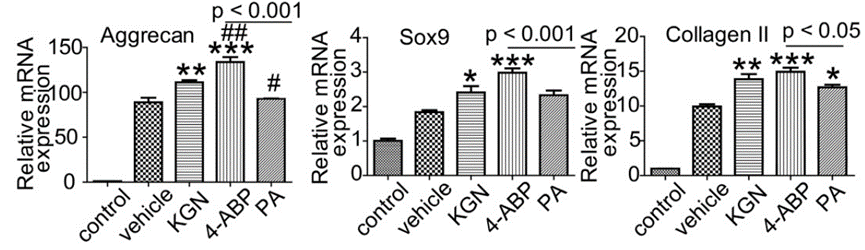
CSPC were isolated from cartilage and treated with vehicle or 10 μM Kartogenin (KGN), 4-ABP or phthalic acid (PA) in the chondrogenic differentiation medium. Aggrecan, Sox9 and type II collagen mRNA expression levels (determined by RT-qPCR) at day 21.
Kartogenin sodium purchased from MedChemExpress. Usage Cited in: Theranostics. 2019 Sep 21;9(24):7108-7121. [Abstract]
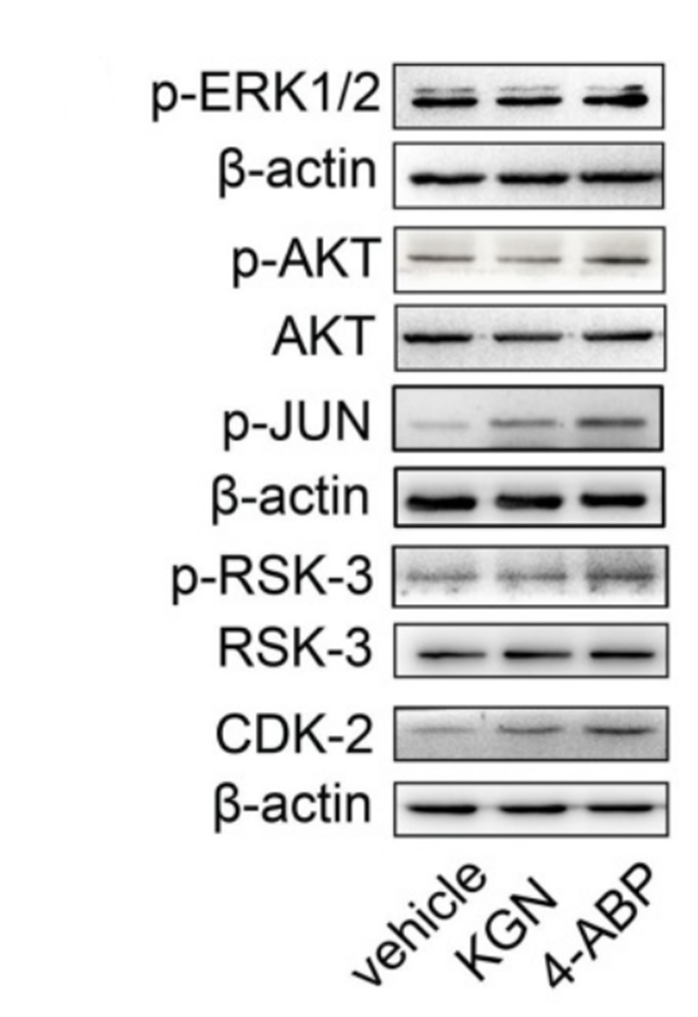
p-ERK1/2, p-AKT, p-JUN, p-RSK-3 and CDK-2 protein expression in UC-MSC treated with vehicle, Kartogenin (KGN) or 4-ABP (10 μM) for 3 days.
Kartogenin sodium purchased from MedChemExpress. Usage Cited in: Theranostics. 2019 Sep 21;9(24):7108-7121. [Abstract]
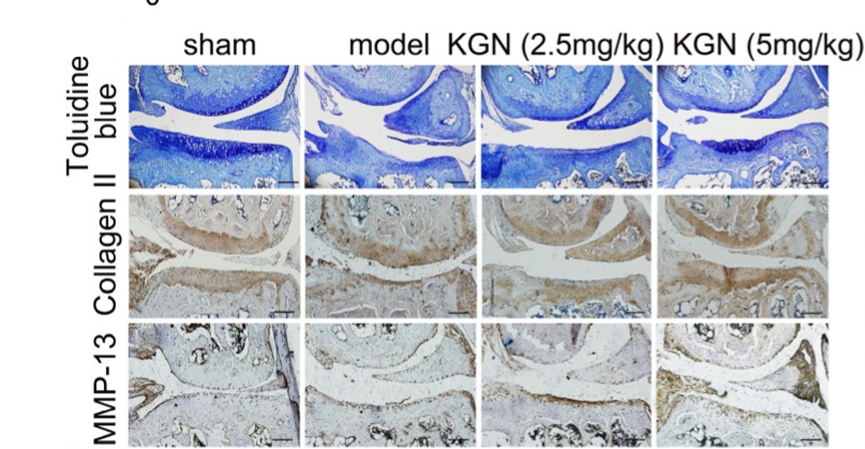
Oral Kartogenin (KGN) (2.5, 5 mg/kg) administration schedule in destabilization of medial meniscus (DMM)-induced osteoarthritis in STR/Ort mice. Representative images of toluidine blue and immunohistochemical staining of type II collagen and MMP-13 in articular cartilage.
-
Biomaterials
Injectable immunomodulation-based porous chitosan microspheres/HPCH hydrogel composites as a controlled drug delivery system for osteochondral regeneration. [Abstract]2022 Jun;285:121530. PMID: 35504181 -
Biomaterials
3D-bioprinted BMSC-laden biomimetic multiphasic scaffolds for efficient repair of osteochondral defects in an osteoarthritic rat model. [Abstract]2021 Dec:279:121216. PMID: 34739982 -
-
-
-
Small
2025 Sep 18:e07138. PMID: 40965039 -
Small
Injectable Double Positively Charged Hydrogel Microspheres for Targeting-Penetration-Phagocytosis. [Abstract]2022 Sep 3;e2202156. PMID: 36056898 -
Adv Healthc Mater
Sustained-Drug-Release, Strong, and Anti-Swelling Water-Lipid Biphasic Hydrogels Prepared via Digital Light Processing 3D Printing for Protection against Osteoarthritis: Demonstration in a Porcine Model. [Abstract]2023 Jul;12(18):e2203236. PMID: 36943891 -
-
-
J Mater Chem B
3D-printed bilayer hydrogel scaffolds incorporating HAP and KGN@Lip for osteochondral regeneration. [Abstract]2026 Jul 1;14(25):7951-7968. PMID: 42300767 -
Colloids Surf B Biointerfaces
Injectable in situ forming kartogenin-loaded chitosan hydrogel with tunable rheological properties for cartilage tissue engineering. [Abstract]2020 Aug:192:111059. PMID: 32380404 -
Int Immunopharmacol
Daucosterol alleviates osteoarthritis by targeting chondrocyte senescence via inhibiting of the JNK pathway. [Abstract]2026 Apr 15:175:116450. PMID: 41775106 -
Int Immunopharmacol
CORM-3 mitigates osteoarthritis by anti-inflammation and enhancing autophagy via inhibiting MAPK and mTOR pathways. [Abstract]2025 Oct 10:163:115296. PMID: 40749610 -
Stem Cell Rev Rep
Dual-specificity Tyrosine Phosphorylation-regulated Kinase Inhibitor ID-8 Promotes Human Somatic Cell Reprogramming by Activating PDK4 Expression. [Abstract]2022 Aug;18(6):2074-2087. PMID: 35080746 -
Biomed Mater
Chondrogenic differentiation of human periosteum-derived cells in spheroids, HAMA hydrogels, and bioprinted constructs: comparison of kartogenin and TGF- β 1. [Abstract]2026 May 28;21(3). PMID: 42102888 -
Osteoarthr Cartil Open
Comparison of multiple synthetic chondroinductive factors in pellet culture against a TGF-β positive control. [Abstract]2023 May 12;5(3):100369. PMID: 37252634 -
Anim Reprod Sci
Effects of TG interaction factor 1 on synthesis of estradiol and progesterone in granulosa cells of goats through SMAD2/3-SP1 signaling pathway. [Abstract]2021 Jun:229:106750. PMID: 33940561 -
Orthop Surg
Synergistic Effects of Kartogenin and Transforming Growth Factor-β3 on Chondrogenesis of Human Umbilical Cord Mesenchymal Stem Cells In Vitro. [Abstract]2020 Jun;12(3):938-945. PMID: 32462800 -
-
-
-
-
-
Dis Markers
Kartogenin Induced Adipose-Derived Stem Cell Exosomes Enhance the Chondrogenic Differentiation Ability of Adipose-Derived Stem Cells. [Abstract]2022 Aug 29:2022:6943630. PMID: 36072901 -
-


Solvent & Solubility
In Vitro:
DMSO : 100 mg/mL (294.71 mM; Need ultrasonic; Hygroscopic DMSO has a significant impact on the solubility of product, please use newly opened DMSO)
Please refer to the solubility information to select the appropriate solvent. Once prepared, please aliquot and store the solution to prevent product inactivation from repeated freeze-thaw cycles.
Storage method and period of stock solution: -80°C, 6 months; -20°C, 1 month (sealed storage, away from moisture and light). When stored at -80°C, please use it within 6 months. When stored at -20°C, please use it within 1 month.
Please refer to the solubility information to select the appropriate solvent. Once prepared, please aliquot and store the solution to prevent product inactivation from repeated freeze-thaw cycles.
Storage method and period of stock solution: -80°C, 6 months; -20°C, 1 month (sealed storage, away from moisture and light). When stored at -80°C, please use it within 6 months. When stored at -20°C, please use it within 1 month.
Concentration (start) × Volume (start) = Concentration (final) × Volume (final)

Protocols
-
Nuclear Protein Extraction (High-Salt/Hypotonic Fractionation)
The high-salt/hypotonic fractionation method for nuclear protein extraction is based on the differential solubility of cellular components. Cytoplasmic proteins are extracted first using a hypotonic buffer that causes cell swelling and membrane rupture, followed by centrifugation to separate the cytoplasmic supernatant from the nuclear pellet. The nuclear pellet is then subjected to high-salt extraction (e. g. , 0. 4 M (NH4)2SO4 or 1 M NaCl) to solubilize tightly bound nuclear matrix proteins, including transcription factors, histones, and structural proteins associated with chromatin and the nuclear scaffold. This approach allows for the isolation of both soluble cytoplasmic proteins and salt-resistant nuclear proteins while minimizing cross-contamination.
-
Mesenchymal stromal/stem cell chondrogenic differentiation
MSC chondrogenic differentiation is commonly induced by culturing bone marrow-derived mesenchymal stromal/stem cells as high-density three-dimensional pellets or micromass aggregates in defined chondrogenic medium containing TGF-β family stimulation; the readout is formation of cartilage-like extracellular matrix, especially sulfated proteoglycans, aggrecan, and type II collagen. The assay detects chondrogenesis by pellet enlargement, metachromatic or Alcian blue/Safranin O staining of proteoglycan-rich matrix, immunodetection of type II collagen and aggrecan, and gene-expression changes in cartilage matrix markers; hypertrophic or fibrocartilaginous drift can be assessed by collagen X and collagen I readouts when included.
-
Cell migration
Cell migration is a method that plays an important role in wound healing, cell differentiation, embryonic development, etc.
-
Cell-Exclusion Zone Migration Assay
The Cell-Exclusion Zone (CEZ) migration assay is an in vitro 2D cell migration method in which a defined cell-free area is created using removable physical barriers such as silicone stoppers, allowing cells to be seeded around the barrier and subsequently migrate into the cleared zone after barrier removal. This approach enables quantification of collective cell migration by monitoring repopulation of the initially cell-free region over time using microscopy-based imaging. Compared with scratch-based wound healing assays, barrier-based exclusion methods are designed to avoid mechanical damage to the extracellular matrix and reduce injury-induced effects on boundary cells, thereby improving interpretability of migration behavior in vitro. The assay readout is typically the progressive reduction in the cell-free area or the number of cells invading the exclusion zone, reflecting coordinated cell motility relevant to physiological processes such as wound healing, epithelial repair, and ca
-
Directly Induced Neuron Culture
Directly induced neuron culture converts somatic cells, most commonly fibroblasts, into induced neurons without passing through a pluripotent or neural progenitor stage; classic evidence shows that mouse fibroblasts can be converted by Ascl1, Brn2/Pou3f2, and Myt1l, human fibroblasts can be converted by defined neuronal transcription factors, and human fibroblasts can also be converted by miR-9/9-124 with neurogenic or subtype-specifying transcription factors. The readout is acquisition of neuronal identity and function, assessed by neuronal morphology, neuronal markers such as Tuj1/βIII-tubulin, MAP2, synapsin, and subtype markers when relevant, together with functional assays such as action-potential firing, synaptic activity, and electrophysiology.


Purity & Documentation
-
Data Sheet (277 KB)
-
SDS (252 KB)
- English - EN (252 KB)
- Français - FR (252 KB)
- Deutsch - DE (252 KB)
- Norwegian - NO (252 KB)
- Español - ES (252 KB)
- Swedish - SV (252 KB)
- Italian - IT (252 KB)
- Korean - KR (252 KB)
- Portuguese - PT (252 KB)
-
Handling Instructions (2659 KB)
References
[1]. Johnson K, et, al. A stem cell-based approach to cartilage repair. Science. 2012 May 11;336(6082):717-21. [Content Brief]
[2]. Liu F, et, al. A novel kartogenin-platelet-rich plasma gel enhances chondrogenesis of bone marrow mesenchymal stem cells in vitro and promotes wounded meniscus healing in vivo. Stem Cell Res Ther. 2019 Jul 8;10(1):201. [Content Brief]


Complete Stock Solution Preparation Table
Please refer to the solubility information to select the appropriate solvent. Once prepared, please aliquot and store the solution to prevent product inactivation from repeated freeze-thaw cycles.
Storage method and period of stock solution: -80°C, 6 months; -20°C, 1 month (sealed storage, away from moisture and light). When stored at -80°C, please use it within 6 months. When stored at -20°C, please use it within 1 month.
| Optional Solvent | Concentration Solvent Mass | 1 mg | 5 mg | 10 mg | 25 mg |
|---|---|---|---|---|---|
| DMSO | 1 mM | 2.9471 mL | 14.7354 mL | 29.4707 mL | 73.6768 mL |
| 5 mM | 0.5894 mL | 2.9471 mL | 5.8941 mL | 14.7354 mL | |
| 10 mM | 0.2947 mL | 1.4735 mL | 2.9471 mL | 7.3677 mL | |
| 15 mM | 0.1965 mL | 0.9824 mL | 1.9647 mL | 4.9118 mL | |
| 20 mM | 0.1474 mL | 0.7368 mL | 1.4735 mL | 3.6838 mL | |
| 25 mM | 0.1179 mL | 0.5894 mL | 1.1788 mL | 2.9471 mL | |
| 30 mM | 0.0982 mL | 0.4912 mL | 0.9824 mL | 2.4559 mL | |
| 40 mM | 0.0737 mL | 0.3684 mL | 0.7368 mL | 1.8419 mL | |
| 50 mM | 0.0589 mL | 0.2947 mL | 0.5894 mL | 1.4735 mL | |
| 60 mM | 0.0491 mL | 0.2456 mL | 0.4912 mL | 1.2279 mL | |
| 80 mM | 0.0368 mL | 0.1842 mL | 0.3684 mL | 0.9210 mL | |
| 100 mM | 0.0295 mL | 0.1474 mL | 0.2947 mL | 0.7368 mL |


Kartogenin sodium Related Classifications
HY-16268A Related Classifications
 Powered by Bioz