



53464-72-5
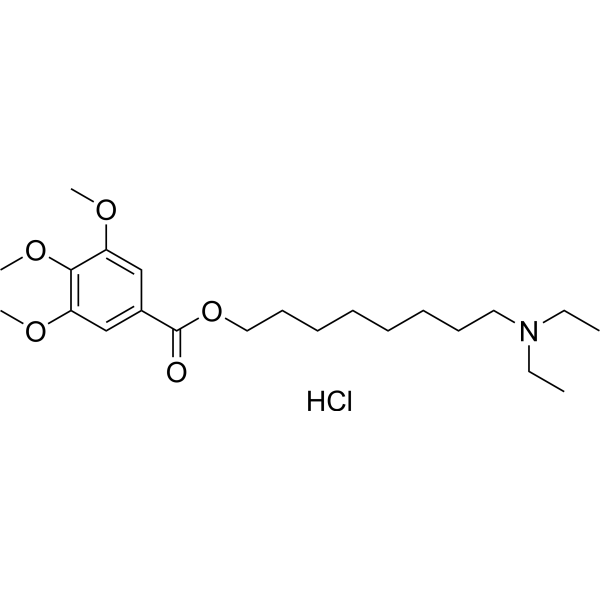
Chemical Structure
TMB-8
- CAS No.: 53464-72-5
- Formula:C22H38ClNO5
- Molecular Weight:431.99
IUPAC Name: 8-(diethylamino)octyl 3,4,5-trimethoxybenzoate hydrochloride
InChIKey: KFJZVXKPPQIYCG-UHFFFAOYSA-N
SMILES: COC1=C(C(OC)=CC(C(OCCCCCCCCN(CC)CC)=O)=C1)OC.Cl
Biological Activity: TMB-8 is a benzoate ester compound. TMB-8 blocks intracellular calcium (Ca) release, catecholamine secretion, and cholinergic/CCK-stimulated amylase release, while stimulating pancreatic hormone release and, under hyperthermia conditions, increasing cytosolic calcium and hyperthermic cell killing. TMB-8 is used in research on chemotherapy-induced painful peripheral neuropathy, human promyelocytic leukemia, and mouse breast cancer[1][2][3][4][5][6][7][8][9][10].
| Cat. No. | Product Name | Purity | Description | Pricing | |||||||||||||||||||
|---|---|---|---|---|---|---|---|---|---|---|---|---|---|---|---|---|---|---|---|---|---|---|---|
|
|
TMB-8 | 98.0% | TMB-8 is a benzoate ester compound. TMB-8 blocks intracellular calcium (Ca) release, catecholamine secretion, and cholinergic/CCK-stimulated amylase release, while stimulating pancreatic hormone release and, under hyperthermia conditions, increasing cytosolic calcium and hyperthermic cell killing. TMB-8 is used in research on chemotherapy-induced painful peripheral neuropathy, human promyelocytic leukemia, and mouse breast cancer. | ||||||||||||||||||||
|
loading...
/
|
|||||||||||||||||||||||
References
- [1]. Siau C, et al. Dysregulation of cellular calcium homeostasis in chemotherapy-evoked painful peripheral neuropathy. Anesthesia and analgesia. 2006 May;102(5):1485-90. [Content Brief]
- [2]. Galeotti N, et al. The phospholipase C-IP3 pathway is involved in muscarinic antinociception. Neuropsychopharmacology : official publication of the American College of Neuropsychopharmacology. 2003 May;28(5):888-97.
- [3]. Lim DY, et al. Influence of TMB-8 on secretion of catecholamines from the perfused rat adrenal glands. Archives of Pharmacal Research. 1992 Jun;15(2):115-25.
- [4]. Ikeda M, et al. Effect of an intracellular calcium antagonist (TMB-8) on carbamylcholine-induced amylase release from dispersed rat pancreatic acini. Life sciences. 1984 Feb 06;34(6):529-33. [Content Brief]
- [5]. Yasuda H, et al. Stimulative effects of TMB-8 and trifluoperazine on pancreatic hormone release. Diabetes research and clinical practice. 1989 Apr 01;6(3):227-32. [Content Brief]
- [6]. Wojewodzka M, et al. Calcium antagonist, TMB-8, prevents the induction of adaptive response by hydrogen peroxide or X-rays in human lymphocytes. International journal of radiation biology. 1994 Jul;66(1):99-109. [Content Brief]
- [7]. Malagodi MH, et al. Pharmacological evaluation of a new Ca2+ antagonist, 8-(N,N-diethylamino)-octyl-3,4,5-trimethoxybenzoate hydrochloride (TMB-8): studies in smooth muscles. Eur J Pharmacol. 1974 Jun;27(1):25-33. [Content Brief]
- [8]. Okazaki T, et al. Role of intracellular calcium ion in human promyelocytic leukemia HL-60 cell differentiation. Cancer research. 1986 Dec;46(12 Pt 1):6059-63. [Content Brief]
- [9]. Kondo T, et al. Enhancement of cell killing and increase in cytosolic calcium concentration by combined treatments with hyperthermia and TMB-8 in mouse mammary carcinoma FM3A cells. Cell calcium. 1993 Oct;14(9):621-9. [Content Brief]
- [10]. Kojima I, et al. Mechanism of inhibitory action of TMB-8 [8-(NN-diethylamino)octyl-3,4,5-trimethoxybenzoate] on aldosterone secretion in adrenal glomerulosa cells. The Biochemical journal. 1985 Nov 15;232(1):87-92.



