



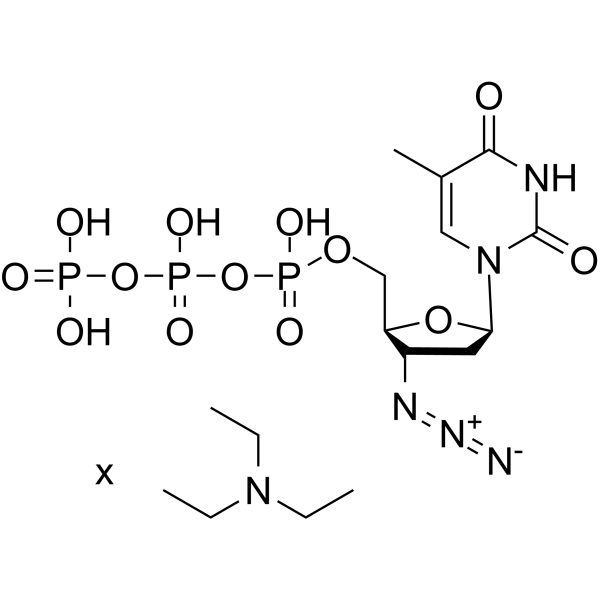
AZT triphosphate TEA
AZT triphosphate (3'-Azido-3'-deoxythymidine-5'-triphosphate) TEA is a active triphosphate metabolite of Zidovudine (AZT). AZT triphosphate TEA exhibits antiretroviral activity and inhibits replication of HIV. AZT triphosphate TEA also inhibits the DNA polymerase of HBV. AZT triphosphate TEA activates the mitochondria-mediated apoptosis pathway.
Nur für Forschungszwecke. Wir verkaufen nicht an Patienten.
- Formel: C10H16N5O13P3.xC6H15N
-
Speicherung:
Please store the product under the recommended conditions in the Certificate of Analysis.

To place orders, for customer services and technical support, please contact: MedChemExpress USA
Tel: 609-228-6898 E-mail: [email protected] [email protected]


-
 Biologische Aktivität
-
Chemical Information
- Protokoll
- Reinheit & Dokumentation
- Verweise
-
 Help & FAQs


Alle DNA/RNA Synthesis Isoform-spezifische Produkte anzeigen
More

Biologische Aktivität
Beschreibung
IC50 & Target
|
DNA Polymerase |
In Vitro
AZT triphosphate (3'-Azido-3'-deoxythymidine-5'-triphosphate) TEA accumulation disrupts the mitochondrial tubular network in H9c2 cells through Treatment with 100 μM Zidovudine (AZT) for 48h. AZT triphosphate TEA accumulation causes downregulation of Opa1 and upregulation of Drp1. AZT triphosphate TEA causes mitochondrial dysfunction, increases the production of cytotoxic reactive oxygen species (ROS), and impairs the balance of the mitochondrial quality control system in H9c2 cell model established from rat embryonic myoblasts[1].
MedChemExpress (MCE) has not independently confirmed the accuracy of these methods. They are for reference only. Further protocols information, click here.


Chemical Information
-
Formel C10H16N5O13P3.xC6H15N
-
SMILES
O=C1NC(N([C@@H](C[C@@H]2N=[N+]=[N-])O[C@@H]2COP(OP(O)(OP(O)(O)=O)=O)(O)=O)C=C1C)=O.CCN(CC)CC.[x]
-
Synonyms
3'-Azido-3'-deoxythymidine-5'-triphosphate TEA
-
Versand
Room temperature in continental US; may vary elsewhere.
-
Speicherung
Please store the product under the recommended conditions in the Certificate of Analysis.

Protokoll
-
Apoptosis
Apoptosis, also called programmed cell death, is generally characterized by distinct morphological characteristics.
-
TUNEL staining for apoptotic DNA fragmentation
TUNEL staining detects DNA strand breaks by using terminal deoxynucleotidyl transferase to add labeled nucleotides to exposed 3′-OH DNA termini, generating either microscopic staining in fixed cells or tissue sections, or fluorescence/cytometric signal in cell suspensions. TUNEL positivity reflects DNA fragmentation but should not be interpreted alone as definitive apoptosis, because TUNEL can also label necrotic, autolytic, mechanically damaged, or DNA-repair-associated DNA breaks.
-
Annexin V plus membrane-impermeant dye apoptosis staining
Annexin V-based apoptosis assays rely on the detection of phosphatidylserine (PS) externalization from the inner leaflet of the plasma membrane to the outer leaflet, an early biochemical hallmark of apoptosis. Fluorescently labeled Annexin V binds PS in a calcium-dependent manner, enabling identification of early apoptotic cells by flow cytometry or fluorescence microscopy. When combined with a membrane-impermeant DNA-binding dye (e. g. , propidium iodide), this approach allows discrimination between viable (Annexin V−/dye−), early apoptotic (Annexin V+/dye−), and late apoptotic or necrotic (Annexin V+/dye+) cell populations by assessing membrane integrity and PS exposure.
-
Apoptosis Solutions
Apoptosis is a regulated, generally non-lytic cell-death pathway that removes unwanted, damaged, infected, or abnormal cells through coordinated morphological changes, caspase activation, DNA fragmentation, and membrane remodeling. The intrinsic apoptosis pathway is controlled mainly by mitochondrial outer membrane permeabilization, BCL-2 family proteins, cytochrome c release, apoptosome formation, caspase-9 activation, and downstream executioner caspase-3/7 activation. The extrinsic apoptosis pathway is initiated by death receptors such as Fas, TNFR, and TRAIL receptors, which recruit adaptor proteins and activate caspase-8 before engaging executioner caspases or mitochondrial amplification through BID cleavage. Apoptosis is linked to many phenotypes, including cancer cell killing, tissue homeostasis, immune regulation, neurodegeneration, infection response, and treatment-induced cytotoxicity; unresolved questions include how apoptosis interacts with necroptosis, pyroptosis, ferroptos


Reinheit & Dokumentation
Verweise
[1]. Ryosuke Nomura, et al. Azidothymidine-triphosphate Impairs Mitochondrial Dynamics by Disrupting the Quality Control System. Redox Biol. 2017 Oct;13:407-417. [Content Brief]
[2]. Takeya Sato, et al. Engineered Human tmpk/AZT as a Novel Enzyme/Prodrug Axis for Suicide Gene Therapy. Mol Ther. 2007 May;15(5):962-70. [Content Brief]
[3]. K Y Hostetler, et al. Enhanced Oral Absorption and Antiviral Activity of 1-O-octadecyl-sn-glycero-3-phospho-acyclovir and Related Compounds in Hepatitis B Virus Infection, in Vitro. Biochem Pharmacol. 1997 Jun 15;53(12):1815-22. [Content Brief]

Calculators
Konzentration (Stammlösung) × Volumen (Stammlösung) = Konzentration (Ziellösung) × Volumen (Ziellösung)


AZT triphosphate TEA Related Classifications
HY-116364A Related Classifications
 Powered by Bioz