



Hydroxy-β-sanshool
Based on 1 publication(s) in Google Scholar
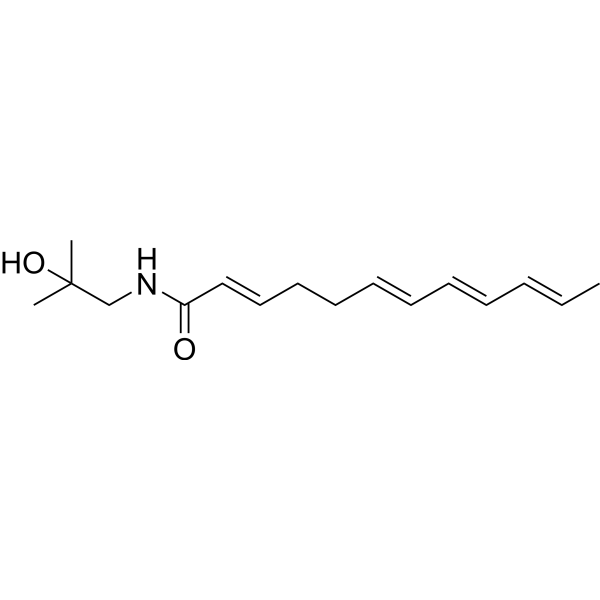
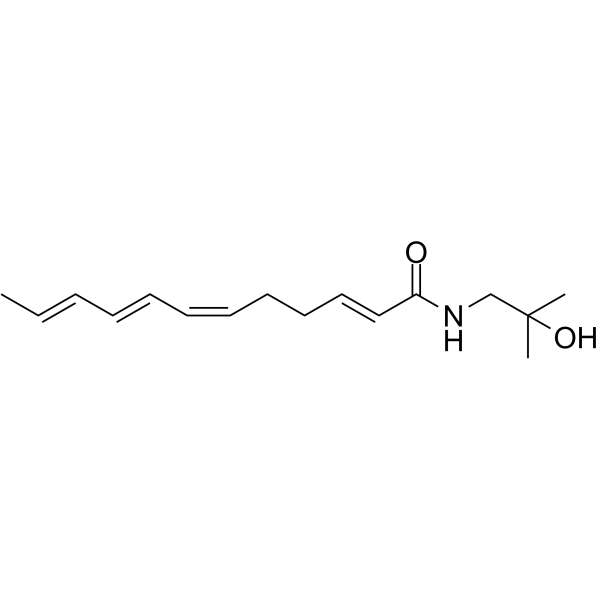
Hydroxy-β-sanshool is an alkylamide exists in Zanthoxylum bungeanum oil and Zanthoxylum schinifolium oil.
Nur für Forschungszwecke. Wir verkaufen nicht an Patienten.
- Reinheit : 99.94%
- CAS. Nr.: 97465-69-5
- Formel: C16H25NO2
- Molecular Weight:263.38
-
Speicherung:
-20°C, protect from light
* In solvent : -80°C, 6 months; -20°C, 1 month (protect from light)

To place orders, for customer services and technical support, please contact: MedChemExpress USA
Tel: 609-228-6898 E-mail: [email protected] [email protected]


-
 Biologische Aktivität
-
Chemical Information
-
Lösungsmittel & Löslichkeit
- Reinheit & Dokumentation
- Verweise
-
 Help & FAQs


Publications Citing Use of MedChemExpress (MCE) Hydroxy-β-sanshool
More

Biologische Aktivität
Beschreibung
Cellular Effect
|
Cell Line

|
Type | Value | Description | References |
|---|---|---|---|---|
| CHO | IC50 |
131 nM
Compound: 3
|
Displacement of [3H]-CP55940 from human CB2 receptor expressed in CHO cells preincubated for 1 hr followed by radioligand addition measured after 1 hr by liquid scintillation counting analysis
Displacement of [3H]-CP55940 from human CB2 receptor expressed in CHO cells preincubated for 1 hr followed by radioligand addition measured after 1 hr by liquid scintillation counting analysis
|
[PMID: 24175626] |
| CHO | IC50 |
9 nM
Compound: 3
|
Displacement of [3H]-Win55212-2 from human CB1 receptor expressed in CHO cells preincubated for 1 hr followed by radioligand addition measured after 1 hr by liquid scintillation counting analysis
Displacement of [3H]-Win55212-2 from human CB1 receptor expressed in CHO cells preincubated for 1 hr followed by radioligand addition measured after 1 hr by liquid scintillation counting analysis
|
[PMID: 24175626] |
In Vitro


Chemical Information
-
CAS. Nr. 97465-69-5
-
Appearance Solid
-
Molecular Weight 263.38
-
Formel C16H25NO2
-
Color White to yellow
-
SMILES
CC(C)(O)CNC(/C=C/CC/C=C/C=C/C=C/C)=O
-
Structure Classification
-
Initial Source
-
Versand
Room temperature in continental US; may vary elsewhere.
-
Speicherung
-20°C, protect from light
* In solvent : -80°C, 6 months; -20°C, 1 month (protect from light)


Publications (1)
-
Journal Impact Factor
-
Most Recent
-
Foods
Stability of Hydroxy-α-Sanshool in Medium-Chain Triglyceride Oil and Corresponding Oil/Water Emulsions. [Abstract]2023 Sep 27;12(19):3589. PMID: 37835243


Lösungsmittel & Löslichkeit
In Vitro:
DMSO : 50 mg/mL (189.84 mM; Need ultrasonic; Hygroscopic DMSO has a significant impact on the solubility of product, please use newly opened DMSO)
Please refer to the solubility information to select the appropriate solvent. Once prepared, please aliquot and store the solution to prevent product inactivation from repeated freeze-thaw cycles.
Storage method and period of stock solution: -80°C, 6 months; -20°C, 1 month (protect from light). When stored at -80°C, please use it within 6 months. When stored at -20°C, please use it within 1 month.
Please refer to the solubility information to select the appropriate solvent. Once prepared, please aliquot and store the solution to prevent product inactivation from repeated freeze-thaw cycles.
Storage method and period of stock solution: -80°C, 6 months; -20°C, 1 month (protect from light). When stored at -80°C, please use it within 6 months. When stored at -20°C, please use it within 1 month.
Konzentration (Stammlösung) × Volumen (Stammlösung) = Konzentration (Ziellösung) × Volumen (Ziellösung)
In Vivo:
Select the appropriate dissolution method based on your experimental animal and administration route.
- For the following dissolution methods, please ensure to first prepare a clear stock solution using an In Vitro approach and then sequentially add co-solvents:
- To ensure reliable experimental results, the clarified stock solution can be appropriately stored based on storage conditions. As for the working solution for In Vivo experiments, it is recommended to prepare freshly and use it on the same day.
- The percentages shown for the solvents indicate their volumetric ratio in the final prepared solution. If precipitation or phase separation occurs during preparation, heat and/or sonication can be used to aid dissolution.
Add each solvent one by one: 10% DMSO 40% PEG300 5% Tween-80 45% Saline
Solubility: ≥ 1.25 mg/mL (4.75 mM); Clear solution
This protocol yields a clear solution of ≥ 1.25 mg/mL (saturation unknown).
Taking 1 mL working solution as an example, add 100 μL DMSO stock solution (12.5 mg/mL) to 400 μL PEG300, and mix evenly; then add 50 μL Tween-80 and mix evenly; then add 450 μL Saline to adjust the volume to 1 mL.
Preparation of Saline: Dissolve 0.9 g sodium chloride in ddH₂O and dilute to 100 mL to obtain a clear Saline solution.
Add each solvent one by one: 10% DMSO 90% (20% SBE-β-CD in Saline)
Solubility: ≥ 1.25 mg/mL (4.75 mM); Clear solution
This protocol yields a clear solution of ≥ 1.25 mg/mL (saturation unknown).
Taking 1 mL working solution as an example, add 100 μL DMSO stock solution (12.5 mg/mL) to 900 μL 20% SBE-β-CD in Saline, and mix evenly.
Preparation of 20% SBE-β-CD in Saline (4°C, storage for one week): 2 g SBE-β-CD powder is dissolved in 10 mL Saline, completely dissolve until clear.
In Vivo Dissolution Calculator
Please enter the basic information of animal experiments:
-
-
-
-
Recommended: Prepare an additional quantity of animals to account for potential losses during experiments.
Please enter your animal formula composition:
-
%DMSO +
Recommended: Keep the proportion of DMSO in working solution below 2% if your animal is weak.
-
%+
-
+%Tween-80 + +
-
%Saline +
The co-solvents required include: DMSO, . All of co-solvents are available by MedChemExpress (MCE). , Tween 80. All of co-solvents are available by MedChemExpress (MCE).
Working solution concentration: 0.22 mg/mL
Method for preparing stock solution: mg drug dissolved in μL DMSO. Stock solution concentration: mg/mL. * In solvent : -80°C, 6 months; -20°C, 1 month (protect from light)
1. Take μL DMSO stock solution;
2. Add μL .
μL , mix evenly;
3. Then add μL Tween 80, mix evenly;
4. Then add μL
Please ensure that the stock solution in the first step is dissolved to a clear state, and add co-solvents in sequence. You can use ultrasonic heating (ultrasonic cleaner, recommended frequency 20-40 kHz), vortexing, etc. to assist dissolution.


Reinheit & Dokumentation
-
Data Sheet (273 KB)
-
SDS (252 KB)
- English - EN (252 KB)
- Français - FR (252 KB)
- Deutsch - DE (252 KB)
- Norwegian - NO (252 KB)
- Español - ES (252 KB)
- Swedish - SV (252 KB)
- Italian - IT (252 KB)
- Korean - KR (252 KB)
- Portuguese - PT (252 KB)
-
Handling Instructions (2659 KB)
Verweise
[1]. Zhao ZF, et al. Characterization and comparison of the pungent components in commercial Zanthoxylum bungeanum oil and Zanthoxylum schinifolium oil. J Food Sci. 2013 Oct;78(10):C1516-C1522. [Content Brief]
[2]. Zhang LL, et al. The relationship between alkylamide compound content and pungency intensity of Zanthoxylum bungeanum based on sensory evaluation and ultra-performance liquid chromatography-mass spectrometry/ mass spectrometry (UPLC-MS/MS) analysis. J Sci Food Agric. 2019 Mar 15;99(4):1475-1483. [Content Brief]
[3]. Bader M, et al. Dynamic Proteome Alteration and Functional Modulation of Human Saliva Induced by Dietary Chemosensory Stimuli. J Agric Food Chem. 2018 Jun 6;66(22):5621-5634. [Content Brief]


Complete Stock Solution Preparation Table
Please refer to the solubility information to select the appropriate solvent. Once prepared, please aliquot and store the solution to prevent product inactivation from repeated freeze-thaw cycles.
Storage method and period of stock solution: -80°C, 6 months; -20°C, 1 month (protect from light). When stored at -80°C, please use it within 6 months. When stored at -20°C, please use it within 1 month.
| Optional Solvent | Concentration Solvent Mass | 1 mg | 5 mg | 10 mg | 25 mg |
|---|---|---|---|---|---|
| DMSO | 1 mM | 3.7968 mL | 18.9840 mL | 37.9680 mL | 94.9199 mL |
| 5 mM | 0.7594 mL | 3.7968 mL | 7.5936 mL | 18.9840 mL | |
| 10 mM | 0.3797 mL | 1.8984 mL | 3.7968 mL | 9.4920 mL | |
| 15 mM | 0.2531 mL | 1.2656 mL | 2.5312 mL | 6.3280 mL | |
| 20 mM | 0.1898 mL | 0.9492 mL | 1.8984 mL | 4.7460 mL | |
| 25 mM | 0.1519 mL | 0.7594 mL | 1.5187 mL | 3.7968 mL | |
| 30 mM | 0.1266 mL | 0.6328 mL | 1.2656 mL | 3.1640 mL | |
| 40 mM | 0.0949 mL | 0.4746 mL | 0.9492 mL | 2.3730 mL | |
| 50 mM | 0.0759 mL | 0.3797 mL | 0.7594 mL | 1.8984 mL | |
| 60 mM | 0.0633 mL | 0.3164 mL | 0.6328 mL | 1.5820 mL | |
| 80 mM | 0.0475 mL | 0.2373 mL | 0.4746 mL | 1.1865 mL | |
| 100 mM | 0.0380 mL | 0.1898 mL | 0.3797 mL | 0.9492 mL |


Hydroxy-β-sanshool Related Classifications
HY-N6824 Related Classifications
 Powered by Bioz