



Aplodan (Standard)
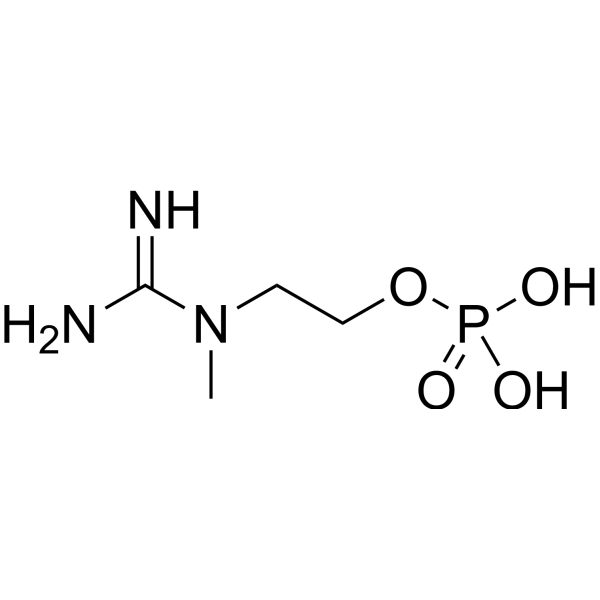
Aplodan (Standard) (Creatinol O-phosphate (Standard)) is the analytical standard of Aplodan (HY-107335). This product is intended for research and analytical applications. Aplodan (Creatinol O-phosphate) is an antiischemic and antiarrhythmic agent. Aplodan has a protective action on cell membrane. Aplodan has the potential for the research of ischemic heart or acute myocardial infarction .
For research use only. We do not sell to patients.
- CAS No.: 6903-79-3
- Formula: C4H12N3O4P
- Molecular Weight:197.13
-
Storage:
Please store the product under the recommended conditions in the Certificate of Analysis.


To place orders, for customer services and technical support, please contact: MedChemExpress USA
Tel: 609-228-6898 E-mail: [email protected] [email protected]


-
 Biological Activity
-
Chemical Information
- Protocols
- Purity & Documentation
- References
-
 Help & FAQs




Biological Activity
Description


Chemical Information
-
CAS No. 6903-79-3
-
Molecular Weight 197.13
-
Formula C4H12N3O4P
-
SMILES
N=C(N)N(C)CCOP(O)(O)=O
-
Synonyms
Creatinol O-phosphate (Standard); Creatinol phosphate (Standard); Creatinolfosfate (Standard)
-
Shipping
Room temperature in continental US; may vary elsewhere.
-
Storage
Please store the product under the recommended conditions in the Certificate of Analysis.

Protocols
-
Research Protocol for Cardiovascular Diseases
Cardiovascular disease can be modeled as maladaptive cardiac remodeling, where ischemic injury or pressure overload activates inflammatory signaling, fibroblast activation, extracellular-matrix deposition, cardiomyocyte hypertrophy, vascular remodeling, and progressive ventricular dysfunction. The TGF-β/SMAD axis is a central profibrotic pathway after myocardial injury and pressure overload, while innate immune and cytokine pathways regulate leukocyte recruitment, scar formation, and adverse remodeling. Key unresolved questions include which inflammatory signals are reparative versus harmful, when fibrosis is protective versus maladaptive, and whether pathway inhibition improves function without weakening necessary infarct healing or compensatory remodeling.


Purity & Documentation
References
[1]. Olsen JI, et al. A 31P NMR spectroscopy study of Xenopus laevis heart perfused in vitro with creatinol-O-phosphate, phosphocreatine, adenosine triphosphate, fructose diphosphate and ouabain. Pharmacol Res. 1993 Sep;28(2):135-51. [Content Brief]
[2]. Botti G, et al. Preliminary report on electrophysiological effectiveness of creatinol O-phosphate (COP) in human subjects. Arzneimittelforschung. 1979;29(9a):1491-1494. [Content Brief]
[3]. Di Maio F, et al. Activity of creatinol O-phosphate on persistent ventricular premature beats in ischemic heart disease. Double blind clinical trial. Arzneimittelforschung. 1979;29(9a):1488-1490. [Content Brief]
[4]. Knippel M, et al. Effects of creatinol O-phosphate on serum enzymes in acute myocardial infarction. Arzneimittelforschung. 1979;29(9a):1480-2. [Content Brief]
[5]. Godfraind T, et al. An analysis of the reduction by creatinol O-phosphate of the myocardial lesions evoked by isoprenaline in the rat. Arzneimittelforschung. 1979;29(9a):1457-64. [Content Brief]
[6]. Marchetti G, et al. Effects of creatinol-O-phosphate (COP) on haemodynamics and cardiac metabolism in conscious and anaesthetized dogs. Arzneimittelforschung. 1978;28(10):1708-11. [Content Brief]

Calculators
Concentration (start) × Volume (start) = Concentration (final) × Volume (final)


Aplodan (Standard) Related Classifications
HY-107335R Related Classifications
 Powered by Bioz