



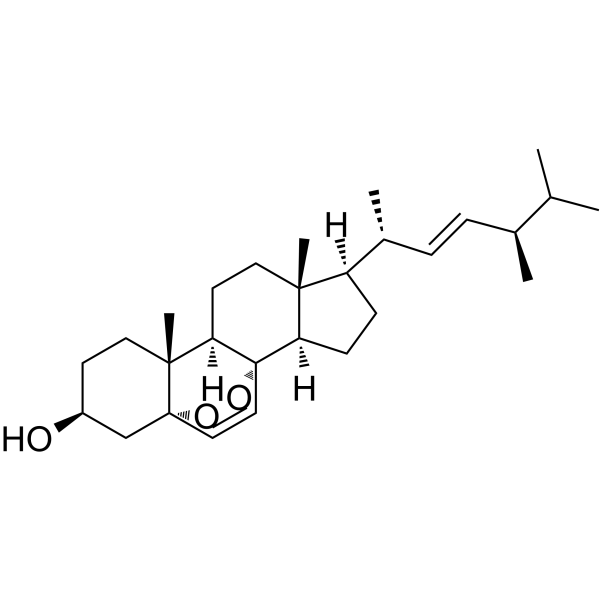
Ergosterol peroxide
Based on 1 publication(s) in Google Scholar
Ergosterol peroxide is a steroid derivative and can be isolated from a variety of fungi, yeast, lichens or sponges. Ergosterol peroxide has anti-tumour, proapoptotic, anti-inflammatory, anti-mycobacterial, and anti-proliferative activities.
For research use only. We do not sell to patients.
- Purity : 99.57%
- CAS No.: 2061-64-5
- Formula: C28H44O3
- Molecular Weight:428.65
-
Storage:
4°C, sealed storage, away from moisture and light
* In solvent : -80°C, 6 months; -20°C, 1 month (sealed storage, away from moisture and light)

To place orders, for customer services and technical support, please contact: MedChemExpress USA
Tel: 609-228-6898 E-mail: [email protected] [email protected]


-
 Biological Activity
-
Chemical Information
-
Solvent & Solubility
- Protocols
- Purity & Documentation
- References
-
 Help & FAQs


Publications Citing Use of MedChemExpress (MCE) Ergosterol peroxide
More

Biological Activity
Description
Cellular Effect
|
Cell Line

|
Type | Value | Description | References |
|---|---|---|---|---|
| A549 | IC50 |
14.32 μg/mL
Compound: 5
|
Cytotoxicity against human A549 cells
Cytotoxicity against human A549 cells
|
[PMID: 23511021] |
| B16 | IC50 |
77.9 μM
Compound: 6
|
Cytotoxicity against murine B16 cells by MTT assay
Cytotoxicity against murine B16 cells by MTT assay
|
[PMID: 17256903] |
| BV-2 | IC50 |
6.3 μM
Compound: 22
|
Antiinflammatory activity in mouse BV2 cells assessed as inhibition of LPS-induced iNOS-dependent nitrite production after 24 hrs by Griess method
Antiinflammatory activity in mouse BV2 cells assessed as inhibition of LPS-induced iNOS-dependent nitrite production after 24 hrs by Griess method
|
[PMID: 21028898] |
| HEK293 | EC50 |
0.85 μM
Compound: 2
|
Agonist activity at full length mouse FXR/RXRalpha expressed in human HEK293 cells assessed as induction of transcriptional activity after 18 hrs by dual luciferase reporter gene assay
Agonist activity at full length mouse FXR/RXRalpha expressed in human HEK293 cells assessed as induction of transcriptional activity after 18 hrs by dual luciferase reporter gene assay
|
[PMID: 22014750] |
| HeLa | IC50 |
19.54 μM
Compound: Ergosterol peroxide
|
Cytotoxicity against human HeLa cells assessed as cell growth inhibition incubated for 24 hrs by MTT assay
Cytotoxicity against human HeLa cells assessed as cell growth inhibition incubated for 24 hrs by MTT assay
|
[PMID: 38107170] |
| Hep 3B2 | IC50 |
16.51 μg/mL
Compound: 5
|
Cytotoxicity against human Hep3B cells
Cytotoxicity against human Hep3B cells
|
[PMID: 23511021] |
| HepG2 | IC50 |
15.27 μg/mL
Compound: 5
|
Cytotoxicity against human HepG2 cells
Cytotoxicity against human HepG2 cells
|
[PMID: 23511021] |
| HepG2 | IC50 |
23.35 μM
Compound: Ergosterol peroxide
|
Antiproliferative activity against human HepG2 cells assessed as reduction in cell viability incubated for 48 hrs by MTT assay
Antiproliferative activity against human HepG2 cells assessed as reduction in cell viability incubated for 48 hrs by MTT assay
|
[PMID: 38107170] |
| KB | ED50 |
9.79 μg/mL
Compound: 4
|
Cytotoxicity against human KB cells after 4 days
Cytotoxicity against human KB cells after 4 days
|
[PMID: 1791484] |
| MCF7 | IC50 |
13.41 μg/mL
Compound: 5
|
Cytotoxicity against human MCF7 cells
Cytotoxicity against human MCF7 cells
|
[PMID: 23511021] |
| MCF7 | IC50 |
18 μM
Compound: Ergosterol peroxide
|
Antiproliferative activity against human MCF7 cells assessed as inhibition of cell growth by CCK8 assay
Antiproliferative activity against human MCF7 cells assessed as inhibition of cell growth by CCK8 assay
|
[PMID: 38107170] |
| MDA-MB-231 | IC50 |
16.74 μg/mL
Compound: 5
|
Cytotoxicity against human MDA-MB-231 cells
Cytotoxicity against human MDA-MB-231 cells
|
[PMID: 23511021] |
| PLC-PRF-5 | ED50 |
10.99 μg/mL
Compound: 4
|
Cytotoxicity against human PLC/PRF/5 cells after 4 days
Cytotoxicity against human PLC/PRF/5 cells after 4 days
|
[PMID: 1791484] |
| RAW264.7 | IC50 |
28.7 μM
Compound: 117
|
Antiinflammatory activity in mouse RAW264.7 cells assessed as inhibition of LPS-induced nitric oxide production
Antiinflammatory activity in mouse RAW264.7 cells assessed as inhibition of LPS-induced nitric oxide production
|
[PMID: 31255927] |
| RAW264.7 | IC50 |
9.4 μM
Compound: 9
|
Antiinflammatory activity in mouse RAW264.7 cells assessed as inhibition of LPS-induced nitric oxide production by Griess reaction method
Antiinflammatory activity in mouse RAW264.7 cells assessed as inhibition of LPS-induced nitric oxide production by Griess reaction method
|
[PMID: 23357630] |
| SNU1 | IC50 |
18.7 μM
Compound: 231
|
Cytotoxicity against human SNU1 cells
Cytotoxicity against human SNU1 cells
|
[PMID: 17618015] |
| SNU-354 | IC50 |
158.2 μM
Compound: 231
|
Cytotoxicity against human SNU354 cells
Cytotoxicity against human SNU354 cells
|
[PMID: 17618015] |
| SNU-C4 | IC50 |
84.6 μM
Compound: 231
|
Cytotoxicity against human SNUC4 cells
Cytotoxicity against human SNUC4 cells
|
[PMID: 17618015] |


Chemical Information
-
CAS No. 2061-64-5
-
Appearance Solid
-
Molecular Weight 428.65
-
Formula C28H44O3
-
Color White to off-white
-
SMILES
C[C@@]12[C@]3([H])[C@]4(C=C[C@]1(C[C@H](CC2)O)OO4)[C@@]5([H])[C@](CC3)([C@@](CC5)([H])[C@H](C)/C=C/[C@H](C)C(C)C)C
-
Structure Classification
-
Initial Source
-
Shipping
Room temperature in continental US; may vary elsewhere.
-
Storage
4°C, sealed storage, away from moisture and light
* In solvent : -80°C, 6 months; -20°C, 1 month (sealed storage, away from moisture and light)


Publications (1)
-
Journal Impact Factor
-
Most Recent


Solvent & Solubility
In Vitro:
DMSO : 12.5 mg/mL (29.16 mM; Need ultrasonic; Hygroscopic DMSO has a significant impact on the solubility of product, please use newly opened DMSO)
Please refer to the solubility information to select the appropriate solvent. Once prepared, please aliquot and store the solution to prevent product inactivation from repeated freeze-thaw cycles.
Storage method and period of stock solution: -80°C, 6 months; -20°C, 1 month (sealed storage, away from moisture and light). When stored at -80°C, please use it within 6 months. When stored at -20°C, please use it within 1 month.
Please refer to the solubility information to select the appropriate solvent. Once prepared, please aliquot and store the solution to prevent product inactivation from repeated freeze-thaw cycles.
Storage method and period of stock solution: -80°C, 6 months; -20°C, 1 month (sealed storage, away from moisture and light). When stored at -80°C, please use it within 6 months. When stored at -20°C, please use it within 1 month.
Concentration (start) × Volume (start) = Concentration (final) × Volume (final)

Protocols
-
Research Protocol for Inflammation-related Diseases
The NLRP3 inflammasome is a cytosolic innate immune signaling platform that integrates priming signals and danger-signal activation to promote caspase-1 activation, maturation of IL-1β and IL-18, and gasdermin D-mediated pyroptotic cell death. The core experimental logic is to determine whether inflammatory disease phenotypes are driven by increased NLRP3 expression, ASC-containing inflammasome assembly, caspase-1 cleavage, GSDMD cleavage, and extracellular release of IL-1β/IL-18 rather than by nonspecific cell injury alone. The pathway is strongly linked to inflammation-related disease phenotypes because monosodium urate crystals activate NALP3/NLRP3 inflammasome signaling in gout-like crystal inflammation, cholesterol crystals activate NLRP3 inflammasomes in atherogenesis models, and DSS-induced intestinal inflammation has been reported to involve NLRP3 inflammasome activity. However, experimental colitis studies also show context-dependent protective effects of NLRP3 inflammasome co
-
Cell Viability Determination by MTT Colorimetric Assay
The following protocol uses the MTT colorimetric assay as a classic literature-established method for assessing cell viability/metabolic activity in cultured mammalian cells. MTT[3-(4,5-dimethylthiazol-2-yl)-2,5-diphenyltetrazolium bromide] is reduced by metabolically active cells to a colored formazan product; the amount of formazan is quantified spectrophotometrically and provides an indirect measure of metabolically active viable cells. Importantly, MTT reduction reflects cellular oxidoreductase/metabolic activity rather than an absolute direct count of living cells, so changes in cellular metabolism can alter the signal independently of cell number.


Purity & Documentation
-
Data Sheet (272 KB)
-
SDS (394 KB)
- English - EN (394 KB)
- Français - FR (394 KB)
- Deutsch - DE (394 KB)
- Norwegian - NO (394 KB)
- Español - ES (394 KB)
- Swedish - SV (394 KB)
- Italian - IT (394 KB)
- Korean - KR (394 KB)
- Portuguese - PT (394 KB)
-
Handling Instructions (2659 KB)
References
[1]. Ming Bu, et al. Synthesis of Ergosterol Peroxide Conjugates as Mitochondria Targeting Probes for Enhanced Anticancer Activity. Molecules. 2019 Sep 11;24(18):3307 [Content Brief]
[2]. Taotao Ling, et al. Development of ergosterol peroxide probes for cellular localisation studies. Org Biomol Chem. 2019 May 29;17(21):5223-5229. [Content Brief]


Complete Stock Solution Preparation Table
Please refer to the solubility information to select the appropriate solvent. Once prepared, please aliquot and store the solution to prevent product inactivation from repeated freeze-thaw cycles.
Storage method and period of stock solution: -80°C, 6 months; -20°C, 1 month (sealed storage, away from moisture and light). When stored at -80°C, please use it within 6 months. When stored at -20°C, please use it within 1 month.
| Optional Solvent | Concentration Solvent Mass | 1 mg | 5 mg | 10 mg | 25 mg |
|---|---|---|---|---|---|
| DMSO | 1 mM | 2.3329 mL | 11.6645 mL | 23.3291 mL | 58.3226 mL |
| 5 mM | 0.4666 mL | 2.3329 mL | 4.6658 mL | 11.6645 mL | |
| 10 mM | 0.2333 mL | 1.1665 mL | 2.3329 mL | 5.8323 mL | |
| 15 mM | 0.1555 mL | 0.7776 mL | 1.5553 mL | 3.8882 mL | |
| 20 mM | 0.1166 mL | 0.5832 mL | 1.1665 mL | 2.9161 mL | |
| 25 mM | 0.0933 mL | 0.4666 mL | 0.9332 mL | 2.3329 mL |


Ergosterol peroxide Related Classifications
HY-N3845 Related Classifications
 Powered by Bioz