



Asperglaucin B
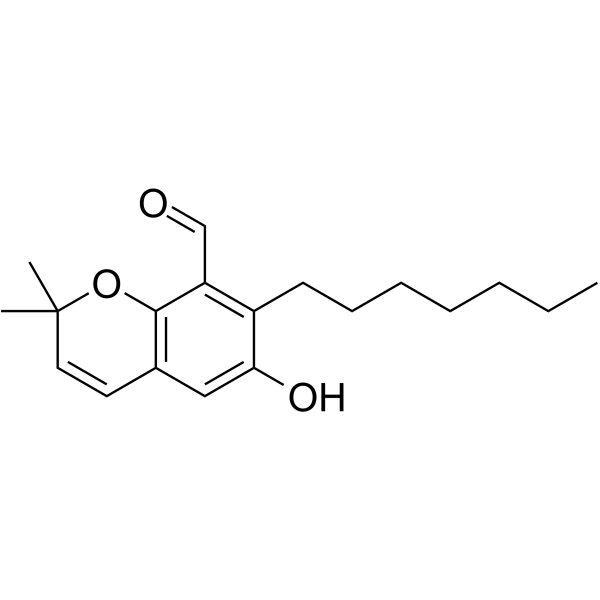
Asperglaucin B is an alkylated salicylaldehyde derivative from the fungus Aspergillus chevalieri SQ-8, with antibacterial activities. Asperglaucin B displays potent antibacterial activities against two plant pathogens Pseudomonas syringae pv actinidae (Psa) and Bacillus cereus, with an MIC value of 6.25 μM.
Nos produits utilisent uniquement pour la recherche. Nous ne vendons pas aux patients.
- CAS No.: 2701570-80-9
- Formule: C19H26O3
- Masse moléculaire:302.41
-
Stockage:
Please store the product under the recommended conditions in the Certificate of Analysis.

To place orders, for customer services and technical support, please contact: MedChemExpress USA
Tel: 609-228-6898 E-mail: [email protected] [email protected]


-
 Activité biologique
-
Chemical Information
- Protocole
- Pureté et documentation
- Références
-
 Help & FAQs




Activité biologique
Description
IC50 & Target
MIC: 6.25 μM (Pseudomonas syringae pv actinidae (Psa) and Bacillus cereus)[1]
In Vitro
The possible bacteriostatic mechanism for Asperglaucin B is to alter the external structure of B. cereus and Psa, and to cause the rupture or deformation of the cell membranes, respectively[1].
MedChemExpress (MCE) has not independently confirmed the accuracy of these methods. They are for reference only.


Chemical Information
-
CAS No. 2701570-80-9
-
Masse moléculaire 302.41
-
Formule C19H26O3
-
SMILES
O=CC1=C(CCCCCCC)C(O)=CC2=C1OC(C)(C)C=C2
-
Structure Classification
-
Initial Source
Aspergillus chevalieri SQ-8
-
Livraison
Room temperature in continental US; may vary elsewhere.
-
Stockage
Please store the product under the recommended conditions in the Certificate of Analysis.


Pureté et documentation
Références

Calculators
Concentration (start) × Volume (start) = Concentration (final) × Volume (final)


Asperglaucin B Related Classifications
HY-N10281 Related Classifications
 Powered by Bioz