



Chlorin e4
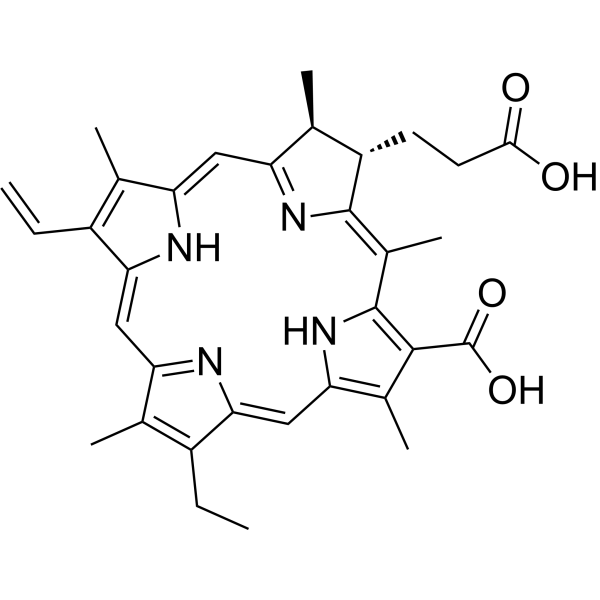
Chlorin e4 is an organic compound belonging to the family of chlorins, which are macrocyclic compounds with a similar structure to porphyrins. It is commonly used to improve photodynamic therapy for cancer and other diseases. Chlorin e4 has multiple applications in medical research, including as a photosensitizer for localized tumor destruction. In addition, its antimicrobial properties and potential use in disinfection applications were investigated.
For research use only. We do not sell to patients.
- CAS No.: 550-52-7
- Formula: C33H36N4O4
- Molecular Weight:552.66
-
Storage:
Please store the product under the recommended conditions in the Certificate of Analysis.

To place orders, for customer services and technical support, please contact: MedChemExpress USA
Tel: 609-228-6898 E-mail: [email protected] [email protected]


-
 Biological Activity
-
Chemical Information
- Protocols
- Purity & Documentation
-
 Help & FAQs




Biological Activity
Description
In Vitro
Chlorin e4 is a biochemical reagent that can be used as a biological material or organic compound for life science related research.
MedChemExpress (MCE) has not independently confirmed the accuracy of these methods. They are for reference only.


Chemical Information
-
CAS No. 550-52-7
-
Molecular Weight 552.66
-
Formula C33H36N4O4
-
SMILES
C=CC1=C(C)C2=CC3=NC(=C(C)C4=C(C(=C(C=C5C(=C(C)C(=N5)C=C1N2)CC)N4)C)C(=O)O)[C@@H](CCC(=O)O)[C@@H]3C
-
Shipping
Room temperature in continental US; may vary elsewhere.
-
Storage
Please store the product under the recommended conditions in the Certificate of Analysis.


Purity & Documentation

Calculators
Concentration (start) × Volume (start) = Concentration (final) × Volume (final)


Chlorin e4 Related Classifications
HY-W127809 Related Classifications
 Powered by Bioz