



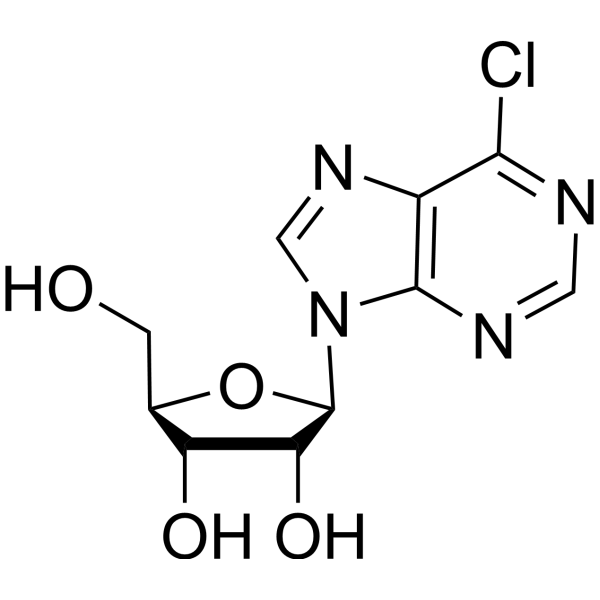
Chloropurine riboside

Based on 1 Customer Validation
Chloropurine (6-Chloropurine) riboside is an analog of Adenosine (HY-B0228). Chloropurine riboside acts as a chemical modifier for affinity labeling of RNase A. Chloropurine riboside exhibits antibacterial activity and can be used in studies related to citrus Huanglongbing (HLB).
For research use only. We do not sell to patients.
- Purity : 98.12%
- CAS No.: 5399-87-1
- Formula: C10H11ClN4O4
- Molecular Weight:286.68
-
Storage:
-20°C, sealed storage, away from moisture
* In solvent : -80°C, 6 months; -20°C, 1 month (sealed storage, away from moisture)

To place orders, for customer services and technical support, please contact: MedChemExpress USA
Tel: 609-228-6898 E-mail: [email protected] [email protected]


-
 Biological Activity
-
Chemical Information
- Protocols
- Purity & Documentation
- References
-
 Help & FAQs


-
HY-Y0247
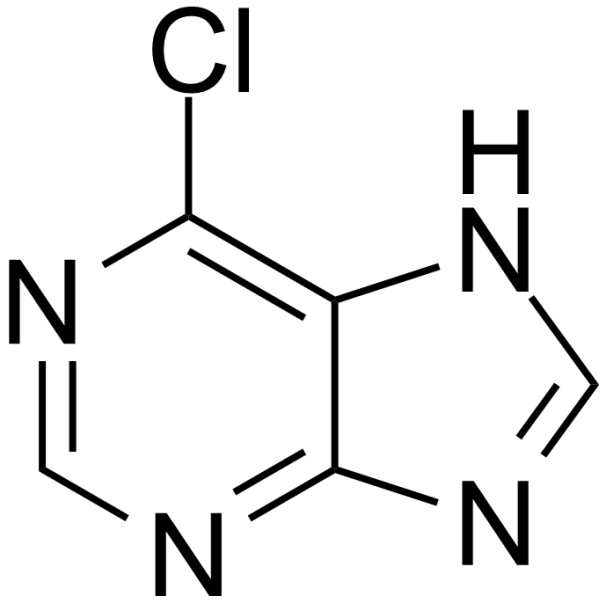
6-Chloropurine -
HY-17422
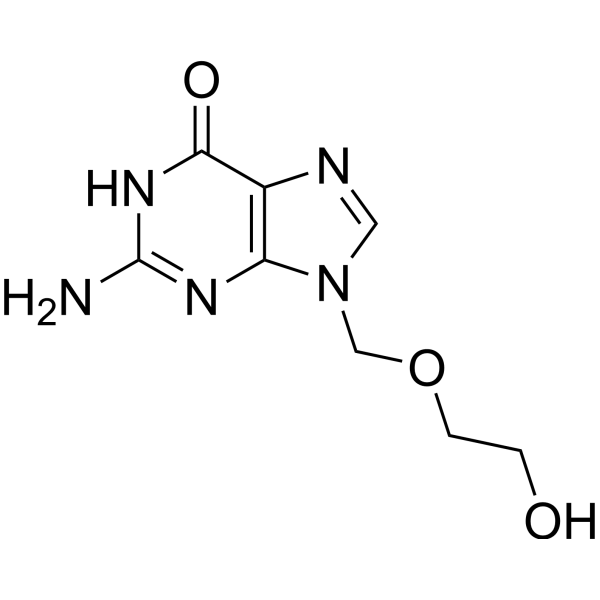
AcyclovirHSV Inhibitor -
HY-W008344
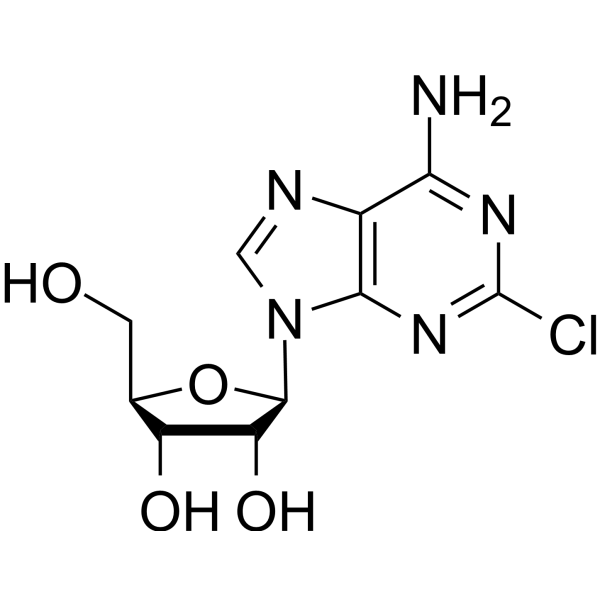
2-ChloroadenosineAdenosine Analogue -

HY-17422R
Acyclovir (Standard)HSV Inhibitor -
HY-B1118
SecnidazoleAntibiotic -
HY-W016999
2-ChloroadenineBiochemical Reagent -

HY-W007416
3,5-Dihydroxybenzaldehydeα-glucosidase Inhibitor -
HY-17425A
Valacyclovir hydrochlorideAntiviral Agent -
HY-B0277
VidarabineAntiviral Agent -
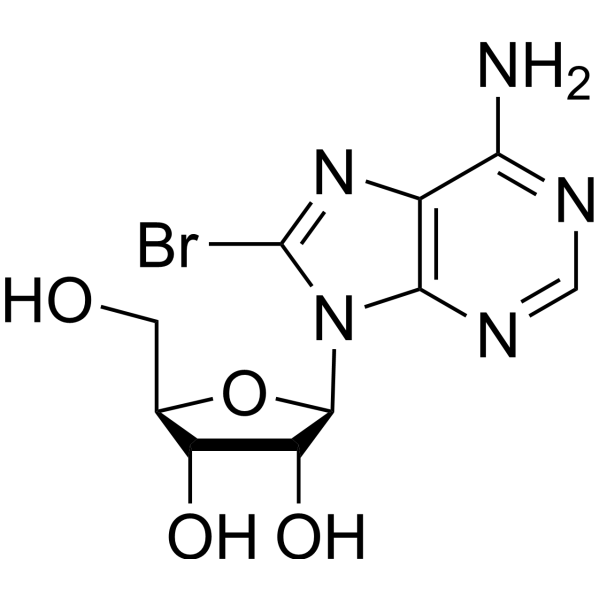
HY-W013195
8-BromoadenosineAdenosine Analog -
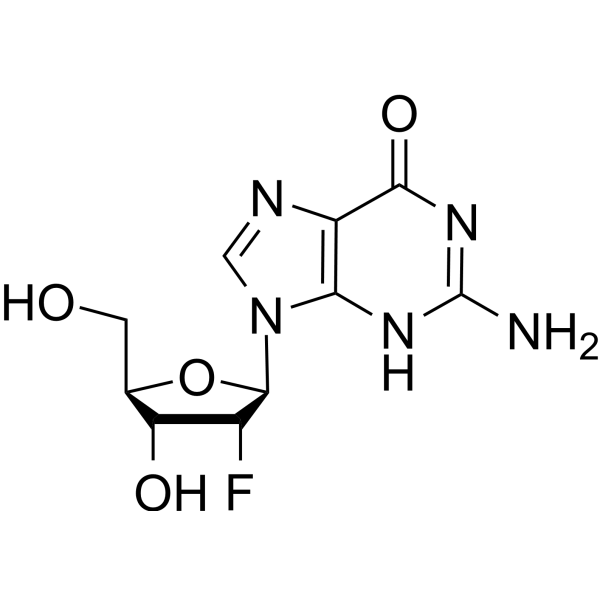
HY-W011518
2′-Deoxy-2′-fluoroguanosineInfluenza Virus Inhibitor -
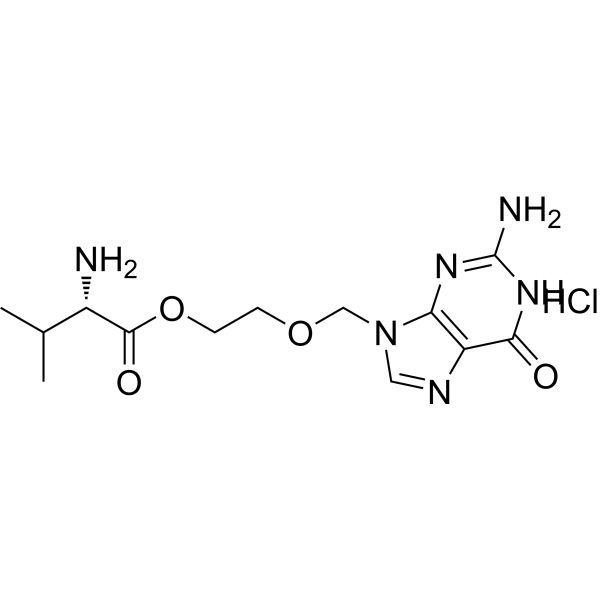
HY-17425AR
Valacyclovir hydrochloride (Standard)Antiviral Agent


Biological Activity
Description
Cellular Effect
|
Cell Line

|
Type | Value | Description | References |
|---|---|---|---|---|
| Huh-7 | CC50 |
>200 μM
Compound: 7
|
Cytotoxicity against Huh7 cells by XTT assay
Cytotoxicity against Huh7 cells by XTT assay
|
[PMID: 17766124] |
| Huh-7 | EC50 |
31 μM
Compound: 7
|
Inhibition of HCV replication in Huh7 cells after 48 hrs by luciferase assay
Inhibition of HCV replication in Huh7 cells after 48 hrs by luciferase assay
|
[PMID: 17766124] |
| Vero | CC50 |
279 μM
Compound: 1
|
Cytotoxicity against Vero E6 cells
Cytotoxicity against Vero E6 cells
|
[PMID: 17336519] |
| Vero | IC50 |
48.7 μM
Compound: 1
|
Antiviral activity against SARS-CoV Frankfurt1 in Vero E6 cells by plaque reduction assay
Antiviral activity against SARS-CoV Frankfurt1 in Vero E6 cells by plaque reduction assay
|
[PMID: 17336519] |
In Vivo
MedChemExpress (MCE) has not independently confirmed the accuracy of these methods. They are for reference only.
-
Animal Model:field-collected from Longping Town, Luodian County, Guizhou Province, China[2]
-
Dosage:500 mg/L
-
Administration:topical brushing; single administration
-
Result:Achieved an average anti-HLB inhibitory activity of 17.95% across 45 replicate tests.
Showed group average activities of 17.83%, 17.29%, 18.63%, 16.74%, and 19.26% with no significant differences between groups.
Covered individual replicate activity values ranging from 0.24% to 45.35%.


Chemical Information
-
CAS No. 5399-87-1
-
Appearance Solid
-
Molecular Weight 286.68
-
Formula C10H11ClN4O4
-
Color Off-white to yellow
-
SMILES
O[C@@H]1[C@H](O)[C@@H](CO)O[C@H]1N2C=NC3=C2N=CN=C3Cl
-
Synonyms
6-Chloropurine riboside
-
Shipping
Room temperature in continental US; may vary elsewhere.
-
Storage
-20°C, sealed storage, away from moisture
* In solvent : -80°C, 6 months; -20°C, 1 month (sealed storage, away from moisture)

Protocols
-
Research Protocol for Infectious Diseases
Infectious-disease experiments test how pathogens interact with host barriers, innate immune receptors, inflammatory signaling, pathogen replication, and tissue injury; pattern-recognition receptors such as TLRs, RIG-I-like receptors, NOD-like receptors, and inflammasomes detect microbial molecules and activate NF-κB, interferon, and cytokine responses. The central hypothesis is that infection severity reflects the balance between pathogen burden and host response: protective inflammation restricts pathogen growth, whereas excessive or mislocalized inflammation contributes to tissue damage and disease phenotype. Unresolved questions include which host pathways are protective versus pathogenic, why some infection models fail to translate to human disease, and which combined readouts best predict clinically relevant infection outcomes.
-
Bacterial live/dead nucleic-acid viability staining
The LIVE/DEAD bacterial viability staining method is based on differential permeability of nucleic-acid-binding fluorescent dyes, most commonly SYTO 9 and propidium iodide (PI), which enables discrimination of bacterial populations with intact versus compromised cytoplasmic membranes. SYTO 9 penetrates both intact and damaged bacterial membranes and binds nucleic acids to produce green fluorescence, whereas propidium iodide penetrates only cells with compromised membranes and fluoresces red while also reducing SYTO 9 signal through competitive binding and fluorescence interactions. The resulting fluorescence pattern is interpreted as a proxy for membrane integrity, which is widely used as an indicator of bacterial viability in microscopy, flow cytometry, and spectroscopic platforms. However, mechanistic studies show that SYTO 9 and PI interactions involve displacement and fluorescence resonance energy transfer effects, which can influence signal interpretation depending on dye ratios a


Purity & Documentation
-
Data Sheet (274 KB)
-
SDS (396 KB)
- English - EN (396 KB)
- Français - FR (396 KB)
- Deutsch - DE (396 KB)
- Norwegian - NO (396 KB)
- Español - ES (396 KB)
- Swedish - SV (396 KB)
- Italian - IT (396 KB)
- Korean - KR (396 KB)
- Portuguese - PT (396 KB)
-
Handling Instructions (2659 KB)
References
[1]. Alonso J, et al. Modification of bovine pancreatic ribonuclease A with 6-chloropurine riboside. Arch Biochem Biophys. 1986;246(2):681-689. [Content Brief]
[2]. Luo X, et al. Screening Method and Antibacterial Activity of 1,3,4-Oxadiazole Sulfone Compounds against Citrus Huanglongbing. Int J Mol Sci. 2023;24(13):10515. Published 2023 Jun 22. [Content Brief]

Calculators
Concentration (start) × Volume (start) = Concentration (final) × Volume (final)


Chloropurine riboside Related Classifications
HY-W007791 Related Classifications
 Powered by Bioz