



Copper(I) chloride

Based on 1 Customer Validation
Copper (I) chloride is an oxidizable, photodegradable cuprous chloride halide that converts to a dark green mixture of copper (II) chloride and basic copper (II) chloride upon exposure to humid air. Copper (I) chloride is ecotoxic and induces oxidative stress in Paphia undulata, with persistent effects after exposure ceases. Copper (I) chloride finds applications in multiple fields such as chemical industry and metallurgy, serving as a catalyst for various reactions and being used in the preparation of the fungicide copper oxychloride.
For research use only. We do not sell to patients.
- Purity : 99.45%
- CAS No.: 7758-89-6
- Formula: CuCl
- Molecular Weight:99.00
-
Storage:
RT, stored under nitrogen, away from moisture.
In solvent -80°C, 1 year , -20°C, 6 months


To place orders, for customer services and technical support, please contact: MedChemExpress USA
Tel: 609-228-6898 E-mail: [email protected] [email protected]


-
 Biological Activity
-
Chemical Information
- Protocols
- Purity & Documentation
- References
-
 Help & FAQs


-

HY-Y1103
Iron(II) sulfate heptahydrate, 99%Iron Salt -

HY-Y0961
Cuprous iodideBiochemical Reagent -
HY-Y1881B
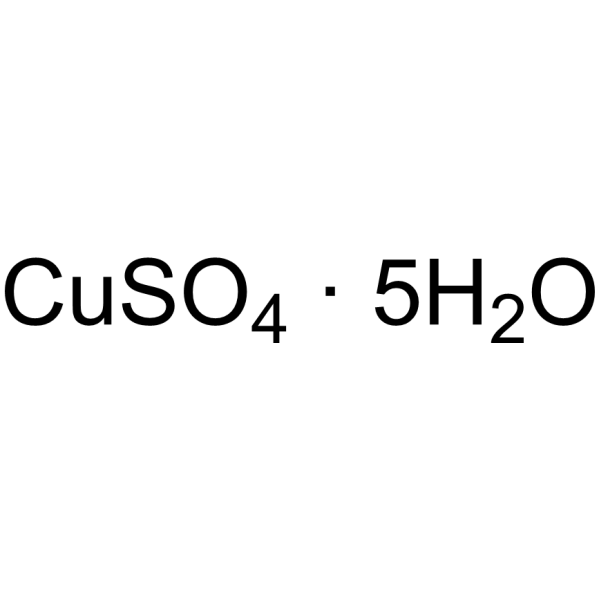
Copper sulfate pentahydrate, for cell culture, 98%Biochemical Reagent -
HY-Y1881A
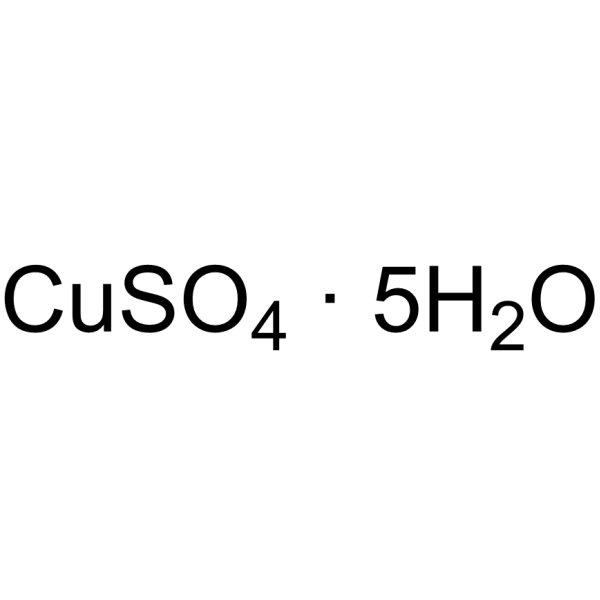
Copper sulfate pentahydrateBiochemical Reagents -

HY-Y1878
Copper(Ⅱ) sulfateBiochemical Reagent -

HY-Y1878C
Copper sulfate anhydrous, 99%Bactericide -

HY-Y0649
Lithium chloride, 99.3%-TBiochemical Reagent -

HY-W034801
Copper(II) acetylacetonateHomoleptic Acetylacetonate Complex of Copper(II)


Biological Activity
Description
In Vitro
Copper (I) chloride forms CuCl (aq), CuCl2−, CuCl32−, Cu2Cl42−, and a tri-charged complex in HCl-HClO4 aqueous solution[1].
Copper (I) chloride can be prepared by reducing copper (II) chloride dihydrate with sodium sulfite; it can also form specific complexes with ammonia and hydrochloric acid, and can absorb carbon monoxide to form crystalline adducts[2].
MedChemExpress (MCE) has not independently confirmed the accuracy of these methods. They are for reference only. Further protocols information, click here.
In Vivo
Copper (I) chloride (0.045-0.90 mg/L; 96 h exposure) induces tissue-specific and dose-dependent oxidative stress in the digestive gland and gill tissues of Ruditapes decussatus. This substance upregulates the activities of CAT, Se-GPx and GST enzymes in the digestive gland, while downregulates the activities of SOD and GST enzymes in the gills. After 96 h of pollutant removal, all antioxidant biomarkers fail to recover[3].
MedChemExpress (MCE) has not independently confirmed the accuracy of these methods. They are for reference only.


Chemical Information
-
CAS No. 7758-89-6
-
Appearance Solid
-
Molecular Weight 99.00
-
Formula CuCl
-
Color Off-white to light green
-
SMILES
Cl[Cu]
-
Shipping
Room temperature in continental US; may vary elsewhere.
-
Storage
RT, stored under nitrogen, away from moisture
In solvent -80°C 1 year -20°C 6 months

Protocols
-
ROS/oxidative-stress fluorescent staining
ROS/oxidative-stress fluorescent staining uses cell-permeant fluorogenic probes that become fluorescent after oxidation inside cells or tissues; commonly used examples include DCFH-DA/DCFDA for broad cellular oxidant detection, DHE for superoxide-related signal detection, MitoSOX for mitochondrial superoxide-related signal detection, and CellROX probes for oxidative-stress-associated fluorescence readouts. The assay detects probe oxidation rather than a single ROS species unless the probe and analysis method have been chemically validated for that species. DCFH-DA enters cells, is deacetylated by intracellular esterases to DCFH, and produces fluorescent DCF after oxidation, so the readout is used as an operational measure of total cellular oxidative stress rather than a species-specific ROS measurement. DHE and MitoSOX can report superoxide-related oxidation, but red fluorescence alone can include non-specific ethidium-like oxidation products; HPLC or optimized spectral approaches are


Purity & Documentation
-
Data Sheet (267 KB)
-
SDS (758 KB)
- English - EN (758 KB)
- Français - FR (758 KB)
- Deutsch - DE (758 KB)
- Norwegian - NO (758 KB)
- Español - ES (758 KB)
- Swedish - SV (758 KB)
- Italian - IT (758 KB)
- Korean - KR (758 KB)
- Portuguese - PT (758 KB)
-
Handling Instructions (2659 KB)
References

Calculators
Concentration (start) × Volume (start) = Concentration (final) × Volume (final)


Copper(I) chloride Related Classifications
HY-Y0988 Related Classifications
 Powered by Bioz