



Acetyl CoA Carboxylase 1 (ACC1) Antibody (YA646)
(Synonyms: ACAC, ACC1, ACCA, ACACA, Acetyl-CoA carboxylase 1, Acetyl-Coenzyme A carboxylase alpha, ACC-alpha)Based on 1 publication(s) in Google Scholar
Acetyl CoA Carboxylase 1 (ACC1) Antibody (YA646) is a Rabbit-derived and non-conjugated IgG monoclonal antibody, targeting to Acetyl CoA Carboxylase 1 (ACC1).
-
Host:
Rabbit
-
Isotype:
IgG
-
Application:
WB, IHC-P
-
Reactivity :
Human, Mouse
-
Formulation:
Supplied in 1*TBS (pH7.4), 0.05% BSA and 40% Glycerol. Preservative: 0.05% Sodium Azide.
-
Conjugation:
Non-conjugated


To place orders, for customer services and technical support, please contact: MedChemExpress USA
Tel: 609-228-6898 E-mail: [email protected] [email protected]



-

HY-P80787
Phospho-Acetyl Coenzyme A Carboxylase (Ser79) Antibody (YA229) -
HY-P8001
HRP-conjugated Goat Anti-Rabbit IgG H&L -
HY-P80533
Adipose Triglyceride Lipase Antibody (YA637) -
HY-P80900
SREBP-1 Antibody -
HY-P80451
Phospho-AMPK alpha 1 (Ser496) Antibody (YA226) -
HY-P80668
Fatty Acid Synthase Antibody (YA766) -
HY-P80560
ATP Citrate Lyase Antibody (YA829) -
HY-P80539
AMPK alpha 1 Antibody
Publications Citing Use of MedChemExpress (MCE) Acetyl CoA Carboxylase 1 (ACC1) Antibody (YA646)
More

Applications
| Application |
WB

WB: Western Blot
|
IHC-P
IHC-P: Immunohistochemistry-Paraffin
|
|---|---|---|
| Dilution Ratio | 1:1000 | 1:50-1:200 |


Product Details
Acetyl CoA Carboxylase 1 (ACC1) Antibody (YA646) is a Rabbit-derived and non-conjugated IgG monoclonal antibody, targeting to Acetyl CoA Carboxylase 1 (ACC1).
-
Host Rabbit

-
Clonality Recombinant,Monoclonal

-
Species ReactivityHuman, Mouse
-
Observed Molecular WeightObserved band size: 250-300 kDa
Note: Due to possible protein modifications or aggregation, the molecular weight should be confirmed by actual measurement, and the predicted value is for reference only.

-
Calculated Molecular Weight Predicted band size: 266 kDa

Entrez Gene: 31 Human ; 32 Human ; 100705 Mouse ; 107476 Mouse ;
SwissProt: Q13085 Human ; Q5SWU9 Mouse ; P11497 Rat
OMIM: 613933 Human
Synthetic peptide corresponding to Human ACC1.AA range:382-427.
Endogenous
Protein A affinity purified.
Non-conjugated
Unmodified
IgG


Product Properties
-
Appearance
Solution
-
Formulation
Supplied in 1*TBS (pH7.4), 0.05% BSA and 40% Glycerol. Preservative: 0.05% Sodium Azide.
-
Concentration
Batch-dependent, Please check the COA for the concentration of each lot. Check Lot Concentration
-
Storage & Stability
Stored at -20°C for 1 year. Avoid repeated freeze / thaw cycles.
-
Shipping
Shipping with blue ice.


Publications (1)
-
Journal Impact Factor
-
Most Recent
-
Drug Metab Dispos
HNF4A-AS1 promotes hepatic steatosis in metabolic dysfunction-associated steatotic liver disease by driving HNF4A degradation. [Abstract]2025 Dec 4;54(1):100211. PMID: 41494245


Verification Images
-
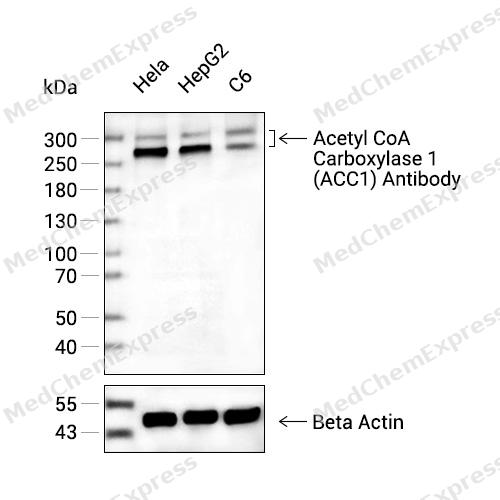 Western blot analysis of extracts from Hela(lane2(20μg) , HepG2(lane 3(20μg) and C6(lane 4(20ug) using Acetyl CoA Carboxylase 1 Antibody (HY-P80482) Rabbit mAb. Proteins were transferred to a PVDF membrane and blocked with 5% non-fat milk in TBST for 2 hour at room temperature. The primary antibody (1/1000) and Loading control antibody (Beta Actin, HY-P80438, 1/10000) was used in 5% non-fat milk in TBST at 4°C overnight. Goat Anti-Mouse/Rabbit IgG-HRP Secondary Antibody (1/10000) was used for 1 hour at room temperature.
 -
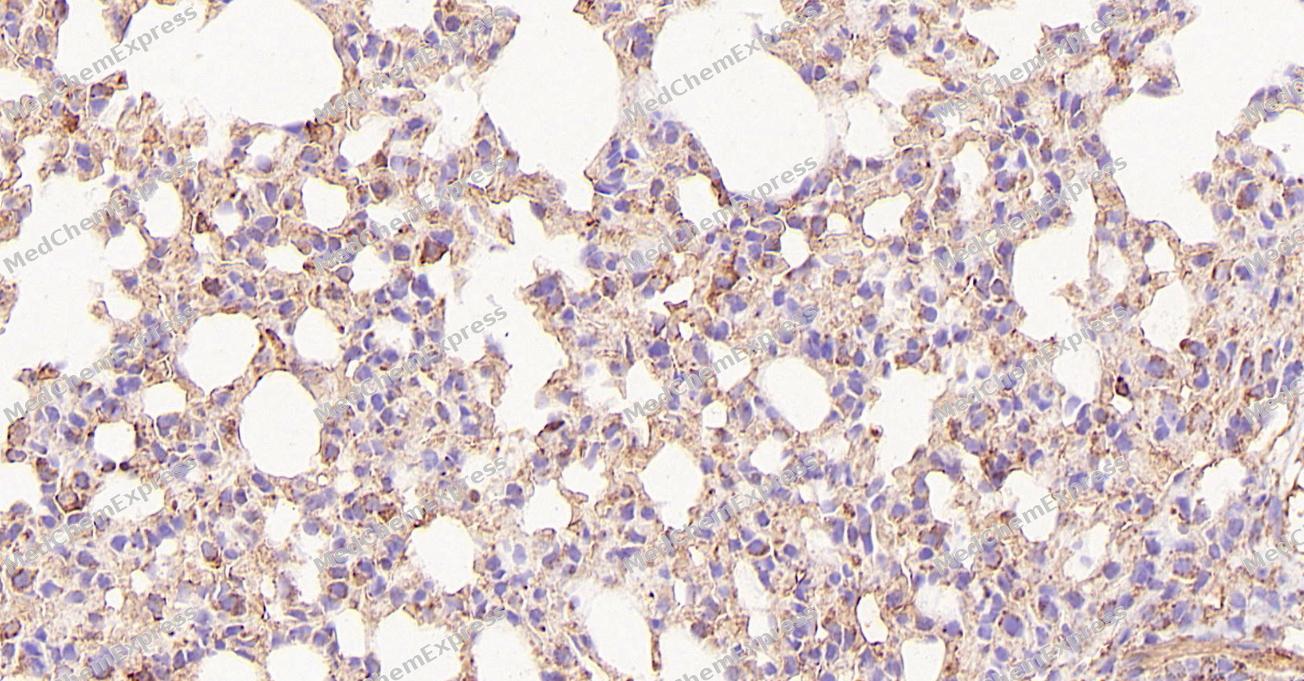 Immunohistochemical analysis of paraffin-embedded Mouse lung tissue using Acetyl CoA Carboxylase 1 (ACC1) Antibody. The section was pre-treated using heat mediated antigen retrieval with Tris-EDTA buffer (pH 9.0) for 8 minutes. The tissues were blocked in QuickBlock for 20 minutes at room temperature, washed with ddH2O and PBS, and then probed with the primary antibody (HY-P80482, 1/200) in 4℃ overnight. The detection was performed using an HRP conjugated compact polymer system. DAB was used as the chromogen. Tissues were counterstained with hematoxylin and mounted with DPX.
 -
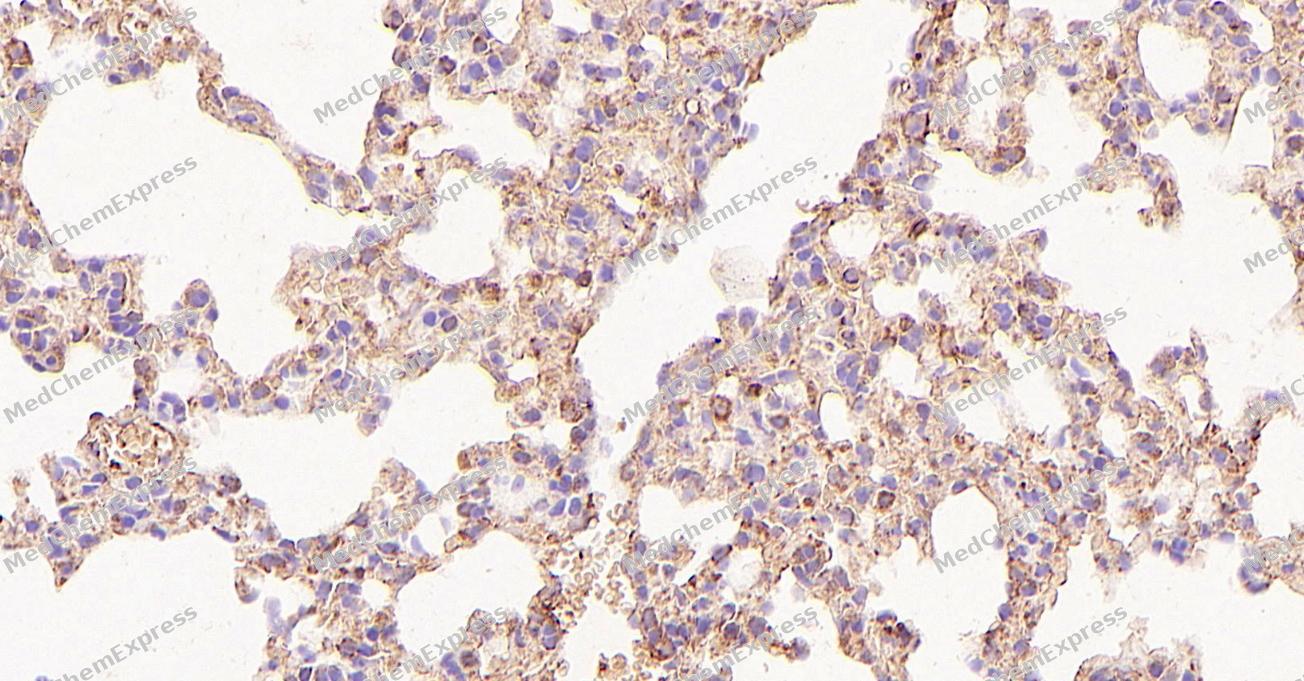 Immunohistochemical analysis of paraffin-embedded Mouse lung tissue using Acetyl CoA Carboxylase 1 (ACC1) Antibody. The section was pre-treated using heat mediated antigen retrieval with Tris-EDTA buffer (pH 9.0) for 8 minutes. The tissues were blocked in QuickBlock for 20 minutes at room temperature, washed with ddH2O and PBS, and then probed with the primary antibody (HY-P80482, 1/200) in 4℃ overnight. The detection was performed using an HRP conjugated compact polymer system. DAB was used as the chromogen. Tissues were counterstained with hematoxylin and mounted with DPX.


Background
-
Function
Acetyl CoA Carboxylase 1 is a Cytosolic enzyme that catalyzes the carboxylation of acetyl-CoA to malonyl-CoA, the first and rate-limiting step of de novo fatty acid biosynthesis. This is a 2 steps reaction starting with the ATP-dependent carboxylation of the biotin carried by the biotin carboxyl carrier (BCC) domain followed by the transfer of the carboxyl group from carboxylated biotin to acetyl-CoA[1][2][3].
-
Subcellular Localization
Cytoplasm, cytosol
-
Expression
Tissue_specificity:It is expressed in the brain, placenta, skeletal muscle, kidney, pancreas, and adipose tissue; it is expressed at low levels in lung tissue; and it was not detected in the liver. -
Subunit
Monomer, homodimer, and homotetramer (PubMed:20952656, PubMed:29899443). Can form filamentous polymers (PubMed:20457939, PubMed:20952656, PubMed:29899443). Interacts in its inactive phosphorylated form with the BRCT domains of BRCA1 which prevents ACACA dephosphorylation and inhibits lipid synthesis (PubMed:12360400, PubMed:16326698, PubMed:18452305, PubMed:29899443). Interacts with MID1IP1; interaction with MID1IP1 promotes oligomerization and increases its activity (PubMed:20457939)
-
SwissProt ID
-
Synonyms
ACAC, ACC1, ACCA, ACACA, Acetyl-CoA carboxylase 1, Acetyl-Coenzyme A carboxylase alpha, ACC-alpha
-
Research Field
Cardiovascular
Documentation
-
Data Sheet (261 KB)
-
SDS (252 KB)
- English - EN (252 KB)
- Français - FR (252 KB)
- Deutsch - DE (252 KB)
- Norwegian - NO (252 KB)
- Español - ES (252 KB)
- Swedish - SV (252 KB)
- Italian - IT (252 KB)
- Korean - KR (252 KB)
- Portuguese - PT (252 KB)
-
User Guide for Antibodies (1077 KB)
References
[1]. Kim CW, et al. Induced polymerization of mammalian acetyl-CoA carboxylase by MIG12 provides a tertiary level of regulation of fatty acid synthesis. Proc Natl Acad Sci U S A. 2010 May 25;107(21):9626-31. [Content Brief]
[2]. Colbert CL, et al. Crystal structure of Spot 14, a modulator of fatty acid synthesis. Proc Natl Acad Sci U S A. 2010 Nov 2;107(44):18820-5. [Content Brief]
[3]. Hunkeler M, et al. Structural basis for regulation of human acetyl-CoA carboxylase. Nature. 2018 Jun;558(7710):470-474. [Content Brief]

 Powered by Bioz
