



ATG4A Antibody (YA601)
(Synonyms: ATG4A; APG4A; AUTL2; Cysteine protease ATG4A; AUT-like 2 cysteine endopeptidase; Autophagin-2; Autophagy-related cysteine endopeptidase 2; Autophagy-related protein 4 homolog A; hAPG4A)
Based on 1 Customer Validation
ATG4A Antibody (YA601) is a Rabbit-derived and non-conjugated IgG monoclonal antibody, targeting to ATG4A.
-
Host:
Rabbit
-
Isotype:
IgG
-
Application:
WB, IHC-P, IP
-
Reactivity :
Human
-
Formulation:
Supplied in 50 mM Tris-Glycine (pH 7.4), 0.15 M NaCl, 40% Glycerol and 0.05% BSA. Preservative: 0.01% Sodium azide
-
Conjugation:
Non-conjugated


To place orders, for customer services and technical support, please contact: MedChemExpress USA
Tel: 609-228-6898 E-mail: [email protected] [email protected]





Applications
| Application |
WB

WB: Western Blot
|
IHC-P
IHC-P: Immunohistochemistry-Paraffin
|
IP
IP: Immunoprecipitation
|
|---|---|---|---|
| Dilution Ratio | 1:500-1:1000 | 1:50-1:100 | 1:20 |


Product Details
ATG4A Antibody (YA601) is a Rabbit-derived and non-conjugated IgG monoclonal antibody, targeting to ATG4A.
-
Host Rabbit

-
Clonality Recombinant,Monoclonal

-
Species ReactivityHuman
-
Observed Molecular WeightObserved band size: 45 kDa
Note: Due to possible protein modifications or aggregation, the molecular weight should be confirmed by actual measurement, and the predicted value is for reference only.

-
Calculated Molecular Weight Predicted band size: 45 kDa

Synthetic peptide corresponding to Human ATG4A.The exact sequence is proprietary to MCE.
Endogenous
affinity purified
Non-conjugated
Unmodified
IgG


Product Properties
-
Appearance
Solution
-
Formulation
Supplied in 50 mM Tris-Glycine (pH 7.4), 0.15 M NaCl, 40% Glycerol and 0.05% BSA. Preservative: 0.01% Sodium azide
-
Concentration
Batch-dependent, Please check the COA for the concentration of each lot. Check Lot Concentration
-
Storage & Stability
Stored at -20°C for 1 year. Avoid repeated freeze / thaw cycles.
-
Shipping
Shipping with blue ice.


Verification Images
-
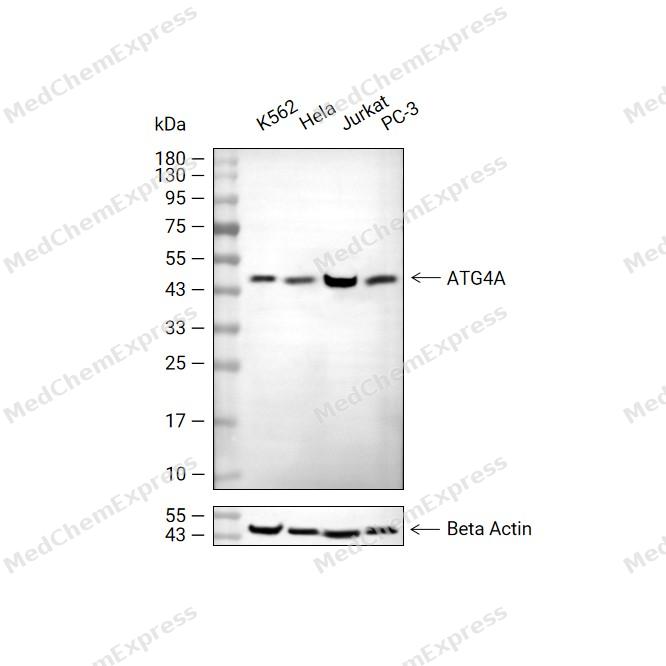 Western blot analysis of extracts from K562 (lane 2, 20ug), Hela (lane 3, 20ug), Jurkat (lane 4, 20ug) and PC-3 (lane 5, 20ug) using ATG4A Antibody (HY-P80557). Proteins were transferred to a PVDF membrane and blocked with 5% non-fat milk in TBST at 4°C overnight. The primary antibody (1/1000) and Loading control antibody (Beta Actin, HY-P80993, 1/10,000) was used in 5% non-fat milk in TBST for 2 hour at room temperature. Goat Anti-Rabbit IgG-HRP Secondary Antibody (HY-P8001, 1/10,000) was used for 1 hour at room temperature.


Background
-
Function
ATG4A is a Cysteine protease that plays a key role in autophagy by mediating both proteolytic activation and delipidation of ATG8 family proteins. The protease activity is required for proteolytic activation of ATG8 family proteins: cleaves the C-terminal amino acid of ATG8 proteins to reveal a C-terminal glycine. Exposure of the glycine at the C-terminus is essential for ATG8 proteins conjugation to phosphatidylethanolamine (PE) and insertion to membranes, which is necessary for autophagy. Preferred substrate is GABARAPL2 followed by MAP1LC3A and GABARAP. Protease activity is also required to counteract formation of high-molecular weight conjugates of ATG8 proteins (ATG8ylation): acts as a deubiquitinating-like enzyme that removes ATG8 conjugated to other proteins, such as ATG3. In addition to the protease activity, also mediates delipidation of ATG8 family proteins. Catalyzes delipidation of PE-conjugated forms of ATG8 proteins during macroautophagy. Compared to ATG4B, the major protein for proteolytic activation of ATG8 proteins, shows weaker ability to cleave the C-terminal amino acid of ATG8 proteins, while it displays stronger delipidation activity. Involved in phagophore growth during mitophagy independently of its protease activity and of ATG8 proteins: acts by regulating ATG9A trafficking to mitochondria and promoting phagophore-endoplasmic reticulum contacts during the lipid transfer phase of mitophagy[1][2][3][4][5][6][7][8][9][10][11].
-
Subcellular Localization
Cytoplasm
-
Isoforms & Post-Translational Modification
Q8WYN0 has 4 isomers: Q8WYN0-1: 45378 Da (predicted); Q8WYN0-2: 38601 Da (predicted); Q8WYN0-3: 36533 Da (predicted); Q8WYN0-5: 42453 Da (predicted).
-
Subunit
Interacts with ATG9A; the interaction is direct
-
SwissProt ID
-
Synonyms
ATG4A; APG4A; AUTL2; Cysteine protease ATG4A; AUT-like 2 cysteine endopeptidase; Autophagin-2; Autophagy-related cysteine endopeptidase 2; Autophagy-related protein 4 homolog A; hAPG4A
-
Research Field
Cell Biology


Documentation
-
Data Sheet (262 KB)
-
SDS (252 KB)
- English - EN (252 KB)
- Français - FR (252 KB)
- Deutsch - DE (252 KB)
- Norwegian - NO (252 KB)
- Español - ES (252 KB)
- Swedish - SV (252 KB)
- Italian - IT (252 KB)
- Korean - KR (252 KB)
- Portuguese - PT (252 KB)
-
User Guide for Antibodies (1077 KB)
References
[1]. Scherz-Shouval R, et al. The COOH terminus of GATE-16, an intra-Golgi transport modulator, is cleaved by the human cysteine protease HsApg4A. J Biol Chem. 2003 Apr 18;278(16):14053-8. [Content Brief]
[2]. Kabeya Y, et al. LC3, GABARAP and GATE16 localize to autophagosomal membrane depending on form-II formation. J Cell Sci. 2004 Jun 1;117(Pt 13):2805-12. [Content Brief]
[3]. Scherz-Shouval R, et al. Reactive oxygen species are essential for autophagy and specifically regulate the activity of Atg4. EMBO J. 2007 Apr 4;26(7):1749-60. [Content Brief]
[4]. Li M, et al. Kinetics comparisons of mammalian Atg4 homologues indicate selective preferences toward diverse Atg8 substrates. J Biol Chem. 2011 Mar 4;286(9):7327-38. [Content Brief]
[5]. Shu CW, et al. High-throughput fluorescence assay for small-molecule inhibitors of autophagins/Atg4. J Biomol Screen. 2011 Feb;16(2):174-82. [Content Brief]
[6]. Li M, et al. A high-throughput FRET-based assay for determination of Atg4 activity. Autophagy. 2012 Mar;8(3):401-12. [Content Brief]
[7]. Nguyen N, et al. The insufficiency of ATG4A in macroautophagy. J Biol Chem. 2020 Sep 25;295(39):13584-13600. [Content Brief]
[8]. Agrotis A, et al. Human ATG4 autophagy proteases counteract attachment of ubiquitin-like LC3/GABARAP proteins to other cellular proteins. J Biol Chem. 2019 Aug 23;294(34):12610-12621. [Content Brief]
[9]. Nguyen TN, et al. ATG4 family proteins drive phagophore growth independently of the LC3/GABARAP lipidation system. Mol Cell. 2021 May 6;81(9):2013-2030.e9. [Content Brief]
[10]. Kauffman KJ, et al. Delipidation of mammalian Atg8-family proteins by each of the four ATG4 proteases. Autophagy. 2018;14(6):992-1010. [Content Brief]
[11]. Durgan J, et al. Non-canonical autophagy drives alternative ATG8 conjugation to phosphatidylserine. Mol Cell. 2021 May 6;81(9):2031-2040.e8. [Content Brief]

 Powered by Bioz
