



MCP-3/CCL7 Protein, Mouse
Based on 5 publication(s) in Google Scholar
MCP-3/CCL7 Protein, Mouse is a CC chemokine and elicitor that binds to CCR1, CCR2 and CCR3 to mediate antiviral, antibacterial, antitumor and other immune responses. MCP-3/CCL7 Protein, Mouse is a recombinant mouse MCP-3/CCL7 protein expressed by E.coilMCP-3/CCL7(Q24-P97).
- Species: Mouse
- Source: E. coli
-
Storage:Stored at -20°C for 2 years from date of receipt. After reconstitution, it is stable at 4°C for 1 week or -20°C for longer (with carrier protein). It is recommended to freeze aliquots at -20°C or -80°C for extended storage.


To place orders, for customer services and technical support, please contact: MedChemExpress USA
Tel: 609-228-6898 E-mail: [email protected] [email protected]


-
 Biological Activity
-
Technical Parameters
-
Product Properties
- Documentation
- References
- Help & FAQs


-

HY-P7764
MCP-1/CCL2 Protein, Mouse -
HY-P71889
CCL4 Protein, Mouse -
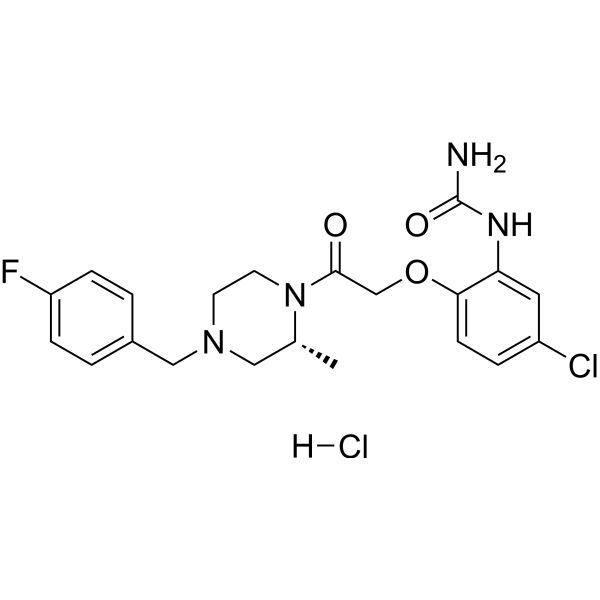
HY-12080A
BX471 hydrochloride -
HY-P7263
MIP-3 alpha/CCL20 Protein, Mouse -
HY-P7255
MIP-1 alpha/CCL3 Protein, Mouse (HEK293) -
HY-P7143
CCL6 Protein, Mouse -
HY-P7235
MCP-1/CCL2 Protein, Mouse (HEK293) -
HY-P7772
CCL9/10/MIP-1 gamma Protein, Mouse


Biological Activity
Description
MCP-3/CCL7 Protein, Mouse is a CC chemokine and elicitor that binds to CCR1, CCR2 and CCR3 to mediate antiviral, antibacterial, antitumor and other immune responses. MCP-3/CCL7 Protein, Mouse is a recombinant mouse MCP-3/CCL7 protein expressed by E.coilMCP-3/CCL7(Q24-P97)[1].
Background
CCL7, also known as monocyte chemotactic protein 3 (MCP3), is a small cell factor. In the human genome, CCL7 is encoded by the CCL7 gene located on chromosome 17q11.2-q12. It consists of 99 amino acids, including a signal peptide of 23 amino acids, while a mature protein of approximately 76 amino acids is secreted upon signal peptide cleavage. CCL7 is expressed in a variety of cell types, such as stromal cells, keratin-forming cells, airway smooth muscle cells, parenchymal cells, fibroblasts and leukocytes, and tumor cells[1]. CCL7 is generally present as a monomer and can bind to a variety of receptors, including CCR1, CCR2, CCR3, CCR5 and CCR10 to mediate effects on immune cell types.CCL7 can act as a chemoattractant, attracting a variety of leukocytes, including monocytes and neutrophils. It mediates the immune response by recruiting leukocytes to infected tissues and is also involved in monocyte mobilization and recruitment of monocytes to sites of inflammation, as well as inducing neutrophil migration to sites of inflammation by increasing intracellular Ca2+ flux. CCL7 is involved in antibacterial, antiviral and antifungal immune responses, as well as being associated with various immune diseases such as ulcerative colitis, multiple sclerosis or non-atopic and atopic asthma. At the same time, CCL7 expression activates antitumor immune responses[2].
In Vitro
CCL7(100 ng/mL, 8 h) reduces the fertilization rate of oocytes and sperm to 31.1 % in cumulus-oocyte complex (COC) but does not affect the fertilization rate of oocytes without oocula[3].
In Vivo
CCL7(i.p., 50 μg/kg) does not significantly alter ovulation, but decreases fertilization rate and significantly stimulates sperm chemotaxis without affecting spermatozoa chemotaxis in wide female mice[3].
Verified Bioactivity
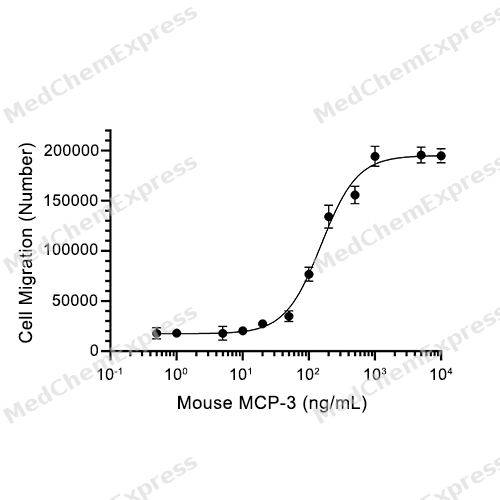
1.Full biological activity determined by a chemotaxis bioassay using human monocytes is in a concentration range of 100-300 ng/ml.
2.Measured by its ability to chemoattract THP-1 human monocytes. The ED50 this effect is 153.9 ng/mL, corresponding to a specific activity is 6497.726 U/mg.
3.Determined by its ability to chemoattract BaF3 mouse pro-B cells transfected with human CCR2A.The ED50 for this effect is 0.7142 μg/mL, corresponding to a specific activity is 1400.168 U/mg.
MCE Validation Data
-
Purity - SDS-PAGE
Purity - SDS-PAGE
-
Bioactivity - Cell-Based Assay
Bioactivity - Cell-Based Assay


Publications (5)
-
Journal Impact Factor
-
Most Recent
-
Nat Methods
Genetically encoded biosensor for monitoring spatiotemporal dynamics of CCR2 ligands in culture and in vivo. [Abstract]2025 Aug;22(8):1731-1741. PMID: 40665002 -
Cell Death Dis
2025 Dec 22;16(1):918. PMID: 41430036
MCP-3/CCL7 Protein, Mouse purchased from MedChemExpress. Usage Cited in: Cell Death Dis. 2025 Dec 22;16(1):918. [Abstract]
Schematic illustration of the experimental design showing orthotopic implantation of MOC1 cells in WT and Zbp1−/− mice, along with intraperitoneal injections of BX471 and recombinant CCL7 (MCP-3/CCL7 Protein, Mouse, 100 μg/kg, ip , daily, 3 weeks).

MCP-3/CCL7 Protein, Mouse purchased from MedChemExpress. Usage Cited in: Cell Death Dis. 2025 Dec 22;16(1):918. [Abstract]
Tumor formation in four groups: WT, WT + BX471, Zbp1−/−, and Zbp1−/−+CCL7 (MCP-3/CCL7 Protein, Mouse, 100 μg/kg, ip , daily, 3 weeks).

MCP-3/CCL7 Protein, Mouse purchased from MedChemExpress. Usage Cited in: Cell Death Dis. 2025 Dec 22;16(1):918. [Abstract]
CCL7 (MCP-3/CCL7 Protein, Mouse, 100 μg/kg, ip , daily, 3 weeks) administration reversed the inhibitory effect of BX471 on Zbp1−/− tumors.
-
Mol Psychiatry
Adolescent social isolation decreases colonic goblet cells and impairs spatial cognition through the reduction of cystine. [Abstract]2025 May;30(5):2137-2151. PMID: 39613916
MCP-3/CCL7 Protein, Mouse purchased from MedChemExpress. Usage Cited in: Mol Psychiatry. 2025 May;30(5):2137-2151. [Abstract]
The NOLT following microinjections of Clo-lip and CCL7 (MCP-3/CCL7 Protein, Mouse, 60 ng/μL/0.5 μL/side). Exploratory preference to object at the novel location in the test session (right) was measured 24 h following the training session (left).
-
Int Immunopharmacol
Isoliquiritigenin inhibited complete Freund's adjuvant-induced chronic inflammatory pain via the CCL7/CCR2/ERK pathway in dorsal root ganglia neurons of mice. [Abstract]2026 Feb 1:170:116059. PMID: 41418643
MCP-3/CCL7 Protein, Mouse purchased from MedChemExpress. Usage Cited in: Int Immunopharmacol. 2026 Feb 1:170:116059. [Abstract]
TBHQ reduced the hyperalgesia ratio in mice treated with either ISL or CCR2 KD following intraplantar CCL7 (MCP-3/CCL7 Protein, Mouse, 100 ng, sc) injection.
-
FASEB J
Convergent alteration of the mesenchymal stem cell heterogeneity in adipose tissue during aging. [Abstract]2023 Aug;37(8):e23114. PMID: 37498236


Technical Parameters
-
Species Mouse
-
Source E. coli
-
Tag Tag Free
-
Accession
Q03366 (Q24-P97)
-
Molecular Construction
-
N-term
-
CCL7 (Q24-P97)
Accession # Q03366 -
C-term
-
-
Protein Length
Full Length of Mature Protein
-
Synonyms
CCL7; Monocyte Chemotactic Protein 3; Prev. SCYA6; FIC; Prev. SCYA7; Small Inducible Cytokine A7 (Monocyte Chemotactic Protein 3); MCP-3; Chemokine (C-C Motif) Ligand 7; NC28; Small-Inducible Cytokine A7; MCP3; C-C Motif Chemokine 7; Monocyte Chemoattract
-
AA Sequence
QPDGPNASTCCYVKKQKIPKRNLKSYRRITSSRCPWEAVIFKTKKGMEVCAEAHQKWVEEAIAYLDMKTPTPKP
-
Predicted Molecular Mass
8.5 kDa
-
Molecular Weight
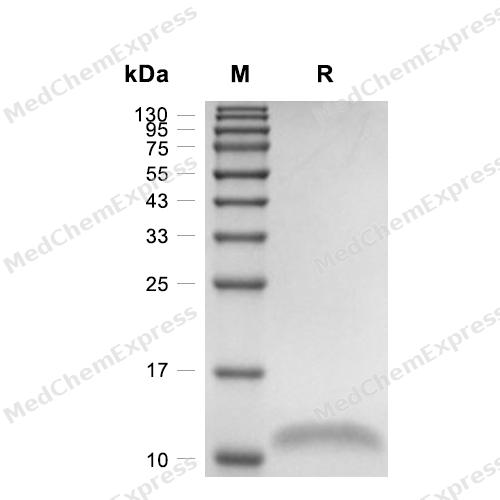
Approximately 12 kDa, based on SDS-PAGE under reducing conditions.
-
Purity
≥ 95%, as determined by reducing SDS-PAGE.


Product Properties
Lyophilized powder
1.Lyophilized from a 0.22 μm filtered solution of 2×PBS, pH 7.4.
2.Lyophilized from a 0.22 μm filtered solution of 40 mM PB, 300 mM NaCl, pH 7.4.
3.Lyophilized from a 0.22 μm filtered solution of PBS, pH 7.4.
Please refer to the lot-specific COA for specific buffer information.
<1 EU/μg, determined by LAL method.
It is not recommended to reconstitute to a concentration less than 100 μg/mL in ddH2O. For long term storage it is recommended to add a carrier protein (0.1% BSA, 5% HSA, 10% FBS or 5% Trehalose).
Stored at -20°C for 2 years from date of receipt. After reconstitution, it is stable at 4°C for 1 week or -20°C for longer (with carrier protein). It is recommended to freeze aliquots at -20°C or -80°C for extended storage.
Room temperature in continental US; may vary elsewhere.


Documentation
-
Data Sheet (263 KB)
-
SDS (252 KB)
- English - EN (252 KB)
- Français - FR (252 KB)
- Deutsch - DE (252 KB)
- Norwegian - NO (252 KB)
- Español - ES (252 KB)
- Swedish - SV (252 KB)
- Italian - IT (252 KB)
- Korean - KR (252 KB)
- Portuguese - PT (252 KB)
-
Handling Instructions (2659 KB)


References
[1]. G Opdenakker, et al. The human MCP-3 gene (SCYA7): cloning, sequence analysis, and assignment to the C-C chemokine gene cluster on chromosome 17q11.2-q12. Genomics. 1994 May 15;21(2):403-8. [Content Brief]
[2]. F Fioretti, et al. Reduced tumorigenicity and augmented leukocyte infiltration after monocyte chemotactic protein-3 (MCP-3) gene transfer: perivascular accumulation of dendritic cells in peritumoral tissue and neutrophil recruitment within the tumor. J Immunol. 1998 Jul 1;161(1):342-6. [Content Brief]
[3]. Shigero Tamba, et al. Timely interaction between prostaglandin and chemokine signaling is a prerequisite for successful fertilization. Proc Natl Acad Sci U S A. 2008 Sep 23;105(38):14539-44. [Content Brief]

Calculators
Concentration (start) × Volume (start) = Concentration (final) × Volume (final)


 Powered by Bioz

