



TARC/CCL17 Protein, Mouse (70a.a)

Based on 1 Customer Validation
TARC/CCL17 Protein, Mouse (70a.a) is the first CC chemokine identified to interact with T cells with high affinity and bind to the CCR4 receptor to mediate inflammation, cancer, and autoimmune related diseases. TARC/CCL17 Protein, Mouse is a recombinant mouse TARC/CCL17(A34-P103) protein expressed by E. coli.
- Species: Mouse
- Source: E. coli
-
Storage:Stored at -20°C for 2 years from date of receipt. After reconstitution, it is stable at 4°C for 1 week or -20°C for longer (with carrier protein). It is recommended to freeze aliquots at -20°C or -80°C for extended storage.


To place orders, for customer services and technical support, please contact: MedChemExpress USA
Tel: 609-228-6898 E-mail: [email protected] [email protected]


-
 Biological Activity
-
Technical Parameters
-
Product Properties
- Documentation
- References
- Help & FAQs




Biological Activity
Description
TARC/CCL17 Protein, Mouse (70a.a) is the first CC chemokine identified to interact with T cells with high affinity and bind to the CCR4 receptor to mediate inflammation, cancer, and autoimmune related diseases. TARC/CCL17 Protein, Mouse is a recombinant mouse TARC/CCL17(A34-P103) protein expressed by E. coli[1][2].
Background
CCL17, also known as thymic and activating regulatory chemokine (TARC), is a powerful chemokine commonly associated with type 2 immune responses, and its encoding gene is located on chromosome 16 in humans. CCL17 can be produced by thymic and antigen-presenting cells such as dendritic cells, macrophages, and monocytes, and acts by binding to the cell surface chemokine receptor CCR4. CCR4 is a G protein-coupled receptor expressed as a chemokine receptor on Th2 cells, cutaneous lymphocytes skin-localized T cells and regulatory T cells, and also on T cells in adult T-cell leukemia/lymphoma and cutaneous T-cell lymphoma. CCR4 has an important role in the regulation of immune homeostasis and activation of innate immune cells in the central nervous system (CNS). CCL17 plays an important role in the recruitment of CCR4-positive Th2 lymphocytes, is involved in the transport of Th2 cells in eosinophil-associated diseases (including AA and AD) and may be involved in the transport of tumor cells in certain T-cell lymphomas.CCL17 is also thought to be a homeostatic and inducible neuromodulatory chemokine that maintains the typical highly branching morphology of hippocampal microglia under homeostatic conditions and promotes adaptation of microglia morphology to acute LPS-induced neuroinflammation. CCL17 is also associated with autoimmune and allergic disorders[1][2].
In Vivo
CCL17 (intradermal injection, 0.1-10 µg/mL, 48 h) induces lymphocytic infiltration of the skin by CD4+ lymphocytes in a dose-dependent manner with a maximum response at 1 µg/mL, also induces interleukin-4 mRNA but not interferon-γ mRNA expression in the skin of female BALB/c mice[3].
CCL17 (intranasally, 10, 30, 90 μg/kg, daily, 3 days) significantly improves neurological function at 72 hours after intracerebral hemorrhage (ICH) at doses of 30 μg/kg and 90 μg/kg, and promotes hematoma resolution and increased CD163 expression on microglia/macrophages by activating the CCR4/ERK/Nrf2 pathway at 30 μg/kg in mice[4].
Verified Bioactivity
1.Full biological activity determined by a chemotaxis bioassay using human T-lymphocytes is in a concentration range of 1.0-10 ng/ml.
2.Measured by its ability to enhance Jurkat human lymphoma cells. The ED50 for this effect is 7.464 ng/mL, corresponding to a specific activity is 1.340×10⁵ U/mg.
MCE Validation Data
-
Purity - SDS-PAGE
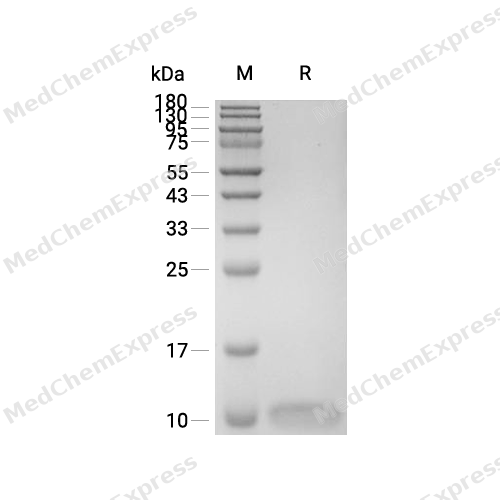
Purity - SDS-PAGE


Technical Parameters
-
Species Mouse
-
Source E. coli
-
Tag Tag Free
-
Accession
F6R5P4 (A34-P103)
-
Molecular Construction
-
N-term
-
CCL17 (A34-P103)
Accession # F6R5P4 -
C-term
-
-
Protein Length
Full Length of Mature Protein
-
Synonyms
CCL17; Chemokine (C-C Motif) Ligand 17; Prev. SCYA17; C-C Motif Chemokine 17; TARC; CC Chemokine TARC; ABCD-2; T Cell-Directed CC Chemokine; Small Inducible Cytokine Subfamily A (Cys-Cys), Member 17; A-152E5.3; Thymus And Activation-Regulated Chemokine; C
-
AA Sequence
ARATNVGRECCLDYFKGAIPIRKLVSWYKTSVECSRDAIVFLTVQGKLICADPKDKHVKKAIRLVKNPRP
-
Predicted Molecular Mass
7.9 kDa
-
Molecular Weight
Approximately 9 kDa, based on SDS-PAGE under reducing conditions.
-
Purity
≥ 95%, as determined by reducing SDS-PAGE.


Product Properties
Lyophilized powder.
1.Lyophilized from a 0.22 μm filtered solution of PBS, pH 7.4.
2.Lyophilized from a 0.22 μm filtered solution of PBS, pH 7.4, 10% trehalose, 0.02% Tween 80.
Please refer to the lot-specific COA for specific buffer information.
<1 EU/μg, determined by LAL method.
It is not recommended to reconstitute to a concentration less than 100 μg/mL in ddH2O.
Stored at -20°C for 2 years from date of receipt. After reconstitution, it is stable at 4°C for 1 week or -20°C for longer (with carrier protein). It is recommended to freeze aliquots at -20°C or -80°C for extended storage.
Room temperature in continental US; may vary elsewhere.


Documentation
-
Data Sheet (264 KB)
-
SDS (251 KB)
- English - EN (251 KB)
- Français - FR (251 KB)
- Deutsch - DE (251 KB)
- Norwegian - NO (251 KB)
- Español - ES (251 KB)
- Swedish - SV (251 KB)
- Italian - IT (251 KB)
- Korean - KR (251 KB)
- Portuguese - PT (251 KB)
-
Handling Instructions (2659 KB)


References
[1]. Julien Catherine, et al. What does elevated TARC/CCL17 expression tell us about eosinophilic disorders? Semin Immunopathol. 2021 Jun;43(3):439-458. [Content Brief]
[2]. Jo KM , et al. Thymus and activation-regulated chemokine (TARC)/CCL17 and IgE are associated with elderly asthmatics. Immun Ageing. 2018 May 5;15:13. [Content Brief]
[3]. Jan Korbecki, et al. CC Chemokines in a Tumor: A Review of Pro-Cancer and Anti-Cancer Properties of the Ligands of Receptors CCR1, CCR2, CCR3, and CCR4. Int J Mol Sci. 2020 Nov 9;21(21):8412. [Content Brief]
[4]. Osabe M, et al. Allopurinol suppresses expression of the regulatory T-cell migration factors TARC/CCL17 and MDC/CCL22 in HaCaT keratinocytes via restriction of nuclear factor-κB activation.J Appl Toxicol. 2018 Feb;38(2):274-283. [Content Brief]
[5]. Christian Vestergaard, et al. Thymus- and activation-regulated chemokine (TARC/CCL17) induces a Th2-dominated inflammatory reaction on intradermal injection in mice. Exp Dermatol. 2004 Apr;13(4):265-71. [Content Brief]
[6]. Shuixiang Deng, et al. Recombinant CCL17 Enhances Hematoma Resolution and Activation of CCR4/ERK/Nrf2/CD163 Signaling Pathway After Intracerebral Hemorrhage in Mice. Neurotherapeutics. 2020 Oct;17(4):1940-1953. [Content Brief]

Calculators
Concentration (start) × Volume (start) = Concentration (final) × Volume (final)


 Powered by Bioz

