



TRAF6 Antibody (YA031)
(Synonyms: TRAF6; RNF85; TNF receptor-associated factor 6; E3 ubiquitin-protein ligase TRAF6; Interleukin-1 signal transducer; RING finger protein 85)Based on 1 Customer Validation
TRAF6 Antibody (YA031) is a Rabbit-derived and non-conjugated IgG monoclonal antibody, targeting to TRAF6.
-
Host:
Rabbit
-
Isotype:
IgG
-
Application:
WB
-
Reactivity :
Human, Rat
-
Formulation:
Supplied in 50 mM Tris-Glycine (pH 7.4), 0.15 M NaCl, 40% Glycerol and 0.05% BSA. Preservative: 0.01% Sodium azide
-
Conjugation:
Non-conjugated


To place orders, for customer services and technical support, please contact: MedChemExpress USA
Tel: 609-228-6898 E-mail: [email protected] [email protected]





Applications
| Application |
WB

WB: Western Blot
|
|---|---|
| Dilution Ratio | 1:500-1:1000 |


Product Details
TRAF6 Antibody (YA031) is a Rabbit-derived and non-conjugated IgG monoclonal antibody, targeting to TRAF6.
-
Host Rabbit

-
Clonality Recombinant,Monoclonal

-
Species ReactivityHuman, Rat
-
Observed Molecular WeightObserved band size: 60 kDa
Note: Due to possible protein modifications or aggregation, the molecular weight should be confirmed by actual measurement, and the predicted value is for reference only.

-
Calculated Molecular Weight Predicted band size: 60 kDa

Entrez Gene: 7189 Human ; 22034 Mouse ; 311245 Rat
SwissProt: Q9Y4K3 Human ; P70196 Mouse ; B5DF45 Rat
OMIM: 602355 Human
Synthetic peptide corresponding to Human TRAF6.The exact sequence is proprietary to MCE.
Endogenous
affinity purified
Non-conjugated
Unmodified
IgG


Product Properties
-
Appearance
Solution
-
Formulation
Supplied in 50 mM Tris-Glycine (pH 7.4), 0.15 M NaCl, 40% Glycerol and 0.05% BSA. Preservative: 0.01% Sodium azide
-
Concentration
Batch-dependent, Please check the COA for the concentration of each lot. Check Lot Concentration
-
Storage & Stability
Stored at -20°C for 1 year. Avoid repeated freeze / thaw cycles.
-
Shipping
Shipping with blue ice.


Verification Images
-
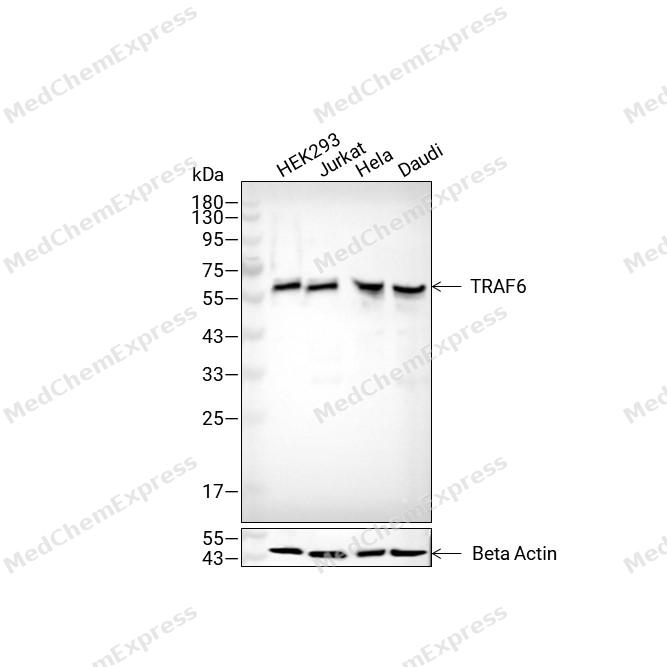 Western blot analysis of extracts from HEK293(lane2(20μg), Jurkat (lane3(20μg), Hela (lane4(20μg) and Daudi (lane5(20μg) using TRAF6 Antibody (HY-P80919). Proteins were transferred to a PVDF membrane and blocked with 5% non-fat milk in TBST for 2 hour at room temperature. The primary antibody (1/1000) and Loading control antibody (Beta Actin, HY-P80993, 1/10,000) was used in 5% non-fat milk in TBST at 4°C overnight. Goat Anti-Rabbit IgG-HRP Secondary Antibody (HY-P8001 ,1/10,000) was used for 1 hour at room temperature.


Background
-
Function
TRAF6 is an E3 ubiquitin ligase that, together with UBE2N and UBE2V1, mediates the synthesis of 'Lys-63'-linked-polyubiquitin chains conjugated to proteins, such as ECSIT, IKBKG, IRAK1, AKT1 and AKT2. Also mediates ubiquitination of free/unanchored polyubiquitin chain that leads to MAP3K7 activation. Leads to the activation of NF-kappa-B and JUN. Seems to also play a role in dendritic cells (DCs) maturation and/or activation. Represses c-Myb-mediated transactivation, in B-lymphocytes. Adapter protein that seems to play a role in signal transduction initiated via TNF receptor, IL-1 receptor and IL-17 receptor. Regulates osteoclast differentiation by mediating the activation of adapter protein complex 1 (AP-1) and NF-kappa-B, in response to RANK-L stimulation. Together with MAP3K8, mediates CD40 signals that activate ERK in B-cells and macrophages, and thus may play a role in the regulation of immunoglobulin production. Acts as a regulator of the JNK and NF-kappa-B signaling pathways by initiating assembly of heterotypic 'Lys-63'-/'Lys-48'-linked branched ubiquitin chains that are then recognized by TAB2: TRAF6 catalyzes initial 'Lys-63'-linked-polyubiquitin chains that are then branched via 'Lys-48'-linked polyubiquitin by HUWE1. 'Lys-63'-/'Lys-48'-linked branched ubiquitin chains protect 'Lys-63'-linkages from CYLD deubiquitination. Participates also in the TCR signaling by ubiquitinating LAT[1][2][3][4][5][6][7][8][9][10][11][12][13][14][15][16][17].
-
Subcellular Localization
Cytoplasm; Cytoplasm, cell cortex; Nucleus; Lipid droplet
-
Expression
Tissue_specificity:It is expressed in the heart, brain, placenta, lungs, liver, skeletal muscle, kidneys, and pancreas. -
Subunit
Homotrimer. Homooligomer. N-terminal region is dimeric while C-terminal region is trimeric; maybe providing a mode of oligomerization. Upon IL1B treatment, forms a complex with PELI1, IRAK1, IRAK4 and MYD88; this complex recruits MAP3K7/TAK1, TAB1 and TAB2 to mediate NF-kappa-B activation. Direct binding of SMAD6 to PELI1 prevents the complex formation and hence negatively regulates IL1R-TLR signaling and eventually NF-kappa-B-mediated gene expression. Binds to TNFRSF5/CD40 and TNFRSF11A/RANK. Associates with NGFR, TNFRSF17, IRAK2, IRAK3, RIPK2, MAP3K1, MAP3K5, MAP3K14, CSK, TRAF, TRAF-interacting protein TRIP and TNF receptor associated protein TDP2. Interacts with IL17R. Interacts with SQSTM1 bridging NTRK1 and NGFR. Forms a ternary complex with SQSTM1 and PRKCZ (By similarity). Interacts with PELI2 and PELI3. Binds UBE2V1. Interacts with TAX1BP1; this interaction mediates deubiquitination of TRAF6 and inhibition of NF-kappa-B activation (PubMed:10920205, PubMed:17703191). Interacts with ZNF675. Interacts with ARRB1 and ARRB2. Interacts with MAP3K7 and TAB1/MAP3K7IP1; during IL-1 signaling. Interacts with UBE2N. Interacts with TGFBR1, HDAC1 and RANGAP1. Interacts with AKT1, AKT2 and AKT3. Interacts (via TRAF domains) with NUMBL (via C-terminal). Interacts with RBCK1. Interacts with LIMD1 (via LIM domains) (By similarity). Interacts with RSAD2/viperin (By similarity). Interacts (via C-terminus) with EIF2AK2/PKR (via the kinase catalytic domain) (By similarity). Interacts with ZFAND5. Interacts with IL1RL1. Interacts with TRAFD1. Interacts with AJUBA. Interacts with MAVS/IPS1. Interacts (via TRAF domains) with DYNC2I2 (via WD domains). Interacts with IFIT3 (via N-terminus). Interacts with TICAM2. Interacts with CARD14. Interacts with CD40 and MAP3K8; the interaction is required for ERK activation (By similarity). Interacts with TICAM1 and this interaction is enhanced in the presence of WDFY1 (PubMed:25736436). Interacts with TANK; this interaction increases in response to DNA damage (PubMed:25861989). Interacts with USP10; this interaction increases in response to DNA damage (PubMed:25861989). Interacts with ZC3H12A; this interaction increases in response to DNA damage and is stimulated by TANK (PubMed:25861989). Interacts with WDFY3 (By similarity). Interacts with TRIM13 (PubMed:28087809). Interacts with GPS2 (By similarity). Interacts (via C-terminus) with SASH1 (PubMed:23776175). Interacts with LRRC19 (PubMed:25026888). Interacts with IL17RA and TRAF3IP2. Interacts with TOMM70 (PubMed:20628368). Interacts with AMBRA1; interaction is required to mediate 'Lys-63'-linked ubiquitination of ULK1 (PubMed:23524951). Interacts with CRBN; this interaction inhibits TLR4-mediated signaling by preventing TRAF6-mediated ubiquitination of ECSIT (PubMed:31620128)
-
SwissProt ID
-
Synonyms
TRAF6; RNF85; TNF receptor-associated factor 6; E3 ubiquitin-protein ligase TRAF6; Interleukin-1 signal transducer; RING finger protein 85
-
Research Field
Cell Biology


Documentation
-
Data Sheet (264 KB)
-
SDS (252 KB)
- English - EN (252 KB)
- Français - FR (252 KB)
- Deutsch - DE (252 KB)
- Norwegian - NO (252 KB)
- Español - ES (252 KB)
- Swedish - SV (252 KB)
- Italian - IT (252 KB)
- Korean - KR (252 KB)
- Portuguese - PT (252 KB)
-
User Guide for Antibodies (1077 KB)
References
[1]. Deng L, et al. Activation of the IkappaB kinase complex by TRAF6 requires a dimeric ubiquitin-conjugating enzyme complex and a unique polyubiquitin chain. Cell. 2000 Oct 13;103(2):351-61. [Content Brief]
[2]. Conze DB, et al. Lys63-linked polyubiquitination of IRAK-1 is required for interleukin-1 receptor- and toll-like receptor-mediated NF-kappaB activation. Mol Cell Biol. 2008 May;28(10):3538-47. [Content Brief]
[3]. Yin Q, et al. E2 interaction and dimerization in the crystal structure of TRAF6. Nat Struct Mol Biol. 2009 Jun;16(6):658-66. [Content Brief]
[4]. Yang WL, et al. The E3 ligase TRAF6 regulates Akt ubiquitination and activation. Science. 2009 Aug 28;325(5944):1134-8. [Content Brief]
[5]. Ohtake F, et al. The K48-K63 Branched Ubiquitin Chain Regulates NF-κB Signaling. Mol Cell. 2016 Oct 20;64(2):251-266. [Content Brief]
[6]. Kim MJ, et al. CRBN Is a Negative Regulator of Bactericidal Activity and Autophagy Activation Through Inhibiting the Ubiquitination of ECSIT and BECN1. Front Immunol. 2019;10:2203. [Content Brief]
[7]. Xia ZP, et al. Direct activation of protein kinases by unanchored polyubiquitin chains. Nature. 2009 Sep 3;461(7260):114-9. [Content Brief]
[8]. Wang Y, et al. Association of beta-arrestin and TRAF6 negatively regulates Toll-like receptor-interleukin 1 receptor signaling. Nat Immunol. 2006 Feb;7(2):139-47. [Content Brief]
[9]. Lamothe B, et al. Site-specific Lys-63-linked tumor necrosis factor receptor-associated factor 6 auto-ubiquitination is a critical determinant of I kappa B kinase activation. J Biol Chem. 2007 Feb 9;282(6):4102-12. [Content Brief]
[10]. Shembade N, et al. Essential role for TAX1BP1 in the termination of TNF-alpha-, IL-1- and LPS-mediated NF-kappaB and JNK signaling. EMBO J. 2007 Sep 5;26(17):3910-22. [Content Brief]
[11]. Pham LV, et al. Nuclear tumor necrosis factor receptor-associated factor 6 in lymphoid cells negatively regulates c-Myb-mediated transactivation through small ubiquitin-related modifier-1 modification. J Biol Chem. 2008 Feb 22;283(8):5081-9. [Content Brief]
[12]. Sorrentino A, et al. The type I TGF-beta receptor engages TRAF6 to activate TAK1 in a receptor kinase-independent manner. Nat Cell Biol. 2008 Oct;10(10):1199-207. [Content Brief]
[13]. Ye H, et al. Distinct molecular mechanism for initiating TRAF6 signalling. Nature. 2002 Jul 25;418(6896):443-7. [Content Brief]
[14]. Liu C, et al. Act1, a U-box E3 ubiquitin ligase for IL-17 signaling. Sci Signal. 2009 Oct 13;2(92):ra63. [Content Brief]
[15]. Cao Z, et al. TRAF6 is a signal transducer for interleukin-1. Nature. 1996 Oct 3;383(6599):443-6. [Content Brief]
[16]. Xie JJ, et al. TNFR-associated factor 6 regulates TCR signaling via interaction with and modification of LAT adapter. J Immunol. 2013 Apr 15;190(8):4027-36. [Content Brief]
[17]. Yang Y, et al. The Us3 Protein of Herpes Simplex Virus 1 Inhibits T Cell Signaling by Confining Linker for Activation of T Cells (LAT) Activation via TRAF6 Protein. J Biol Chem. 2015 Jun 19;290(25):15670-15678. [Content Brief]

 Powered by Bioz
