



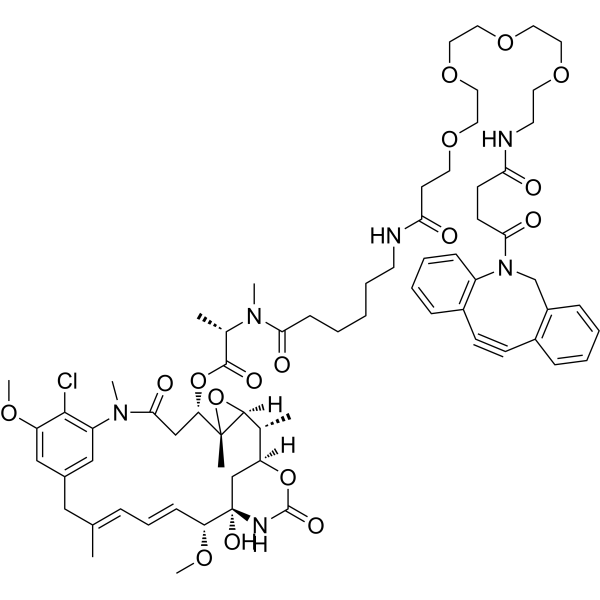
DBCO-PEG4-Ahx-DM1
DBCO-PEG4-Ahx-DM1 is a agent-linker conjugate composed of a potent microtubulin inhibitor DM1 and a linker DBCO-PEG4-Ahx to make antibody agent conjugate (ADC). Mertansine (DM1) is a microtubulin inhibitor and is an antibody-conjugatable maytansinoid that is developed to overcome systemic toxicity associated with maytansine and to enhance tumor-specific delivery. DBCO-PEG4-Ahx-DM1 is a click chemistry reagent, it contains a DBCO group that can undergo strain-promoted alkyne-azide cycloaddition (SPAAC) with molecules containing Azide groups.
For research use only. We do not sell to patients.
- CAS No.: 2479378-44-2
- Formula: C68H89ClN6O17
- Molecular Weight:1297.92
-
Storage:Powder -20°C, 3 years ; In solvent -80°C, 6 months , -20°C, 1 month

To place orders, for customer services and technical support, please contact: MedChemExpress USA
Tel: 609-228-6898 E-mail: [email protected] [email protected]


-
 Biological Activity
-
Chemical Information
- Protocols
- Purity & Documentation
-
 Help & FAQs


All Drug-Linker Conjugates for ADC Isoforms
More

Biological Activity
Description
IC50 & Target
|
Maytansinoids |
In Vitro
Antibody-drug conjugates (ADCs) carry a highly potent small-molecule toxin covalently connected on the antibody via a proper linker. For therapeutic ADCs in cancer treatment, the antibody targets specific antigen of tumor cell surface with high binding affinity, thereafter the intact ADC was internalized into the tumor cells with the antigen and digested in the lysosome to release the antitumor toxin[1].
MedChemExpress (MCE) has not independently confirmed the accuracy of these methods. They are for reference only. Further protocols information, click here.


Chemical Information
-
CAS No. 2479378-44-2
-
Appearance Solid
-
Molecular Weight 1297.92
-
Formula C68H89ClN6O17
-
Color White to off-white
-
SMILES
COC1=CC(C/C(C)=C/C=C/[C@@H](OC)[C@]2(O)NC(O[C@@]([C@@H](C)[C@@](O3)([H])[C@]3(C)[C@@H](OC([C@H](C)N(C)C(CCCCCNC(CCOCCOCCOCCOCCNC(CCC(N4CC(C=CC=C5)=C5C#CC6=C4C=CC=C6)=O)=O)=O)=O)=O)CC7=O)([H])C2)=O)=CC(N7C)=C1Cl
-
Shipping
Room temperature in continental US; may vary elsewhere.
-
Storage
Powder -20°C 3 years In solvent -80°C 6 months -20°C 1 month

Protocols
-
EdU Incorporation Assay (Click Chemistry-Based DNA Synthesis Measurement)
The EdU incorporation assay measures DNA synthesis by adding the thymidine analog 5-ethynyl-2′-deoxyuridine to cells or tissues, where it is incorporated into newly synthesized DNA during S phase. Incorporated EdU is detected by copper-catalyzed azide-alkyne cycloaddition, in which a fluorescent azide covalently reacts with the ethynyl group on EdU, allowing S-phase cells to be detected by fluorescence microscopy, flow cytometry, or high-content imaging. EdU detection does not require DNA denaturation or anti-BrdU antibody access, which preserves sample structure and improves compatibility with immunostaining and multiparameter cytometry compared with BrdU-based detection. EdU can be cytotoxic in a cell-type- and exposure-dependent manner, so pulse duration, concentration, and continuous-labeling designs should be validated for each cell type.
-
Subchronic/Chronic Toxicity Study
A subchronic/chronic oral toxicity study detects systemic adverse effects caused by repeated administration of a test article, using mortality, clinical signs, body weight, food/water intake, ophthalmology, urinalysis, hematology, serum biochemistry, organ weights, gross necropsy, and histopathology as integrated readouts. The readout reflects dose-related physiological injury, target-organ pathology, reversibility after recovery, and derivation of NOAEL, LOAEL, or related point-of-departure values when the dataset supports them.
-
Acute Systemic Toxicity Study
Acute systemic toxicity studies evaluate adverse effects occurring after a single exposure, or repeated exposure within a short acute window, and the main in vivo readouts are mortality, moribund condition, clinical signs, body-weight change, and gross pathological findings; acute oral toxicity methods were developed to replace classical LD50 testing with reduced-animal designs such as fixed-dose procedure, acute toxic class method, and up-and-down procedure. The fixed-dose procedure classifies acute toxicity by administering predefined dose levels and observing evident toxicity rather than using death as the primary endpoint, whereas the acute toxic class method uses sequential groups of three animals per step and the up-and-down procedure doses animals sequentially to estimate an LD50 with fewer animals than conventional LD50 testing.


Purity & Documentation
-
Data Sheet (249 KB)
-
SDS (251 KB)
- English - EN (251 KB)
- Français - FR (251 KB)
- Deutsch - DE (251 KB)
- Norwegian - NO (251 KB)
- Español - ES (251 KB)
- Swedish - SV (251 KB)
- Italian - IT (251 KB)
- Korean - KR (251 KB)
- Portuguese - PT (251 KB)
-
Handling Instructions (2659 KB)

Calculators
Concentration (start) × Volume (start) = Concentration (final) × Volume (final)


DBCO-PEG4-Ahx-DM1 Related Classifications
HY-136260 Related Classifications
 Powered by Bioz