



DL-Xylose

Based on 1 Customer Validation
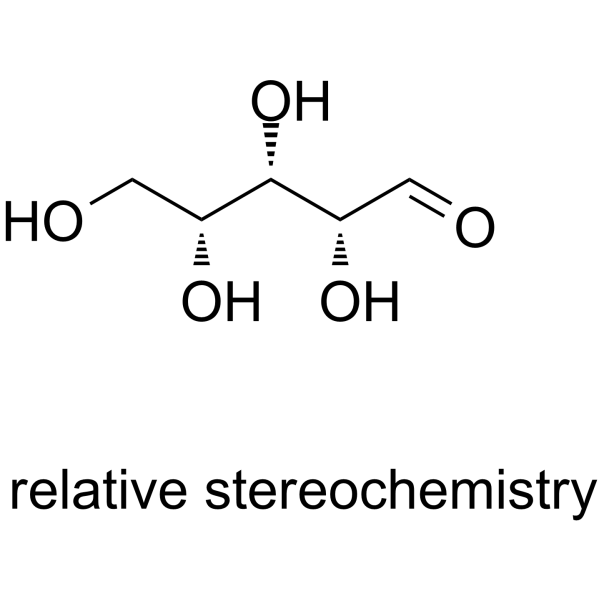
DL-Xylose ((±)-Xylos) is a carbohydrate metabolite found in the leaves of Murraya plants. DL-Xylose is a metabolic intermediate in the interconversion pathway between pentoses and glucuronic acid, and it can be interconverted with related pentoses through enzymatic reactions. D-Xylose can be used as a low-calorie sweetener and serves as a precursor for xylitol production. DL-Xylose can serve as a candidate warning biomarker for severe progression in diabetic patients co-infected with SARS-CoV-2. DL-Xylose can be used in research related to severe COVID-19 in diabetes.
For research use only. We do not sell to patients.
- Purity : 98.0%
- CAS No.: 25990-60-7
- Formula: C5H10O5
- Molecular Weight:150.13
-
Storage:Powder -20°C, 3 years , 4°C, 2 years ; In solvent -80°C, 2 years , -20°C, 1 year

To place orders, for customer services and technical support, please contact: MedChemExpress USA
Tel: 609-228-6898 E-mail: [email protected] [email protected]


-
 Biological Activity
-
Chemical Information
-
Solvent & Solubility
- Protocols
- Purity & Documentation
- References
-
 Help & FAQs




Biological Activity
Description
In Vitro
DL-Xylose is a key differentially accumulated sugar in the leaves of Murraya species, with the highest abundance in Murraya tetramera and the lowest abundance in Murraya kwangsiensis[2].
DL-Xylose accumulation in leaves is significantly correlated with 11 differentially expressed candidate genes[2].
MedChemExpress (MCE) has not independently confirmed the accuracy of these methods. They are for reference only. Further protocols information, click here.


Chemical Information
-
CAS No. 25990-60-7
-
Appearance Solid
-
Molecular Weight 150.13
-
Formula C5H10O5
-
Color White to off-white
-
SMILES
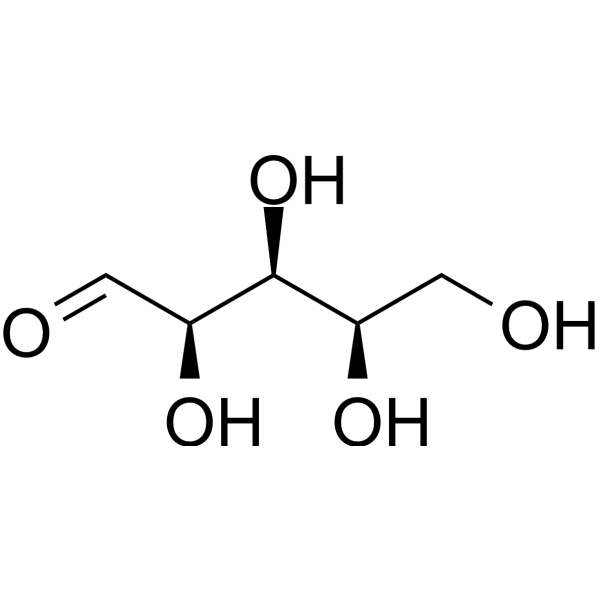
O=C[C@@H]([C@H]([C@@H](CO)O)O)O
-
Synonyms
(±)-Xylos
-
Structure Classification
-
Initial Source
-
Shipping
Room temperature in continental US; may vary elsewhere.
-
Storage
Powder -20°C 3 years 4°C 2 years In solvent -80°C 2 years -20°C 1 year


Solvent & Solubility
In Vitro:
H2O : 125 mg/mL (832.61 mM; Need ultrasonic)
Please refer to the solubility information to select the appropriate solvent. Once prepared, please aliquot and store the solution to prevent product inactivation from repeated freeze-thaw cycles.
Storage method and period of stock solution: -80°C, 2 years; -20°C, 1 year. When stored at -80°C, please use it within 2 years. When stored at -20°C, please use it within 1 year.
* Note: If you choose water as the stock solution, please dilute it to the working solution, then filter and sterilize it with a 0.22 μm filter before use.
Please refer to the solubility information to select the appropriate solvent. Once prepared, please aliquot and store the solution to prevent product inactivation from repeated freeze-thaw cycles.
Storage method and period of stock solution: -80°C, 2 years; -20°C, 1 year. When stored at -80°C, please use it within 2 years. When stored at -20°C, please use it within 1 year.
* Note: If you choose water as the stock solution, please dilute it to the working solution, then filter and sterilize it with a 0.22 μm filter before use.
Concentration (start) × Volume (start) = Concentration (final) × Volume (final)
In Vivo:
For the following dissolution methods, please prepare the working solution directly:
It is recommended to prepare fresh solutions and use them promptly within a short period of time.
The percentages shown for the solvents indicate their volumetric ratio in the final prepared solution. If precipitation or phase separation occurs during preparation, heat and/or sonication can be used to aid dissolution.
Add each solvent one by one: PBS
Solubility: 50 mg/mL (333.04 mM); Clear solution; Need ultrasonic

Protocols
-
Research Protocol for Metabolic Diseases
AMP-activated protein kinase, AMPK, is a conserved cellular energy sensor that responds to reduced cellular energy status and coordinates metabolism by increasing ATP-generating catabolic pathways while suppressing ATP-consuming anabolic processes. In metabolic disease research, the AMPK pathway is experimentally relevant because it regulates hepatic lipid synthesis, fatty acid oxidation, glucose production, skeletal-muscle glucose disposal, mTORC1-linked biosynthesis, autophagy, mitochondrial homeostasis, and whole-body energy balance. The central pathway logic is that energy stress, metformin, exercise-like stimulation, or direct AMPK activators increase AMPKα Thr172 phosphorylation and downstream substrate phosphorylation, including ACC and RAPTOR. Phosphorylation of ACC suppresses lipogenesis and supports fatty acid oxidation, whereas phosphorylation of RAPTOR suppresses mTORC1 signaling and links cellular energy status to growth and protein synthesis control. The pathway is linked


Purity & Documentation
-
Data Sheet (276 KB)
-
SDS (394 KB)
- English - EN (394 KB)
- Français - FR (394 KB)
- Deutsch - DE (394 KB)
- Norwegian - NO (394 KB)
- Español - ES (394 KB)
- Swedish - SV (394 KB)
- Italian - IT (394 KB)
- Korean - KR (394 KB)
- Portuguese - PT (394 KB)
-
Handling Instructions (2659 KB)
References


Complete Stock Solution Preparation Table
Please refer to the solubility information to select the appropriate solvent. Once prepared, please aliquot and store the solution to prevent product inactivation from repeated freeze-thaw cycles.
Storage method and period of stock solution: -80°C, 2 years; -20°C, 1 year. When stored at -80°C, please use it within 2 years. When stored at -20°C, please use it within 1 year.
| Optional Solvent | Concentration Solvent Mass | 1 mg | 5 mg | 10 mg | 25 mg |
|---|---|---|---|---|---|
| H2O | 1 mM | 6.6609 mL | 33.3045 mL | 66.6089 mL | 166.5223 mL |
| 5 mM | 1.3322 mL | 6.6609 mL | 13.3218 mL | 33.3045 mL | |
| 10 mM | 0.6661 mL | 3.3304 mL | 6.6609 mL | 16.6522 mL | |
| 15 mM | 0.4441 mL | 2.2203 mL | 4.4406 mL | 11.1015 mL | |
| 20 mM | 0.3330 mL | 1.6652 mL | 3.3304 mL | 8.3261 mL | |
| 25 mM | 0.2664 mL | 1.3322 mL | 2.6644 mL | 6.6609 mL | |
| 30 mM | 0.2220 mL | 1.1101 mL | 2.2203 mL | 5.5507 mL | |
| 40 mM | 0.1665 mL | 0.8326 mL | 1.6652 mL | 4.1631 mL | |
| 50 mM | 0.1332 mL | 0.6661 mL | 1.3322 mL | 3.3304 mL | |
| 60 mM | 0.1110 mL | 0.5551 mL | 1.1101 mL | 2.7754 mL | |
| 80 mM | 0.0833 mL | 0.4163 mL | 0.8326 mL | 2.0815 mL | |
| 100 mM | 0.0666 mL | 0.3330 mL | 0.6661 mL | 1.6652 mL |
* Note: If you choose water as the stock solution, please dilute it to the working solution, then filter and sterilize it with a 0.22 μm filter before use.


DL-Xylose Related Classifications
HY-B1070 Related Classifications
 Powered by Bioz