



Claramine
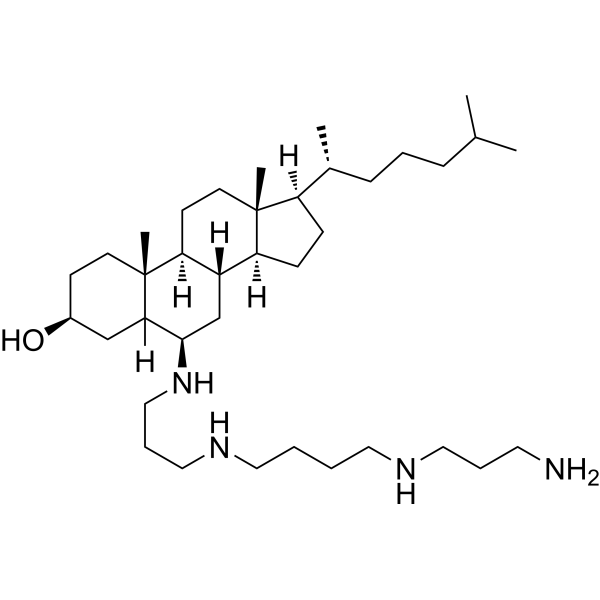
Claramine is a steroid polyamine with blood-brain barrier permeability. Claramine can regulate the properties of lipid membranes and protect cells from various biological toxins, including misfolded protein oligomers and biological protein-based toxins.
For research use only. We do not sell to patients.
- CAS No.: 1430194-56-1
- Formula: C37H72N4O
- Molecular Weight:588.99
-
Storage:
Please store the product under the recommended conditions in the Certificate of Analysis.

To place orders, for customer services and technical support, please contact: MedChemExpress USA
Tel: 609-228-6898 E-mail: [email protected] [email protected]


-
 Biological Activity
-
Chemical Information
- Protocols
- Purity & Documentation
- References
-
 Help & FAQs




Biological Activity
Description
In Vitro
Claramine (2-20 μM; 20 h) does not affect cell viability in human neuroblastoma cells (SH-SY5Y) at concentrations below 10 μM. Similarly, Claramine (2-20 μM; 20 h) does not impact cell activity in HEK293 cells[1].
Claramine (2.5-10 μM; 20 h) protects human neuroblastoma (SH-SY5Y) cells from the harmful effects of pore-forming agents, melittin (HY-P0233) (4 μM; 20 h) and α-hemolysin (50 μg/mL; 20 h), by inhibiting their binding to cell membranes[1].
MedChemExpress (MCE) has not independently confirmed the accuracy of these methods. They are for reference only.


Chemical Information
-
CAS No. 1430194-56-1
-
Molecular Weight 588.99
-
Formula C37H72N4O
-
SMILES
C[C@@]12[C@]3([H])[C@](C[C@H](C1([H])C[C@H](CC2)O)NCCCNCCCCNCCCN)([H])[C@@]4([H])[C@](CC3)([C@@](CC4)([H])[C@H](C)CCCC(C)C)C
-
Shipping
Room temperature in continental US; may vary elsewhere.
-
Storage
Please store the product under the recommended conditions in the Certificate of Analysis.


Purity & Documentation
References

Calculators
Concentration (start) × Volume (start) = Concentration (final) × Volume (final)


Claramine Related Classifications
HY-160791 Related Classifications
 Powered by Bioz