



Rubropunctamine
Based on 1 publication(s) in Google Scholar
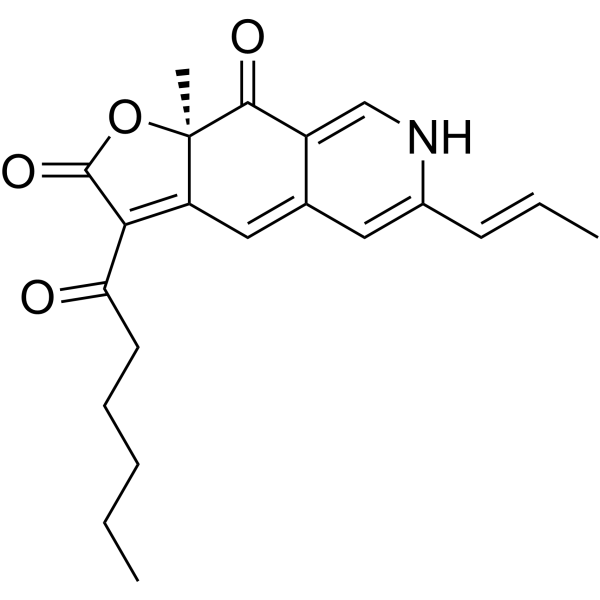
Rubropunctamine is a redMonascus pigment. Not only Rubropunctamine exerts antibiotic action against bacteria but also against some yeast and filamentous fungi strains. Rubropunctamine has potential embryotoxicity and teratogenicity.
For research use only. We do not sell to patients.
- Purity : 99.57%
- CAS No.: 514-66-9
- Formula: C21H23NO4
- Molecular Weight:353.41
-
Storage:
-80°C, protect from light

To place orders, for customer services and technical support, please contact: MedChemExpress USA
Tel: 609-228-6898 E-mail: [email protected] [email protected]


-
 Biological Activity
-
Chemical Information
- Protocols
- Purity & Documentation
- References
-
 Help & FAQs


Publications Citing Use of MedChemExpress (MCE) Rubropunctamine
More

Biological Activity
Description
In Vitro
Rubropunctamine (0.32-32 nM; 48 h) inhibits Epstein-Barr virus early antigen (EBV-EA) activation induced by 12-O-tetradecanoylphorbol-13-acetate (TPA), with an IC50 of 433 mol ratio/32 pmol TPA[2].
Rubropunctamine (1 h) exhibits moderate scavenging activity (inhibitory ratio (IR)=1.5) against NO generation by (±)-(E)-methyl-2[(E)-hydroxy-imino]-5-nitro-6-methoxy-3-hexemide (NOR 1) in normal human hepato cells[2].
MedChemExpress (MCE) has not independently confirmed the accuracy of these methods. They are for reference only.
In Vivo
MedChemExpress (MCE) has not independently confirmed the accuracy of these methods. They are for reference only.


Chemical Information
-
CAS No. 514-66-9
-
Appearance Solid
-
Molecular Weight 353.41
-
Formula C21H23NO4
-
Color Brown to black
-
SMILES
O=C1O[C@]2(C)C(C=C3C(C2=O)=CNC(/C=C/C)=C3)=C1C(CCCCC)=O
-
Structure Classification
-
Initial Source
Monascus
-
Shipping
Shipping with dry ice.
-
Storage
-80°C, protect from light


Publications (1)
-
Journal Impact Factor
-
Most Recent
-
Spectrochim Acta A Mol Biomol Spectrosc
Active pharmaceutical ingredient-correlated wavelength selection of UV-vis spectroscopy for the rapid quality assessment of red yeast Rice. [Abstract]2026 Jul 5:355:127669. PMID: 41785610


Purity & Documentation
-
Data Sheet (274 KB)
-
SDS (394 KB)
- English - EN (394 KB)
- Français - FR (394 KB)
- Deutsch - DE (394 KB)
- Norwegian - NO (394 KB)
- Español - ES (394 KB)
- Swedish - SV (394 KB)
- Italian - IT (394 KB)
- Korean - KR (394 KB)
- Portuguese - PT (394 KB)
-
Handling Instructions (2659 KB)
References
[2]. Akihisa T, et, al. Azaphilones, furanoisophthalides, and amino acids from the extracts of Monascus pilosus-fermented rice (red-mold rice) and their chemopreventive effects. J Agric Food Chem. 2005 Feb 9;53(3):562-5. [Content Brief]
[3]. Patakova P. Monascus secondary metabolites: production and biological activity. J Ind Microbiol Biotechnol. 2013 Feb;40(2):169-81. [Content Brief]

Calculators
Concentration (start) × Volume (start) = Concentration (final) × Volume (final)


Rubropunctamine Related Classifications
HY-N6643 Related Classifications
 Powered by Bioz