



des-Gln14-Ghrelin TFA
des-Gln14-Ghrelin TFA is a second endogenous ligand for the growth hormone secretagogue receptor. a). des-Gln14-ghrelin potently induces increases in [Ca2+]i in CHO-GHSR62 cells, with an EC50 of 2.4 nM.
For research use only. We do not sell to patients.
- Formula: C142H237N43O40.xC2HF3O2
- Molecular Weight:3186.67 (free acid)
-
Storage:
Please store the product under the recommended conditions in the Certificate of Analysis.

To place orders, for customer services and technical support, please contact: MedChemExpress USA
Tel: 609-228-6898 E-mail: [email protected] [email protected]


-
 Biological Activity
-
Chemical Information
- Protocols
- Purity & Documentation
- References
-
 Help & FAQs




Biological Activity
Description


Chemical Information
-
Molecular Weight 3186.67 (free acid)
-
Formula C142H237N43O40.xC2HF3O2
-
Sequence
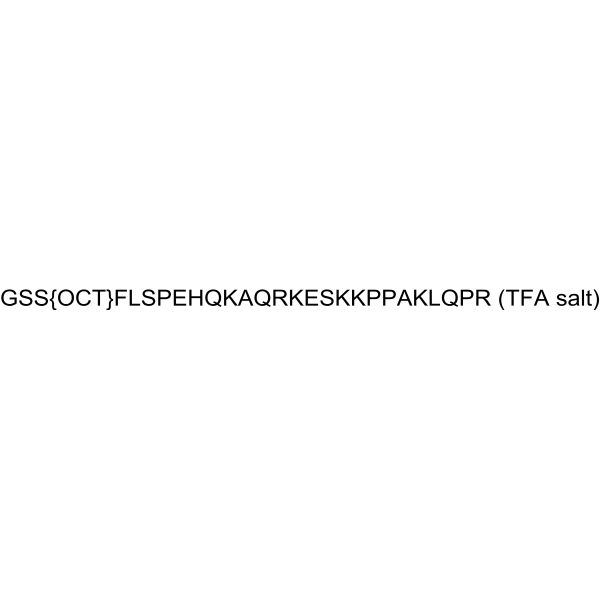
Gly-Ser-{Oct-Ser}-Phe-Leu-Ser-Pro-Glu-His-Gln-Lys-Ala-Gln-Arg-Lys-Glu-Ser-Lys-Lys-Pro-Pro-Ala-Lys-Leu-Gln-Pro-Arg
-
Sequence Shortening
GS-{Oct-Ser}-FLSPEHQKAQRKESKKPPAKLQPR
-
Shipping
Room temperature in continental US; may vary elsewhere.
-
Storage
Please store the product under the recommended conditions in the Certificate of Analysis.

Protocols
-
Research Protocol for Endocrine Diseases
Endocrine diseases often arise from disrupted hormone production, hormone signaling, or target-tissue responsiveness; for diabetes-focused endocrine disease models, insulin signaling regulates glucose uptake, hepatic glucose output, lipid metabolism, and β-cell compensation. Type 2 diabetes develops through interacting defects in insulin resistance, β-cell dysfunction, adipose inflammation, hepatic glucose overproduction, altered incretin signaling, and ectopic lipid metabolism. A major unresolved question is whether endocrine dysfunction is driven primarily by target-tissue insulin resistance, intrinsic β-cell failure, immune/inflammatory stress, or combined multi-organ failure that differs by disease stage.
-
Ca2+ Staining Technique
Ca2+ staining is an experimental technique that utilizes specific fluorescent probes (such as Fluo-4 AM, Fura-2, etc.) to qualitatively or quantitatively detect dynamic changes in intracellular Ca2+ concentrations; this is achieved by monitoring the changes in fluorescent signals generated when these probes bind to free intracellular calcium ions. The underlying principle relies primarily on the presence of chelating groups within the probe's molecular structure that possess high affinity for calcium ions.


Purity & Documentation
References

Calculators
Concentration (start) × Volume (start) = Concentration (final) × Volume (final)


des-Gln14-Ghrelin TFA Related Classifications
HY-P1366A Related Classifications
 Powered by Bioz