



Celiac Disease
-
Celiac Disease (5)

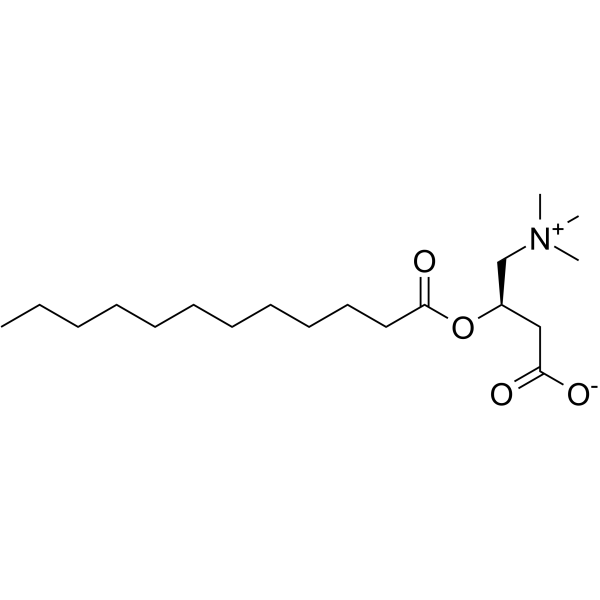
- Formula: C19H37NO4
- Molecular Weight: 343.50
Dodecanoylcarnitine ((-)-Lauroylcarnitine) is a medium long-chain acylcarnitine, an intermediate product in key energy metabolic pathways of fatty acid β-oxidation and amino acids catabolism. The abnormal decrease in the Dodecanoylcarnitine levels indicats that mitochondrial fuel metabolism, including fatty acid oxidation is significantly disturbed. Changes in plasma concentrations of Dodecanoylcarnitine are not only associated with type II diabetes, but also with pre-diabetes status. Dodecanoylcarnitine is present in fatty acid oxidation disorders such as long-chain acyl CoA dehydrogenase deficiency, carnitine palmitoyltransferase I/II deficiency, and is also associated with celiac disease. Dodecanoylcarnitine deomonstrates high sensitivities and specificities in predicting asthma. Combined model of Decanoylcarnitine (HY-113069), Dodecanoylcarnitine, PC (16:0/0:0), and Asp Arg Pro can be used as a potential biomarker for the diagnosis of Yin-deficiency-heat syndrome.

- Formula: C15H21BrN2
- Molecular Weight: 309.24

- Molecular Weight: 144.52 kDa
FB102 is an anti-human CD122 (IL-2Rβ) monoclonal antibody with selective activity. FB102 blocks the proliferation and activation of pathogenic NK cells and specific T cell subsets induced by IL-2 and IL-15, without affecting the proliferation of regulatory T cells. FB102 inhibits IL-2/IL-15-induced activation of CD4+ and CD8+ T cells in in vitro disease models. FB102 is applicable to research related to celiac disease.

- Formula: C66H86N10O14S2
- Molecular Weight: 1307.58
HB-230 is a Transglutaminase-2 (TG2) (human IC50 = 4.9 μM) inhibitor and a selective fluorescent imaging probe for active TG2 localization. HB-230 modifies TG2 Cys277 to sustain the enzyme open conformation. HB-230 forms a ternary complex with TG2 and α2-macroglobulin, undergoes receptor-mediated endocytosis, and trafficks directly to lysosomes without early/late endosome fusion. HB-230 exhibits TG2 activity-dependent and α2-macroglobulin-dependent uptake. HB-230 can be used for the research of celiac disease, (Ex/Em = 649/665 nm).

- Formula: C19H37NO4
- Molecular Weight: 343.50
Dodecanoylcarnitine (Standard) is the analytical standard of Dodecanoylcarnitine (HY-113166). This product is intended for research and analytical applications. Dodecanoylcarnitine ((-)-Lauroylcarnitine) is a medium long-chain acylcarnitine, an intermediate product in key energy metabolic pathways of fatty acid β-oxidation and amino acids catabolism. The abnormal decrease in the Dodecanoylcarnitine levels indicats that mitochondrial fuel metabolism, including fatty acid oxidation is significantly disturbed. Changes in plasma concentrations of Dodecanoylcarnitine are not only associated with type II diabetes, but also with pre-diabetes status. Dodecanoylcarnitine is present in fatty acid oxidation disorders such as long-chain acyl CoA dehydrogenase deficiency, carnitine palmitoyltransferase I/II deficiency, and is also associated with celiac disease. Dodecanoylcarnitine deomonstrates high sensitivities and specificities in predicting asthma. Combined model of Decanoylcarnitine (HY-113069), Dodecanoylcarnitine, PC (16:0/0:0), and Asp Arg Pro can be used as a potential biomarker for the diagnosis of Yin-deficiency-heat syndrome.



