



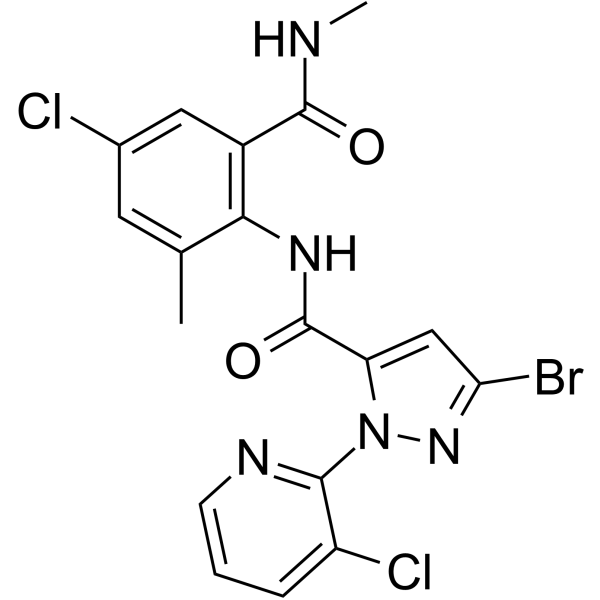
Chlorantraniliprole
Based on 2 publication(s) in Google Scholar
Chlorantraniliprole is an insecticide that potently and selectively activates insect ryanodine receptor, with EC50s of 40 nM and 50 nM for Drosophila melanogaster and H. virescens ryanodine receptor, and ~300-fold more potent than that in the mouse myoblast cell line, C2C12 (EC50, 14 μM).
For research use only. We do not sell to patients.
- Purity: 98.05%
- CAS No.: 500008-45-7
- Formula: C18H14BrCl2N5O2
- Molecular Weight:483.15
-
Storage:Powder -20°C, 3 years , 4°C, 2 years ; In solvent -80°C, 2 years , -20°C, 1 year

To place orders, for customer services and technical support, please contact: MedChemExpress USA
Tel: 609-228-6898 E-mail: [email protected] [email protected]


-
 Biological Activity
-
Chemical Information
-
Solvent & Solubility
- Purity & Documentation
- References
-
 Help & FAQs
-

Anti-Infection Compound Library
HY-L002
-
Targeted Diversity Library
HY-L099
-
Heterocyclic Compound Library
HY-L138
-
Bioactive Compound Library Max
HY-L181
-
MCE Bioactive Compound Library
HY-L001V
-
Bioactive Compound Library
HY-L001
-
Pesticide Compound Library
HY-L183
-
High-Throughput Bioactive Compound Library
HY-L205
-
Environmental Pollutant Compound Library
HY-L247


Publications Citing Use of MedChemExpress (MCE) Chlorantraniliprole
More

Biological Activity
EC50: 40 nM (Drosophila melanogaster Ryanodine receptor), 50 nM (H. virescens Ryanodine receptor), 14 μM (Ryanodine receptor, in C2C12 cells)
|
Cell Line

|
Type | Value | Description | References |
|---|---|---|---|---|
| C2C12 | EC50 |
14 μM
Compound: rynaxypyr
|
Activation of ryanodine receptor in mouse C2C12 cells assessed as induction of calcium mobilization
Activation of ryanodine receptor in mouse C2C12 cells assessed as induction of calcium mobilization
|
[PMID: 17884492] |
| C2C12 | EC50 |
14 μM
Compound: 5
|
Activation of ryanodine receptor 1 in mouse C2C12 cells assessed as induction of calcium mobilization
Activation of ryanodine receptor 1 in mouse C2C12 cells assessed as induction of calcium mobilization
|
[PMID: 19186058] |
| IMR-32 | EC50 |
>100 μM
Compound: rynaxypyr
|
Activation of ryanodine receptor in human IMR32 cells assessed as induction of calcium mobilization
Activation of ryanodine receptor in human IMR32 cells assessed as induction of calcium mobilization
|
[PMID: 17884492] |
| IMR-32 | EC50 |
>100 μM
Compound: 5
|
Activation of ryanodine receptor in human IMR32 cells assessed as induction of calcium mobilization
Activation of ryanodine receptor in human IMR32 cells assessed as induction of calcium mobilization
|
[PMID: 19186058] |
| PC-12 | EC50 |
>100 μM
Compound: rynaxypyr
|
Activation of ryanodine receptor in rat PC12 cells assessed as induction of calcium mobilization
Activation of ryanodine receptor in rat PC12 cells assessed as induction of calcium mobilization
|
[PMID: 17884492] |
| PC-12 | EC50 |
>100 μM
Compound: 5
|
Activation of ryanodine receptor 2 in rat PC12 cells assessed as induction of calcium mobilization
Activation of ryanodine receptor 2 in rat PC12 cells assessed as induction of calcium mobilization
|
[PMID: 19186058] |
| Sf9 | EC50 |
0.04 μM
Compound: rynaxypyr
|
Activation of Drosophila melanogaster ryanodine receptor in Sf9 cells assessed as induction of calcium mobilization
Activation of Drosophila melanogaster ryanodine receptor in Sf9 cells assessed as induction of calcium mobilization
|
[PMID: 17884492] |
| Sf9 | EC50 |
0.05 μM
Compound: rynaxypyr
|
Activation of Heliothis virescens recombinant ryanodine receptor expressed in Sf9 cells assessed as induction of calcium mobilization
Activation of Heliothis virescens recombinant ryanodine receptor expressed in Sf9 cells assessed as induction of calcium mobilization
|
[PMID: 17884492] |
| Sf9 | EC50 |
52 nM
Compound: D3
|
Activation of Heliothis virescens recombinant ryanodine receptor expressed in Sf9 cells assessed as induction of calcium mobilization
Activation of Heliothis virescens recombinant ryanodine receptor expressed in Sf9 cells assessed as induction of calcium mobilization
|
[PMID: 17884492] |
Chlorantraniliprole is an insecticide that potently and selectively activates insect ryanodine receptor. Chlorantraniliprole actions by release of intracellular Ca2+ stores mediated by the ryanodine receptor. Chlorantraniliprole is ~300-fold less potent against ryanodine receptor (RyRs) in the mouse myoblast cell line, C2C12 (EC50, 14 μM), than in insect RyRs from Drosophila melanogaster and H. virescens (EC50, 40 nM, 50 nM), and shows little selectivity at the rat cell line RyR2 (EC50, >100 μM)[1].
MedChemExpress (MCE) has not independently confirmed the accuracy of these methods. They are for reference only.
MedChemExpress (MCE) has not independently confirmed the accuracy of these methods. They are for reference only.


Chemical Information
-
CAS No. 500008-45-7
-
Appearance Solid
-
Molecular Weight 483.15
-
Formula C18H14BrCl2N5O2
-
Color White to off-white
-
SMILES
O=C(C1=CC(Br)=NN1C2=NC=CC=C2Cl)NC3=C(C(NC)=O)C=C(Cl)C=C3C
-
Shipping
Room temperature in continental US; may vary elsewhere.
-
Storage
Powder -20°C 3 years 4°C 2 years In solvent -80°C 2 years -20°C 1 year


Publications (2)
-
Journal Impact Factor
-
Most Recent
-
Anal Chem
Exposome-Scale Investigation of Cl-/Br-Containing Chemicals Using High-Resolution Mass Spectrometry, Multistage Machine Learning, and Cloud Computing. [Abstract]2025 Jun 3;97(21):11099-11109. PMID: 40401576 -
J Agric Food Chem
Molecular Characterization of Spodoptera frugiperda Heme Oxygenase and Its Involvement in Susceptibility to Chlorantraniliprole. [Abstract]2023 Feb 8;71(5):2313-2321. PMID: 36705998


Solvent & Solubility
DMSO : ≥ 62.5 mg/mL (129.36 mM; Hygroscopic DMSO has a significant impact on the solubility of product, please use newly opened DMSO)
* "≥" means soluble, but saturation unknown.
Please refer to the solubility information to select the appropriate solvent. Once prepared, please aliquot and store the solution to prevent product inactivation from repeated freeze-thaw cycles.
Storage method and period of stock solution: -80°C, 2 years; -20°C, 1 year. When stored at -80°C, please use it within 2 years. When stored at -20°C, please use it within 1 year.
Please refer to the solubility information to select the appropriate solvent. Once prepared, please aliquot and store the solution to prevent product inactivation from repeated freeze-thaw cycles.
Storage method and period of stock solution: -80°C, 2 years; -20°C, 1 year. When stored at -80°C, please use it within 2 years. When stored at -20°C, please use it within 1 year.
Concentration (start) × Volume (start) = Concentration (final) × Volume (final)
Select the appropriate dissolution method based on your experimental animal and administration route.
- For the following dissolution methods, please ensure to first prepare a clear stock solution using an In Vitro approach and then sequentially add co-solvents:
- To ensure reliable experimental results, the clarified stock solution can be appropriately stored based on storage conditions. As for the working solution for In Vivo experiments, it is recommended to prepare freshly and use it on the same day.
- The percentages shown for the solvents indicate their volumetric ratio in the final prepared solution. If precipitation or phase separation occurs during preparation, heat and/or sonication can be used to aid dissolution.
Add each solvent one by one: 10% DMSO 40% PEG300 5% Tween-80 45% Saline
Solubility: ≥ 2.08 mg/mL (4.31 mM); Clear solution
This protocol yields a clear solution of ≥ 2.08 mg/mL (saturation unknown).
Taking 1 mL working solution as an example, add 100 μL DMSO stock solution (20.8 mg/mL) to 400 μL PEG300, and mix evenly; then add 50 μL Tween-80 and mix evenly; then add 450 μL Saline to adjust the volume to 1 mL.
Preparation of Saline: Dissolve 0.9 g sodium chloride in ddH₂O and dilute to 100 mL to obtain a clear Saline solution.
Please enter the basic information of animal experiments:
-
-
-
-
Recommended: Prepare an additional quantity of animals to account for potential losses during experiments.
Please enter your animal formula composition:
-
%DMSO +
Recommended: Keep the proportion of DMSO in working solution below 2% if your animal is weak.
-
%+
-
+%Tween-80 + +
-
%Saline +
The co-solvents required include: DMSO, . All of co-solvents are available by MedChemExpress (MCE). , Tween 80. All of co-solvents are available by MedChemExpress (MCE).
Working solution concentration: 0.22 mg/mL
Method for preparing stock solution: mg drug dissolved in μL DMSO. Stock solution concentration: mg/mL.
1. Take μL DMSO stock solution;
2. Add μL .
μL , mix evenly;
3. Then add μL Tween 80, mix evenly;
4. Then add μL
Please ensure that the stock solution in the first step is dissolved to a clear state, and add co-solvents in sequence. You can use ultrasonic heating (ultrasonic cleaner, recommended frequency 20-40 kHz), vortexing, etc. to assist dissolution.


Purity & Documentation
-
Data Sheet (280 KB)
-
SDS (596 KB)
- English - EN (596 KB)
- Français - FR (596 KB)
- Deutsch - DE (596 KB)
- Norwegian - NO (596 KB)
- Español - ES (596 KB)
- Swedish - SV (596 KB)
- Italian - IT (596 KB)
- Korean - KR (596 KB)
- Portuguese - PT (596 KB)
-
Handling Instructions (2659 KB)
References


Complete Stock Solution Preparation Table
Please refer to the solubility information to select the appropriate solvent. Once prepared, please aliquot and store the solution to prevent product inactivation from repeated freeze-thaw cycles.
Storage method and period of stock solution: -80°C, 2 years; -20°C, 1 year. When stored at -80°C, please use it within 2 years. When stored at -20°C, please use it within 1 year.
| Optional Solvent | Concentration Solvent Mass | 1 mg | 5 mg | 10 mg | 25 mg |
|---|---|---|---|---|---|
| DMSO | 1 mM | 2.0698 mL | 10.3488 mL | 20.6975 mL | 51.7438 mL |
| 5 mM | 0.4140 mL | 2.0698 mL | 4.1395 mL | 10.3488 mL | |
| 10 mM | 0.2070 mL | 1.0349 mL | 2.0698 mL | 5.1744 mL | |
| 15 mM | 0.1380 mL | 0.6899 mL | 1.3798 mL | 3.4496 mL | |
| 20 mM | 0.1035 mL | 0.5174 mL | 1.0349 mL | 2.5872 mL | |
| 25 mM | 0.0828 mL | 0.4140 mL | 0.8279 mL | 2.0698 mL | |
| 30 mM | 0.0690 mL | 0.3450 mL | 0.6899 mL | 1.7248 mL | |
| 40 mM | 0.0517 mL | 0.2587 mL | 0.5174 mL | 1.2936 mL | |
| 50 mM | 0.0414 mL | 0.2070 mL | 0.4140 mL | 1.0349 mL | |
| 60 mM | 0.0345 mL | 0.1725 mL | 0.3450 mL | 0.8624 mL | |
| 80 mM | 0.0259 mL | 0.1294 mL | 0.2587 mL | 0.6468 mL | |
| 100 mM | 0.0207 mL | 0.1035 mL | 0.2070 mL | 0.5174 mL |


Chlorantraniliprole Related Classifications
HY-112820 Related Classifications
 Powered by Bioz