



MA220607

Based on 1 Customer Validation
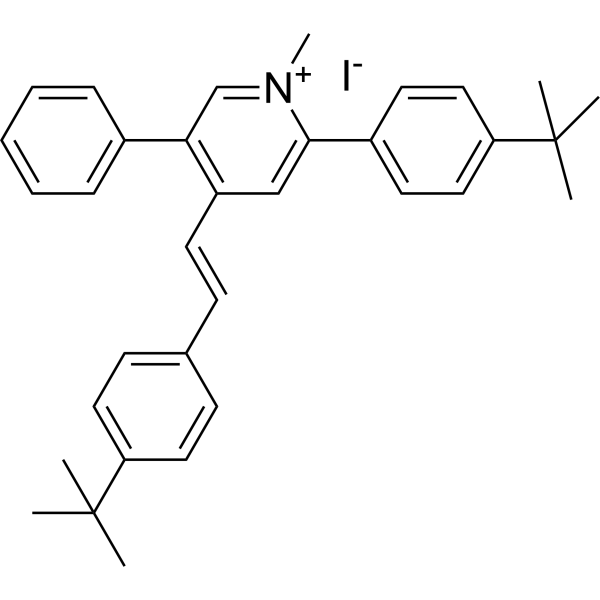
MA220607 is a FtsZ protein inhibitor with activity against both Gram-positive and Gram-negative bacteria. MA220607 inhibits bacterial growth and shows low bacterial resistance frequency. MA220607 increases bacterial membrane permeability and alters proton gradients. MA220607 blocks the formation of bacterial biofilms. MA220607 can be used in studies of bacterial infections.
For research use only. We do not sell to patients.
- Purity : 97.12%
- CAS No.: 2922826-56-8
- Formula: C34H38IN
- Molecular Weight:587.58
-
Storage:
-20°C, sealed storage, away from moisture
* In solvent : -80°C, 6 months; -20°C, 1 month (sealed storage, away from moisture)

To place orders, for customer services and technical support, please contact: MedChemExpress USA
Tel: 609-228-6898 E-mail: [email protected] [email protected]


-
 Biological Activity
-
Chemical Information
-
Solvent & Solubility
- Protocols
- Purity & Documentation
- References
-
 Help & FAQs




Biological Activity
Description
In Vitro
MA220607 exhibits potent broad-spectrum antibacterial activity against both sensitive and drug-resistant Gram-positive strains (MIC = 0.062-2 μg/mL) and Gram-negative strains (MIC = 0.5-4 μg/mL)[1].
MA220607 exhibits bactericidal activity against susceptible S. aureus ATCC25923, Methicillin (HY-121544)-resistant S. aureus ATCC43300, B. subtilis ATCC9372, clinically isolated S. aureus, and A. baumannii ATCC19606, with an MBC/MIC ratio ranging from 2 to 4[1].
MA220607 (0-1 μg/mL; 0-24 h) exerts a concentration-dependent bactericidal effect against S. aureus ATCC25923 and inhibits biofilm formation[1].
MA220607 (2.5-10 μg/mL; 30 min) stimulates the polymerization of purified BsFtsZ protein in a concentration-dependent manner[1].
MA220607 (1 μg/mL) disrupts the membrane integrity of S. aureus ATCC25923, thereby causing leakage of intracellular contents[1].
MedChemExpress (MCE) has not independently confirmed the accuracy of these methods. They are for reference only.
In Vivo
MedChemExpress (MCE) has not independently confirmed the accuracy of these methods. They are for reference only.
-
Animal Model:Kunming mice (male, average body mass 30 g)[1]
-
Dosage:5 mg/kg; 25 mg/kg
-
Administration:i.p.; single dose
-
Result:Reduced bacterial load in mouse blood.
Demonstrated greater activity than Linezolid (HY-10394) at equivalent 5 mg/kg and 25 mg/kg doses.


Chemical Information
-
CAS No. 2922826-56-8
-
Appearance Solid
-
Molecular Weight 587.58
-
Formula C34H38IN
-
Color Light yellow to yellow
-
SMILES
C[N+]1=CC(C2=CC=CC=C2)=C(/C=C/C3=CC=C(C(C)(C)C)C=C3)C=C1C4=CC=C(C(C)(C)C)C=C4.[I-]
-
Shipping
Room temperature in continental US; may vary elsewhere.
-
Storage
-20°C, sealed storage, away from moisture
* In solvent : -80°C, 6 months; -20°C, 1 month (sealed storage, away from moisture)


Solvent & Solubility
In Vitro:
DMSO : 116.67 mg/mL (198.56 mM; Need ultrasonic; Hygroscopic DMSO has a significant impact on the solubility of product, please use newly opened DMSO)
Please refer to the solubility information to select the appropriate solvent. Once prepared, please aliquot and store the solution to prevent product inactivation from repeated freeze-thaw cycles.
Storage method and period of stock solution: -80°C, 6 months; -20°C, 1 month (sealed storage, away from moisture). When stored at -80°C, please use it within 6 months. When stored at -20°C, please use it within 1 month.
Please refer to the solubility information to select the appropriate solvent. Once prepared, please aliquot and store the solution to prevent product inactivation from repeated freeze-thaw cycles.
Storage method and period of stock solution: -80°C, 6 months; -20°C, 1 month (sealed storage, away from moisture). When stored at -80°C, please use it within 6 months. When stored at -20°C, please use it within 1 month.
Concentration (start) × Volume (start) = Concentration (final) × Volume (final)


Purity & Documentation
-
Data Sheet (275 KB)
-
SDS (252 KB)
- English - EN (252 KB)
- Français - FR (252 KB)
- Deutsch - DE (252 KB)
- Norwegian - NO (252 KB)
- Español - ES (252 KB)
- Swedish - SV (252 KB)
- Italian - IT (252 KB)
- Korean - KR (252 KB)
- Portuguese - PT (252 KB)
-
Handling Instructions (2659 KB)
References


Complete Stock Solution Preparation Table
Please refer to the solubility information to select the appropriate solvent. Once prepared, please aliquot and store the solution to prevent product inactivation from repeated freeze-thaw cycles.
Storage method and period of stock solution: -80°C, 6 months; -20°C, 1 month (sealed storage, away from moisture). When stored at -80°C, please use it within 6 months. When stored at -20°C, please use it within 1 month.
| Optional Solvent | Concentration Solvent Mass | 1 mg | 5 mg | 10 mg | 25 mg |
|---|---|---|---|---|---|
| DMSO | 1 mM | 1.7019 mL | 8.5095 mL | 17.0190 mL | 42.5474 mL |
| 5 mM | 0.3404 mL | 1.7019 mL | 3.4038 mL | 8.5095 mL | |
| 10 mM | 0.1702 mL | 0.8509 mL | 1.7019 mL | 4.2547 mL | |
| 15 mM | 0.1135 mL | 0.5673 mL | 1.1346 mL | 2.8365 mL | |
| 20 mM | 0.0851 mL | 0.4255 mL | 0.8509 mL | 2.1274 mL | |
| 25 mM | 0.0681 mL | 0.3404 mL | 0.6808 mL | 1.7019 mL | |
| 30 mM | 0.0567 mL | 0.2836 mL | 0.5673 mL | 1.4182 mL | |
| 40 mM | 0.0425 mL | 0.2127 mL | 0.4255 mL | 1.0637 mL | |
| 50 mM | 0.0340 mL | 0.1702 mL | 0.3404 mL | 0.8509 mL | |
| 60 mM | 0.0284 mL | 0.1418 mL | 0.2836 mL | 0.7091 mL | |
| 80 mM | 0.0213 mL | 0.1064 mL | 0.2127 mL | 0.5318 mL | |
| 100 mM | 0.0170 mL | 0.0851 mL | 0.1702 mL | 0.4255 mL |


MA220607 Related Classifications
HY-149734 Related Classifications
 Powered by Bioz
Keywords
- MA220607
- 2922826-56-8
- MA 220607
- MA-220607
- Bacterial
- Acinetobacter baumannii ATCC19606
- FtsZ protein
- bacteremia
- Staphylococcus aureus ATCC25923
- Gram-negative bacteria
- Escherichia coli ATCC25922
- Bacillus subtilis ATCC9372
- bacterial biofilm
- Gram-positive bacteria
- methicillin-resistant Staphylococcus aureus ATCC43300
- Inhibitor
- inhibitor
- inhibit