



EGFR-IN-50
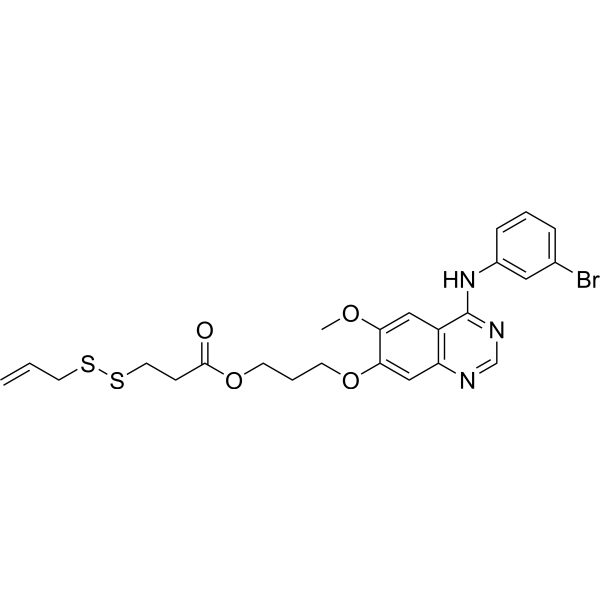
EGFR-IN-50 (Compound 9h) is a potent EGFR inhibitor against L858R resistance mutation (TEL-EGFR-L858R-BaF3: GI50=8 nM, TEL-EGFR-T790M-L858R-BaF3: GI50=6.03 μM). EGFR-IN-50 shows anti-proliferative activity to cancer cells.
For research use only. We do not sell to patients.
- CAS No.: 2044508-48-5
- Formula: C24H26BrN3O4S2
- Molecular Weight:564.51
-
Storage:
Please store the product under the recommended conditions in the Certificate of Analysis.

To place orders, for customer services and technical support, please contact: MedChemExpress USA
Tel: 609-228-6898 E-mail: [email protected] [email protected]


-
 Biological Activity
-
Chemical Information
- Protocols
- Purity & Documentation
- References
-
 Help & FAQs


All EGFR Isoforms
More

Biological Activity
Description
Cellular Effect
|
Cell Line

|
Type | Value | Description | References |
|---|---|---|---|---|
| HUVEC | IC50 |
>10 μM
Compound: 9h
|
Cytotoxicity against HUVEC assessed as reduction in cell viability measured after 72 hrs by Celltiter-Glo luminescent cell viability assay
Cytotoxicity against HUVEC assessed as reduction in cell viability measured after 72 hrs by Celltiter-Glo luminescent cell viability assay
|
[PMID: 32619886] |
In Vitro
EGFR-IN-50 (0-10 μM; 72 h) selectively inhibits NSCLC cell line H3255 (expressing EGFR-L858R) compared to other tumor cells[1].
EGFR-IN-50 (1-10 μM; 72 h) induces cell cycle arrest in G0-G1 phase[1].
EGFR-IN-50 (0.039-10 μM; 4 h) inhibits the phosphorylation of EGFR in H3255 cells[1].
MedChemExpress (MCE) has not independently confirmed the accuracy of these methods. They are for reference only.
-
Cell Line:A549, H3255, HepG2, MCF-7, HT-29 and A431 cells
-
Concentration:0-10 μM
-
Incubation Time:72 hours
-
Result:Showed GI50 values of >10, and 0.7873 μM for A549 and H3255 cells, respectively.
Showed IC50 values of >10, 7.309, >10 and 6.703 μM for HepG2, MCF-7, HT-29 and A431 cells, respectively.
-
Cell Line:H3255 cells
-
Concentration:1, 5, and 10 μM
-
Incubation Time:72 hours
-
Result:Increased the percentage of H3255 cells in G0-G1 phase from 60.32% to 88.61%.
-
Cell Line:H3255 cells
-
Concentration:0.039, 0.15, 0.62, 2.5, and 10 μM
-
Incubation Time:4 hours
-
Result:Inhibited the phosphorylation of EGFR in H3255 cells in a dose-dependent manner.


Chemical Information
-
CAS No. 2044508-48-5
-
Molecular Weight 564.51
-
Formula C24H26BrN3O4S2
-
SMILES
C=CCSSCCC(OCCCOC1=CC2=C(C(NC3=CC(Br)=CC=C3)=NC=N2)C=C1OC)=O
-
Shipping
Room temperature in continental US; may vary elsewhere.
-
Storage
Please store the product under the recommended conditions in the Certificate of Analysis.


Purity & Documentation
References

Calculators
Concentration (start) × Volume (start) = Concentration (final) × Volume (final)


EGFR-IN-50 Related Classifications
HY-146210 Related Classifications
 Powered by Bioz