



eIF4A-IN-3

Based on 1 Customer Validation
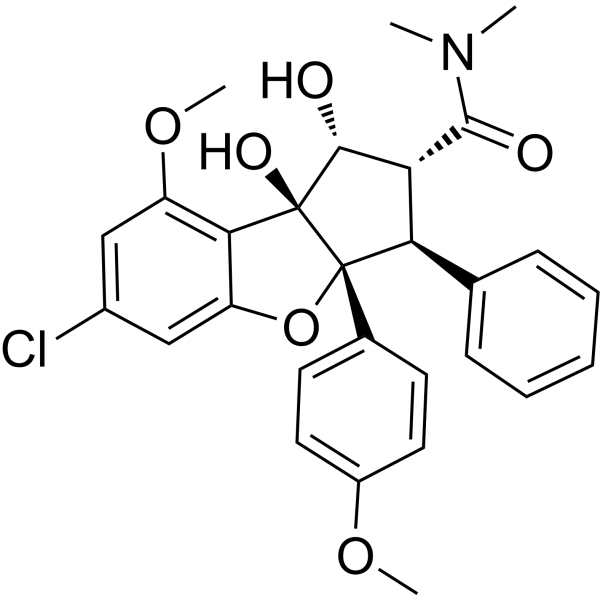
eIF4A-IN-3, Silvestrol (HY-13251) analogue, is an eIF4A inhibitor. eIF4A-IN-3 blocks protein translation initiation by interfering with eIF4F complex assembly, preferentially inhibiting translation of mRNAs with long, highly structured 5'-untranslated regions. eIF4A-IN-3 inhibits proliferation of human breast cancer cells. eIF4A-IN-3 has moderate apical to basolateral permeability in intestinal cell monolayers and a low efflux ratio.
For research use only. We do not sell to patients.
- Purity : 99.92%
- CAS No.: 1402931-85-4
- Formula: C28H28ClNO6
- Molecular Weight:509.98
-
Storage:
4°C, sealed storage, away from moisture and light
* In solvent : -80°C, 6 months; -20°C, 1 month (sealed storage, away from moisture and light)

To place orders, for customer services and technical support, please contact: MedChemExpress USA
Tel: 609-228-6898 E-mail: [email protected] [email protected]


-
 Biological Activity
-
Chemical Information
- Protocols
- Purity & Documentation
- References
-
 Help & FAQs




Biological Activity
Description
IC50 & Target
[1]|
eIF4A |
Cellular Effect
|
Cell Line

|
Type | Value | Description | References |
|---|---|---|---|---|
| MDA-MB-231 | EC50 |
0.4 nM
Compound: 75
|
Growth inhibition of human MDA-MB-231 cells incubated for 72 hrs by MTS assay
Growth inhibition of human MDA-MB-231 cells incubated for 72 hrs by MTS assay
|
[PMID: 23025805] |
| MDA-MB-231 | EC50 |
0.6 nM
Compound: 75
|
Inhibition of eIF4FA in human MDA-MB-231 cells transfected with c-myc- 5'-UTR-luciferase construct assessed as reduction in translation initiation incubated for 24 hrs by differential translation assay
Inhibition of eIF4FA in human MDA-MB-231 cells transfected with c-myc- 5'-UTR-luciferase construct assessed as reduction in translation initiation incubated for 24 hrs by differential translation assay
|
[PMID: 23025805] |
| MDA-MB-231 | EC50 |
15 nM
Compound: 75
|
Inhibition of eIF4FA in human MDA-MB-231 cells transfected with tubulin 5'-UTR-luciferase construct assessed as reduction in translation initiation incubated for 24 hrs by differential translation assay
Inhibition of eIF4FA in human MDA-MB-231 cells transfected with tubulin 5'-UTR-luciferase construct assessed as reduction in translation initiation incubated for 24 hrs by differential translation assay
|
[PMID: 23025805] |
In Vitro
eIF4A-IN-3 (Compound 75) (24 h) potently inhibits translation initiation of mRNAs with highly structured 5′UTRs in MDA-MB-231 human breast cancer cells, with a myc-LUC EC50 of 0.6 nM and tub-LUC EC50 of 15 nM[1].
eIF4A-IN-3 (72 h) potently inhibits the proliferation of MDA-MB-231 human breast cancer cells, with a growth inhibition EC50 of 0.4 nM[1].
eIF4A-IN-3 has moderate permeability across Caco-2 cell monolayers (15.5 × 10⁻⁶ cm/s) and a low efflux ratio of 2.0, indicating minimal interaction with P-glycoprotein[1].
MedChemExpress (MCE) has not independently confirmed the accuracy of these methods. They are for reference only. Further protocols information, click here.


Chemical Information
-
CAS No. 1402931-85-4
-
Appearance Solid
-
Molecular Weight 509.98
-
Formula C28H28ClNO6
-
Color White to off-white
-
SMILES
COC1=CC=C([C@@]23OC4=CC(Cl)=CC(OC)=C4[C@]2(O)[C@@H]([C@@H]([C@H]3C5=CC=CC=C5)C(N(C)C)=O)O)C=C1
-
Shipping
Room temperature in continental US; may vary elsewhere.
-
Storage
4°C, sealed storage, away from moisture and light
* In solvent : -80°C, 6 months; -20°C, 1 month (sealed storage, away from moisture and light)

Protocols
-
Transepithelial/transendothelial electrical resistance assay
TEER measures electrical resistance across epithelial or endothelial monolayers cultured on permeable supports, and the readout reflects ionic conductance through the cell barrier, especially the paracellular pathway regulated by junctional integrity. TEER can be measured without destroying the monolayer and is commonly used before or during transport, permeability, barrier-disruption, and barrier-maturation experiments. TEER values are influenced by biological maturation and technical conditions; reported factors include temperature, medium formulation, passage number, electrode geometry, membrane properties, and junctional length during early monolayer maturation. Therefore, TEER should be interpreted with blank-insert subtraction, area normalization, repeated readings, and, when possible, orthogonal barrier readouts such as FITC-dextran flux or tight-junction staining.
-
Breast Cancer Modeling
Breast cancer is a heterogeneous cancer, and it has been distinguished into four subtypes: luminal A, luminal B, HER2-positive and basal-like. Molecular mutations, epigenetic alterations, hormone exposure and immune microenvironment are related to the progression of breast cancer.
-
Cell Viability Determination by MTT Colorimetric Assay
The following protocol uses the MTT colorimetric assay as a classic literature-established method for assessing cell viability/metabolic activity in cultured mammalian cells. MTT[3-(4,5-dimethylthiazol-2-yl)-2,5-diphenyltetrazolium bromide] is reduced by metabolically active cells to a colored formazan product; the amount of formazan is quantified spectrophotometrically and provides an indirect measure of metabolically active viable cells. Importantly, MTT reduction reflects cellular oxidoreductase/metabolic activity rather than an absolute direct count of living cells, so changes in cellular metabolism can alter the signal independently of cell number.


Purity & Documentation
-
Data Sheet (281 KB)
-
SDS (251 KB)
- English - EN (251 KB)
- Français - FR (251 KB)
- Deutsch - DE (251 KB)
- Norwegian - NO (251 KB)
- Español - ES (251 KB)
- Swedish - SV (251 KB)
- Italian - IT (251 KB)
- Korean - KR (251 KB)
- Portuguese - PT (251 KB)
-
Handling Instructions (2659 KB)
References

Calculators
Concentration (start) × Volume (start) = Concentration (final) × Volume (final)


eIF4A-IN-3 Related Classifications
HY-148447 Related Classifications
 Powered by Bioz