



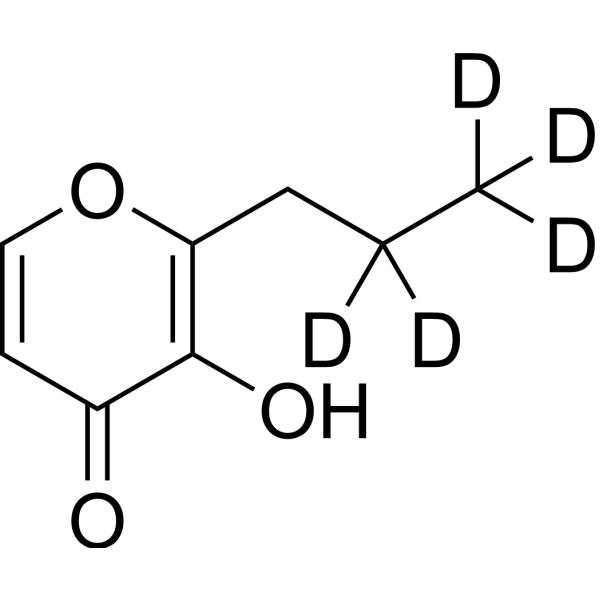
Ethyl maltol-d5

Based on 1 Customer Validation
Ethyl maltol-d5 is the deuterium labeled Ethyl maltol. Ethyl maltol (2-Ethyl-3-hydroxy-4H-pyran-4-one) is an orally active and important food additive and flavor enhancer. Ethyl maltol is less toxic to rats and dogs. Ethyl maltol can enhance copper-mediated cytotoxicity and induce apoptosis in lung epithelial cells.
Para uso exclusivo en investigación. No vendemos a pacientes.
- Pureza : 99.0%
- Fòrmula: C7H3D5O3
- Peso molecular:145.17
-
Almacenamiento:
4°C, stored under nitrogen
* In solvent : -80°C, 6 months; -20°C, 1 month (stored under nitrogen)

To place orders, for customer services and technical support, please contact: MedChemExpress USA
Tel: 609-228-6898 E-mail: [email protected] [email protected]


-
 Actividad biológica
-
Chemical Information
-
Solvente y solubilidad
- Protocolo
- Pureza y Documentación
- Referencias
-
 Help & FAQs




Actividad biológica
Descripciòn
In Vitro
Stable heavy isotopes of hydrogen, carbon, and other elements have been incorporated into drug molecules, largely as tracers for quantitation during the drug development process. Deuteration has gained attention because of its potential to affect the pharmacokinetic and metabolic profiles of drugs[1].
MedChemExpress (MCE) has not independently confirmed the accuracy of these methods. They are for reference only.
Aplicación
1. This compound can be used as a tracer
2. This compound can be used as an internal standard for quantitative analysis by NMR, GC-MS, or LC-MS.


Chemical Information
-
Unlabeled CAS 4940-11-8
-
Appearance Solid
-
Peso molecular 145.17
-
Fòrmula C7H3D5O3
-
Color White to off-white
-
SMILES
O=C1C=COC(C([2H])(C([2H])([2H])[2H])[2H])=C1O
-
Synonyms
2-Ethyl-3-hydroxy-4H-pyran-4-one-d5
-
Envío
Room temperature in continental US; may vary elsewhere.
-
Almacenamiento
4°C, stored under nitrogen
* In solvent : -80°C, 6 months; -20°C, 1 month (stored under nitrogen)


Solvente y solubilidad
In Vitro:
DMSO : 100 mg/mL (688.85 mM; Need ultrasonic; Hygroscopic DMSO has a significant impact on the solubility of product, please use newly opened DMSO)
Please refer to the solubility information to select the appropriate solvent. Once prepared, please aliquot and store the solution to prevent product inactivation from repeated freeze-thaw cycles.
Storage method and period of stock solution: -80°C, 6 months; -20°C, 1 month (stored under nitrogen). When stored at -80°C, please use it within 6 months. When stored at -20°C, please use it within 1 month.
Please refer to the solubility information to select the appropriate solvent. Once prepared, please aliquot and store the solution to prevent product inactivation from repeated freeze-thaw cycles.
Storage method and period of stock solution: -80°C, 6 months; -20°C, 1 month (stored under nitrogen). When stored at -80°C, please use it within 6 months. When stored at -20°C, please use it within 1 month.
Concentration (start) × Volume (start) = Concentration (final) × Volume (final)


Pureza y Documentación
-
Ficha de datos (277 KB)
-
SDS (252 KB)
- English - EN (252 KB)
- Français - FR (252 KB)
- Deutsch - DE (252 KB)
- Norwegian - NO (252 KB)
- Español - ES (252 KB)
- Swedish - SV (252 KB)
- Italian - IT (252 KB)
- Korean - KR (252 KB)
- Portuguese - PT (252 KB)
-
Instrucciones de manejo (2659 KB)
Referencias
[1]. Russak EM, et al. Impact of Deuterium Substitution on the Pharmacokinetics of Pharmaceuticals. Ann Pharmacother. 2019;53(2):211-216. [Content Brief]
[2]. Niu Y, et al. Characterization of odor-active compounds of various cherry wines by gas chromatography-mass spectrometry, gas chromatography-olfactometry and their correlation with sensory attributes. J Chromatogr B Analyt Technol Biomed Life Sci. 2011 Aug 1;879(23):2287-93. [Content Brief]
[3]. Li Z, et al. Toxicity Studies of Ethyl Maltol and Iron Complexes in Mice.Biomed Res Int. 2017;2017:2640619. [Content Brief]


Complete Stock Solution Preparation Table
Please refer to the solubility information to select the appropriate solvent. Once prepared, please aliquot and store the solution to prevent product inactivation from repeated freeze-thaw cycles.
Storage method and period of stock solution: -80°C, 6 months; -20°C, 1 month (stored under nitrogen). When stored at -80°C, please use it within 6 months. When stored at -20°C, please use it within 1 month.
| Optional Solvent | Concentration Solvent Mass | 1 mg | 5 mg | 10 mg | 25 mg |
|---|---|---|---|---|---|
| DMSO | 1 mM | 6.8885 mL | 34.4424 mL | 68.8848 mL | 172.2119 mL |
| 5 mM | 1.3777 mL | 6.8885 mL | 13.7770 mL | 34.4424 mL | |
| 10 mM | 0.6888 mL | 3.4442 mL | 6.8885 mL | 17.2212 mL | |
| 15 mM | 0.4592 mL | 2.2962 mL | 4.5923 mL | 11.4808 mL | |
| 20 mM | 0.3444 mL | 1.7221 mL | 3.4442 mL | 8.6106 mL | |
| 25 mM | 0.2755 mL | 1.3777 mL | 2.7554 mL | 6.8885 mL | |
| 30 mM | 0.2296 mL | 1.1481 mL | 2.2962 mL | 5.7404 mL | |
| 40 mM | 0.1722 mL | 0.8611 mL | 1.7221 mL | 4.3053 mL | |
| 50 mM | 0.1378 mL | 0.6888 mL | 1.3777 mL | 3.4442 mL | |
| 60 mM | 0.1148 mL | 0.5740 mL | 1.1481 mL | 2.8702 mL | |
| 80 mM | 0.0861 mL | 0.4305 mL | 0.8611 mL | 2.1526 mL | |
| 100 mM | 0.0689 mL | 0.3444 mL | 0.6888 mL | 1.7221 mL |


Ethyl maltol-d5 Related Classifications
HY-W010320S Related Classifications
 Powered by Bioz