



F15845
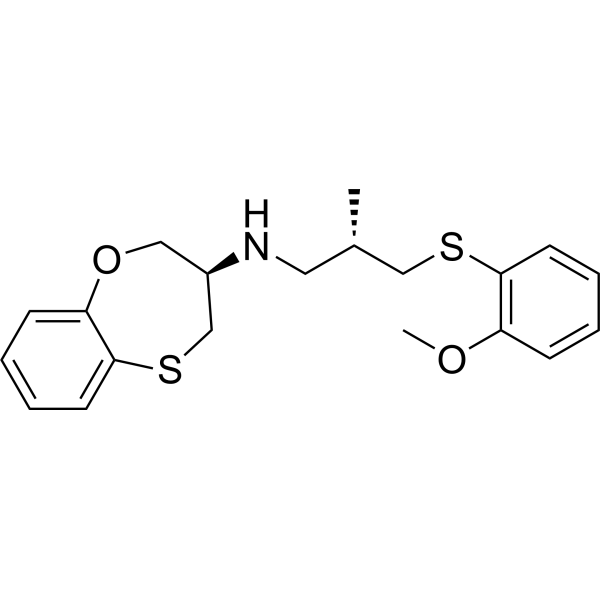
F 15845 is a highly effective persistent sodium current blocker. F 15845 also is a cardioprotective agent, has anti-ischemic activity and exerts short- and long-term cardioprotection after myocardial infarction. F 15845 can be used for the research of myocardium functional impairment.
Nos produits utilisent uniquement pour la recherche. Nous ne vendons pas aux patients.
- CAS No.: 470454-73-0
- Formule: C20H25NO2S2
- Masse moléculaire:375.55
-
Stockage:
Please store the product under the recommended conditions in the Certificate of Analysis.

To place orders, for customer services and technical support, please contact: MedChemExpress USA
Tel: 609-228-6898 E-mail: [email protected] [email protected]


-
 Activité biologique
-
Chemical Information
- Protocole
- Pureté et documentation
- Références
-
 Help & FAQs




Activité biologique
Description
In Vitro
F 15845 (10 nM-10 μM) concentration-dependently reduces veratrine-induced diastolic contracture with an IC50 value of 0.14 μM in isolated atria[1].
F 15845 (0.1-10 μM) preserves viability in isolated cardiomyocytes exposed to lysophosphatidylcholine (LPC)[1].
F 15845 (0.3 μM) significantly counteracts [Na+] increase during no-flow ischemia[1].
F 15845 (0.3 μM, 0-35 min) delays the reduction in [Na+], but marks and maintains upon reperfusion[1].
MedChemExpress (MCE) has not independently confirmed the accuracy of these methods. They are for reference only.
In Vivo
MedChemExpress (MCE) has not independently confirmed the accuracy of these methods. They are for reference only.
-
Animal Model:Rat[1]
-
Dosage:2.5 mg/kg, 5 mg/kg
-
Administration:intravenously
-
Result:Significantly reduced infarct size, decreased of troponin I levels and limited the long-term expansion of infarct size.


Chemical Information
-
CAS No. 470454-73-0
-
Masse moléculaire 375.55
-
Formule C20H25NO2S2
-
SMILES
COC(C=CC=C1)=C1SC[C@@H](C)CN[C@@H]2COC3=CC=CC=C3SC2
-
Livraison
Room temperature in continental US; may vary elsewhere.
-
Stockage
Please store the product under the recommended conditions in the Certificate of Analysis.


Pureté et documentation
Références

Calculators
Concentration (start) × Volume (start) = Concentration (final) × Volume (final)


F15845 Related Classifications
HY-19463A Related Classifications
 Powered by Bioz