



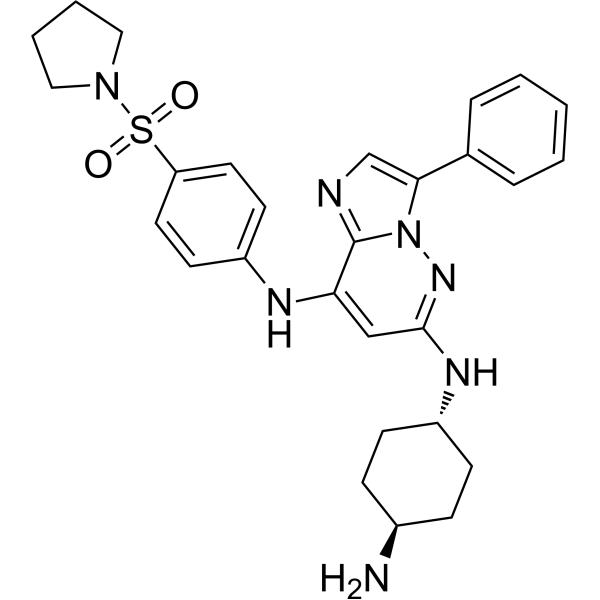
FLT3-IN-20
FLT3-IN-20 (compound 34f) is a potent FLT3 inhibitor with IC50 values of 1 and 4 nM for FLT3-D835Y and FLT3-ITD, respectively. FLT3-IN-20 has anti-proliferation efficacy in FLT3-ITD-positive AML cell lines MV4-11 and MOLM-13 (7 and 9 nM, respectively) and the MOLM-13 variant (4 nM) with the FLT3-ITD-D835Y mutation. FLT3-IN-20 can be used in research of cancer.
Nur für Forschungszwecke. Wir verkaufen nicht an Patienten.
- Formel: C28H33N7O2S
- Molecular Weight:531.67
-
Speicherung:
Please store the product under the recommended conditions in the Certificate of Analysis.

To place orders, for customer services and technical support, please contact: MedChemExpress USA
Tel: 609-228-6898 E-mail: [email protected] [email protected]


-
 Biologische Aktivität
-
Chemical Information
- Protokoll
- Reinheit & Dokumentation
- Verweise
-
 Help & FAQs




Biologische Aktivität
Beschreibung
Cellular Effect
|
Cell Line

|
Type | Value | Description | References |
|---|---|---|---|---|
| CCRF-CEM | GI50 |
1.768 μM
Compound: 34f
|
Antiproliferative activity against FLT3-independent human CEM cells assessed as cell growth inhibition by resorufin dye based fluorescence analysis
Antiproliferative activity against FLT3-independent human CEM cells assessed as cell growth inhibition by resorufin dye based fluorescence analysis
|
[PMID: 37535845] |
| K562 | GI50 |
1.525 μM
Compound: 34f
|
Antiproliferative activity against FLT3-independent human K562 cells assessed as cell growth inhibition by resorufin dye based fluorescence analysis
Antiproliferative activity against FLT3-independent human K562 cells assessed as cell growth inhibition by resorufin dye based fluorescence analysis
|
[PMID: 37535845] |
| Kasumi 1 | GI50 |
0.188 μM
Compound: 34f
|
Antiproliferative activity against human Kasumi 1 cells harboring KIT N822K mutant assessed as cell growth inhibition by resorufin dye based fluorescence analysis
Antiproliferative activity against human Kasumi 1 cells harboring KIT N822K mutant assessed as cell growth inhibition by resorufin dye based fluorescence analysis
|
[PMID: 37535845] |
| ML-2 | GI50 |
3.03 μM
Compound: 34f
|
Antiproliferative activity against FLT3-independent human ML-2 cells assessed as cell growth inhibition by resorufin dye based fluorescence analysis
Antiproliferative activity against FLT3-independent human ML-2 cells assessed as cell growth inhibition by resorufin dye based fluorescence analysis
|
[PMID: 37535845] |
| MOLM-13 | GI50 |
0.004 μM
Compound: 34f
|
Antiproliferative activity against drug-resistant human MOLM-13 cells expressing FLT3-ITD-D835Y mutant assessed as cell growth inhibition incubated for 72 hrs by resorufin dye based fluorescence analysis
Antiproliferative activity against drug-resistant human MOLM-13 cells expressing FLT3-ITD-D835Y mutant assessed as cell growth inhibition incubated for 72 hrs by resorufin dye based fluorescence analysis
|
[PMID: 37535845] |
| MOLM-13 | GI50 |
0.009 μM
Compound: 34f
|
Antiproliferative activity against human MOLM-13 cells harboring FLT3-ITD mutant assessed as cell growth inhibition by resorufin dye based fluorescence analysis
Antiproliferative activity against human MOLM-13 cells harboring FLT3-ITD mutant assessed as cell growth inhibition by resorufin dye based fluorescence analysis
|
[PMID: 37535845] |
| MOLM-13 | GI50 |
0.01 μM
Compound: 34f
|
Antiproliferative activity against FLT3-dependent human MOLM-13 cells assessed as cell growth inhibition incubated for 72 hrs by resorufin dye based fluorescence analysis
Antiproliferative activity against FLT3-dependent human MOLM-13 cells assessed as cell growth inhibition incubated for 72 hrs by resorufin dye based fluorescence analysis
|
[PMID: 37535845] |
| MV4-11 | GI50 |
0.007 μM
Compound: 34f
|
Antiproliferative activity against human MV4-11 cells harboring FLT3-ITD mutant assessed as cell growth inhibition by resorufin dye based fluorescence analysis
Antiproliferative activity against human MV4-11 cells harboring FLT3-ITD mutant assessed as cell growth inhibition by resorufin dye based fluorescence analysis
|
[PMID: 37535845] |
| NOMO-1 | GI50 |
4.275 μM
Compound: 34f
|
Antiproliferative activity against FLT3-independent human NOMO-1 cells assessed as cell growth inhibition by resorufin dye based fluorescence analysis
Antiproliferative activity against FLT3-independent human NOMO-1 cells assessed as cell growth inhibition by resorufin dye based fluorescence analysis
|
[PMID: 37535845] |
| SEM | GI50 |
0.14 μM
Compound: 34f
|
Antiproliferative activity against human SEM cells overexpressing wild type FLT3 assessed as cell growth inhibition by resorufin dye based fluorescence analysis
Antiproliferative activity against human SEM cells overexpressing wild type FLT3 assessed as cell growth inhibition by resorufin dye based fluorescence analysis
|
[PMID: 37535845] |


Chemical Information
-
Molecular Weight 531.67
-
Formel C28H33N7O2S
-
SMILES
O=S(C1=CC=C(NC2=CC(N[C@@H]3CC[C@@H](N)CC3)=NN4C2=NC=C4C5=CC=CC=C5)C=C1)(N6CCCC6)=O
-
Versand
Room temperature in continental US; may vary elsewhere.
-
Speicherung
Please store the product under the recommended conditions in the Certificate of Analysis.


Reinheit & Dokumentation
Verweise

Calculators
Konzentration (Stammlösung) × Volumen (Stammlösung) = Konzentration (Ziellösung) × Volumen (Ziellösung)


FLT3-IN-20 Related Classifications
HY-155770 Related Classifications
 Powered by Bioz