



Fontolizumab

Based on 1 Customer Validation
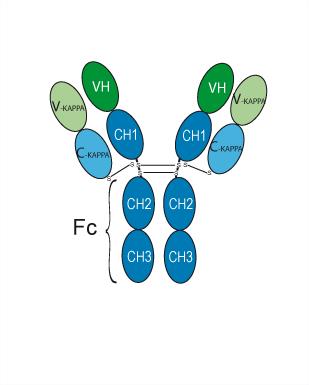
Fontolizumab (HuZAF) is a human monoclonal antibody targeting interferon γ (IFN-γ). Fontolizumab binds specifically and with high affinity to secreted IFN-γ, neutralizes its activity, blocks receptor binding, and inhibits downstream signal transduction and the expression of IFNγ-responsive genes. Fontolizumab reduces serum C-reactive protein levels, inhibits the expression of IL-1α, IL-1β and IL-12Rβ2, and decreases the number of IFNγ-producing T cells in activated peripheral blood mononuclear cells. Fontolizumab can be used in research related to Crohn's disease.
For research use only. We do not sell to patients.
- Purity : 97.18%
- CAS No.: 326859-36-3
- Molecular Weight:144.8 kDa
-
Storage:
Please store the product under the recommended conditions in the Certificate of Analysis.


To place orders, for customer services and technical support, please contact: MedChemExpress USA
Tel: 609-228-6898 E-mail: [email protected] [email protected]


-
 Biological Activity
-
Chemical Information
- Protocols
- Purity & Documentation
- References
-
 Help & FAQs







Biological Activity
Description
Isotype
Human IgG1 kappa
Recommend Isotype Controls
Species Reactivity
Human
|
IFN-γ |
In Vitro
Fontolizumab (100 μg/mL; 24 h) suppresses IFNγ-associated gene and protein expression in activated human PBMCs, with a 7.0-fold reduction in IFNG mRNA and ~30% reduction in IFNγ-producing CD3+ T cells, while not significantly affecting T-cell activation or viability[5].
MedChemExpress (MCE) has not independently confirmed the accuracy of these methods. They are for reference only. Further protocols information, click here.
Clinical Trial
| NCT Number | Sponsor | Condition | Start Date |
Phase

|
|---|---|---|---|---|
| NCT01329991 | Plexxikon| | 2011-05 | PHASE1 |
Gene ID
Accession
Conjugated
Unconjugated
Reconsititution
The product can be reconstituted/diluted with sterile PBS or saline.
Format
-
Human IgG1 kappa
Application
ELISA, FACS, Functional assay


Chemical Information
-
CAS No. 326859-36-3
-
Appearance Liquid
-
Molecular Weight 144.8 kDa
-
Color Colorless to light yellow
-
SMILES
[Fontolizumab]
-
Synonyms
HuZAF; Anti-Human IFNG Recombinant Antibody
-
Shipping
Shipping with dry ice.
-
Formulation
Please refer to the lot-specific COA for specific buffer information.
-
Storage
Please store the product under the recommended conditions in the Certificate of Analysis.

Protocols
-
RNA extraction experimental
By lysing cells, releasing RNA, and removing impurities such as proteins and DNA, high-purity RNA products are finally obtained. The commonly used traditional method is the guanidine isothiocyanate/phenol/chloroform method (Trizol), which is suitable for a variety of animal materials including animal tissues, microorganisms, cultured cells, etc., and most plant materials.
-
PBMC Thawing for Immune Assays
PBMC thawing for immune assays recovers viable cryopreserved peripheral blood mononuclear cells for downstream functional or phenotypic readouts, including ELISPOT, intracellular cytokine staining, proliferation assays, and flow-cytometric immunophenotyping. Cryopreserved PBMCs can support immune monitoring because antigen-specific T-cell function and major CD4/CD8 phenotypes may be retained after optimized freezing and thawing, although some lymphocyte subsets and activation or memory markers can be altered by cryopreservation. The technical objective is rapid warming of the frozen vial followed by controlled dilution and removal of DMSO-containing cryomedium, because thawing and wash conditions measurably affect viable PBMC recovery and downstream assay performance. Viability alone is insufficient for protocol evaluation because high viability may occur with low live-cell recovery, so both viable percentage and absolute live-cell recovery should be measured after thawing.
-
Pyroptosis Solutions
Pyroptosis is a lytic inflammatory cell-death pathway executed by gasdermin pores, most classically through inflammasome-mediated activation of caspase-1, cleavage of gasdermin D, membrane pore formation, LDH release, and secretion of IL-1β and IL-18. The canonical pathway is commonly modeled by priming cells with an inflammatory signal such as LPS to induce pro-IL-1β and inflammasome components, followed by an activation signal such as ATP or nigericin to activate NLRP3, ASC speck formation, caspase-1 cleavage, GSDMD cleavage, cytokine release, and pyroptotic membrane rupture. The non-canonical pathway is triggered when cytosolic LPS activates mouse caspase-11 or human caspase-4/5, leading to GSDMD cleavage and pyroptosis, and this can secondarily activate NLRP3-dependent IL-1β release. Pyroptosis is linked to inflammatory injury, infection, cancer, liver disease, ocular disease, placental inflammation, and other disease phenotypes, but unresolved questions include which gasdermin fam


Purity & Documentation
-
Data Sheet (260 KB)
-
SDS (251 KB)
- English - EN (251 KB)
- Français - FR (251 KB)
- Deutsch - DE (251 KB)
- Norwegian - NO (251 KB)
- Español - ES (251 KB)
- Swedish - SV (251 KB)
- Italian - IT (251 KB)
- Korean - KR (251 KB)
- Portuguese - PT (251 KB)
-
Inhibitory Antibodies User Guide (603 KB)
References
[1]. Hommes DW, et al. Fontolizumab, a humanised anti-interferon gamma antibody, demonstrates safety and clinical activity in patients with moderate to severe Crohn's disease. Gut. 2006 Aug;55(8):1131-7. [Content Brief]
[2]. Reinisch W, et al. A dose escalating, placebo controlled, double blind, single dose and multidose, safety and tolerability study of fontolizumab, a humanised anti-interferon gamma antibody, in patients with moderate to severe Crohn's disease. Gut. 2006 Aug;55(8):1138-44. [Content Brief]
[3]. Reinisch W, et al. Fontolizumab in moderate to severe Crohn's disease: a phase 2, randomized, double-blind, placebo-controlled, multiple-dose study. Inflammatory bowel diseases. 2010 Feb;16(2):233-42. [Content Brief]
[5]. Haider AS, et al. Insights into gene modulation by therapeutic TNF and IFNgamma antibodies: TNF regulates IFNgamma production by T cells and TNF-regulated genes linked to psoriasis transcriptome. The Journal of investigative dermatology. 2008 Mar;128(3):655-66. [Content Brief]

Calculators
Concentration (start) × Volume (start) = Concentration (final) × Volume (final)


Fontolizumab Related Classifications
HY-P99292 Related Classifications
 Powered by Bioz