



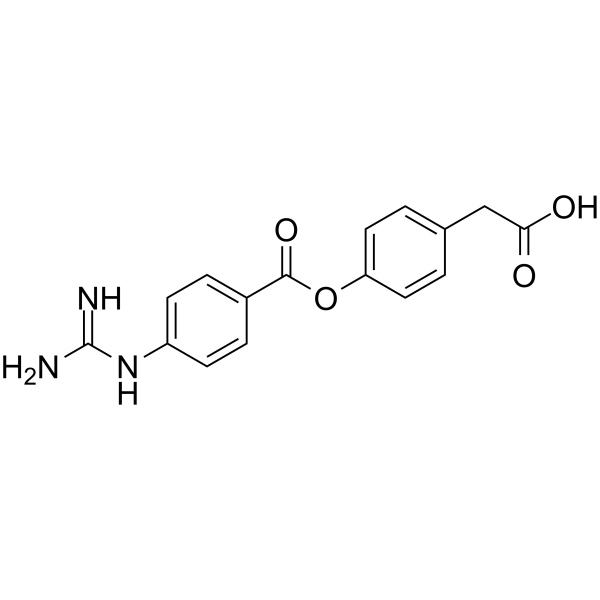
FOY 251 free base
Based on 2 publication(s) in Google Scholar
FOY 251 free base, an anti-proteolytic active metabolite of Camostate (HY-13512), acts as a proteinase inhibitor. FOY 25 free base inhibits SARS-CoV-2 infection in cells assay.
For research use only. We do not sell to patients.
- CAS No.: 71079-08-8
- Formula: C16H15N3O4
- Molecular Weight:313.31
-
Storage:
Please store the product under the recommended conditions in the Certificate of Analysis.

To place orders, for customer services and technical support, please contact: MedChemExpress USA
Tel: 609-228-6898 E-mail: [email protected] [email protected]


-
 Biological Activity
-
Chemical Information
- Protocols
- Purity & Documentation
- References
-
 Help & FAQs




Publications Citing Use of MedChemExpress (MCE) FOY 251 free base
More

Biological Activity
Description
IC50 & Target
Proteinase[1]
In Vitro


Chemical Information
-
CAS No. 71079-08-8
-
Molecular Weight 313.31
-
Formula C16H15N3O4
-
SMILES
O=C(O)CC1=CC=C(OC(C2=CC=C(NC(N)=N)C=C2)=O)C=C1
-
Shipping
Room temperature in continental US; may vary elsewhere.
-
Storage
Please store the product under the recommended conditions in the Certificate of Analysis.


Publications (2)
-
Journal Impact Factor
-
Most Recent
-
Nucleic Acids Res
COVID19 Drug Repository: text-mining the literature in search of putative COVID19 therapeutics. [Abstract]2021 Jan 8;49(D1):D1113-D1121. PMID: 33166390 -
Res Sq
An orally available Mpro/TMPRSS2 bispecific inhibitor with potent anti-coronavirus efficacy in vivo. [Abstract]2024 Nov 21:rs.3.rs-5454588. PMID: 39606435


Purity & Documentation
References
[1]. K Beckh, et al. Elimination of the Low-Molecular Weight Proteinase Inhibitor Camostate (FOY 305) and Its Degradation Products by the Rat Liver. Res Exp Med (Berl). 1987;187(6):401-6. [Content Brief]
[2]. Ai Maekawa, et al. Camostat Mesilate Inhibits Prostasin Activity and Reduces Blood Pressure and Renal Injury in Salt-Sensitive Hypertension. J Hypertens . 2009 Jan;27(1):181-9. [Content Brief]
[3]. Markus Hoffmann, et al. Camostat mesylate inhibits SARS-CoV-2 activation by TMPRSS2-related proteases and its metabolite GBPA exerts antiviral activity. bioRxiv. 2020 Aug 5;2020.08.05.237651. [Content Brief]

Calculators
Concentration (start) × Volume (start) = Concentration (final) × Volume (final)


FOY 251 free base Related Classifications
HY-19727 Related Classifications
 Powered by Bioz