



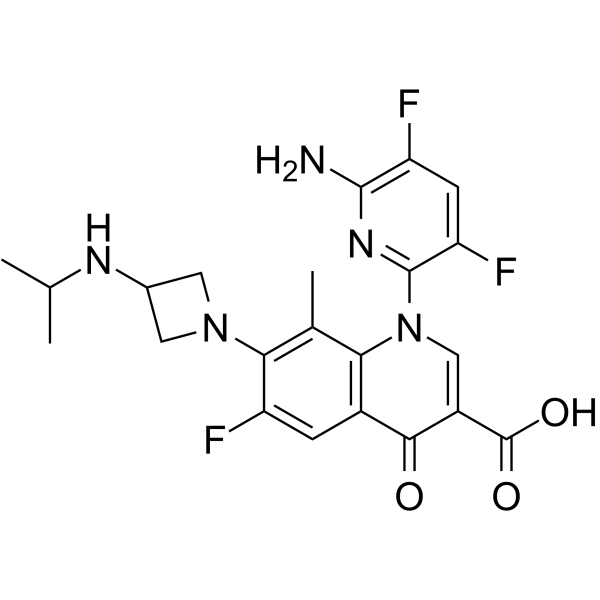
WQ3810
WQ3810 is an orally active fluoroquinolone, with potent antibacterial activities.
Para uso exclusivo en investigación. No vendemos a pacientes.
- No. CAS: 888032-58-4
- Fòrmula: C22H22F3N5O3
- Peso molecular:461.44
-
Almacenamiento:
Please store the product under the recommended conditions in the Certificate of Analysis.

To place orders, for customer services and technical support, please contact: MedChemExpress USA
Tel: 609-228-6898 E-mail: [email protected] [email protected]


-
 Actividad biológica
-
Chemical Information
- Protocolo
- Pureza y Documentación
- Referencias
-
 Help & FAQs




Actividad biológica
Descripciòn
In Vitro
WQ-3810 shows potent activity against A. baumannii, including MDR isolates, with MIC90 of 1 mg/L, more than eight-fold higher than that of ciprofloxacin (64 mg/L) and levofloxacin (8 mg/L). WQ-3810 also exhibits inhibitory effects on E. coli and S. pneumoniae, including FQR isolates, with MIC90 of 4 mg/L and 0.06 mg/L, respectively. WQ-3810 is the most potent among the fluoroquinolones tested against meticillin-resistant Staphylococcus aureus (MRSA) and Neisseria gonorrhoeae, including FQR isolates[1].
MedChemExpress (MCE) has not independently confirmed the accuracy of these methods. They are for reference only.


Chemical Information
-
No. CAS 888032-58-4
-
Peso molecular 461.44
-
Fòrmula C22H22F3N5O3
-
SMILES
O=C(C1=CN(C2=NC(N)=C(F)C=C2F)C3=C(C=C(F)C(N4CC(NC(C)C)C4)=C3C)C1=O)O
-
Synonyms
KPI-10 free base
-
Envío
Room temperature in continental US; may vary elsewhere.
-
Almacenamiento
Please store the product under the recommended conditions in the Certificate of Analysis.


Pureza y Documentación
Referencias

Calculators
Concentration (start) × Volume (start) = Concentration (final) × Volume (final)


WQ3810 Related Classifications
HY-U00389 Related Classifications
 Powered by Bioz