



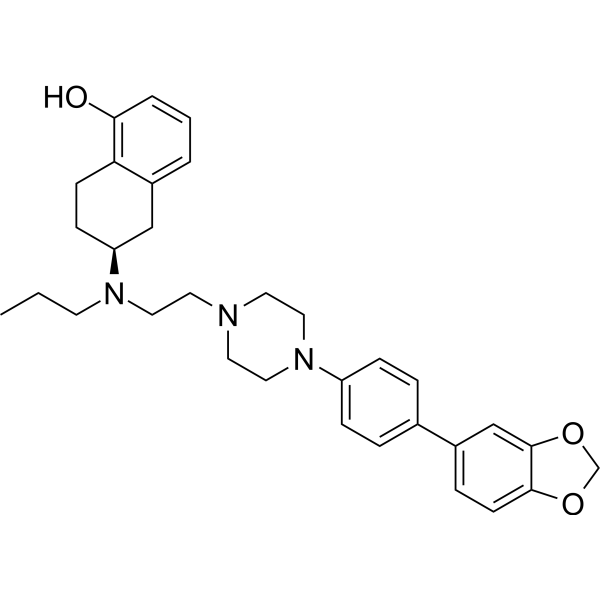
D-685
D-685, a prodrug of D-520, exhibits higher in vivo anti-Parkinsonian efficacy in a reserpinized Parkinson's disease (PD) animal model than the parent D-520. D-685 reduces accumulation of human α-synuclein (α-syn) protein. D-685 exhibits facile brain penetration.
Para uso exclusivo en investigación. No vendemos a pacientes.
- No. CAS: 2893801-00-6
- Fòrmula: C32H39N3O3
- Peso molecular:513.67
-
Almacenamiento:
Please store the product under the recommended conditions in the Certificate of Analysis.

To place orders, for customer services and technical support, please contact: MedChemExpress USA
Tel: 609-228-6898 E-mail: [email protected] [email protected]


-
 Actividad biológica
-
Chemical Information
- Protocolo
- Pureza y Documentación
- Referencias
-
 Help & FAQs


Ver todos los productos específicos de isoformas α-synuclein
More

Actividad biológica
Descripciòn
IC50 & Target
|
α-synuclein Aggregation |
In Vivo
D-685 (10 μmol/kg; ip) is not only highly efficacious in reversing akinesia in male and female Sprague-Dawley rats weighing 220-225 g, compared to Reserpine (HY-N0480; 5.0 mg/kg; SC) alone, but also demonstrates significant enhancement of locomotion for the entire duration of the 6 h study[1].
D-685 exhibits facile penetration into the brain under ip administration with a high brain-to-plasma ratio (B/P: 4)[1].
MedChemExpress (MCE) has not independently confirmed the accuracy of these methods. They are for reference only.
-
Animal Model:Five-month-old D-Line α-syn tg Balb/c female mice 20-22 g[1]
-
Dosage:12 mg/kg
-
Administration:Intraperitoneally daily for 1 month
-
Result:Caused a significant reduction in α-syn accumulation in the neocortex and the striatum and a trend toward a reduction in the CA3 region of the hippocampus.
There was a significant reduction in phospho-α-syn accumulation in all regions examined.


Chemical Information
-
No. CAS 2893801-00-6
-
Peso molecular 513.67
-
Fòrmula C32H39N3O3
-
SMILES
OC1=C2CC[C@H](N(CCN3CCN(C4=CC=C(C5=CC=C(OCO6)C6=C5)C=C4)CC3)CCC)CC2=CC=C1
-
Envío
Room temperature in continental US; may vary elsewhere.
-
Almacenamiento
Please store the product under the recommended conditions in the Certificate of Analysis.


Pureza y Documentación
Referencias

Calculators
Concentration (start) × Volume (start) = Concentration (final) × Volume (final)


D-685 Related Classifications
HY-149065 Related Classifications
 Powered by Bioz