



Thunalbene
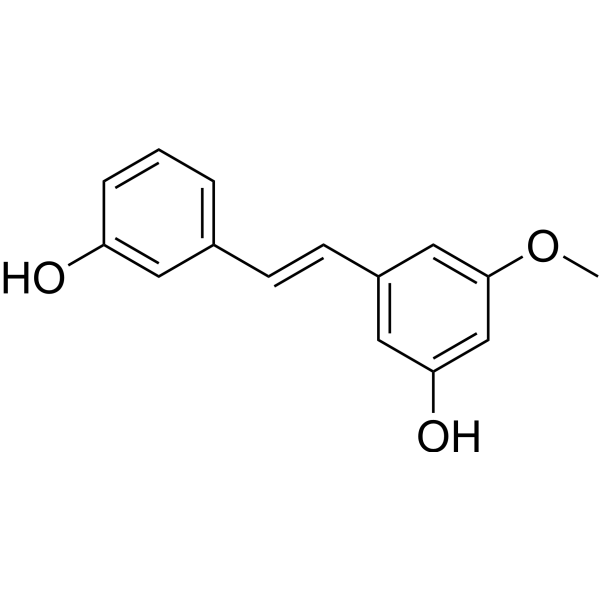
Thunalbene is a stilbene derivative isolated from Thunia alba. Thunalbene has a weak inhibitory effect on nitric oxide production and is not cytotoxic.
Para uso exclusivo en investigación. No vendemos a pacientes.
- No. CAS: 220862-05-5
- Fòrmula: C15H14O3
- Peso molecular:242.27
-
Almacenamiento:
Please store the product under the recommended conditions in the Certificate of Analysis.

To place orders, for customer services and technical support, please contact: MedChemExpress USA
Tel: 609-228-6898 E-mail: [email protected] [email protected]


-
 Actividad biológica
-
Chemical Information
- Protocolo
- Pureza y Documentación
- Referencias
-
 Help & FAQs




Actividad biológica
Descripciòn
In Vitro
Thunalbene (1 or 10 μM) produces a value of 92.92 for NO at a concentration of 1μM and 75.08 for NO at a concentration of 10 μM with no cytotoxicity in lipopolysaccharide (LPS)-stimulated RAW 264.7 macrophages[1].
MedChemExpress (MCE) has not independently confirmed the accuracy of these methods. They are for reference only. Further protocols information, click here.


Chemical Information
-
No. CAS 220862-05-5
-
Peso molecular 242.27
-
Fòrmula C15H14O3
-
SMILES
OC1=CC(OC)=CC(/C=C/C2=CC=CC(O)=C2)=C1
-
Structure Classification
-
Initial Source
-
Envío
Room temperature in continental US; may vary elsewhere.
-
Almacenamiento
Please store the product under the recommended conditions in the Certificate of Analysis.

Protocolo
-
Cell Viability Determination by MTT Colorimetric Assay
The following protocol uses the MTT colorimetric assay as a classic literature-established method for assessing cell viability/metabolic activity in cultured mammalian cells. MTT[3-(4,5-dimethylthiazol-2-yl)-2,5-diphenyltetrazolium bromide] is reduced by metabolically active cells to a colored formazan product; the amount of formazan is quantified spectrophotometrically and provides an indirect measure of metabolically active viable cells. Importantly, MTT reduction reflects cellular oxidoreductase/metabolic activity rather than an absolute direct count of living cells, so changes in cellular metabolism can alter the signal independently of cell number.


Pureza y Documentación
Referencias

Calculators
Concentration (start) × Volume (start) = Concentration (final) × Volume (final)


Thunalbene Related Classifications
HY-116885 Related Classifications
 Powered by Bioz