



Glucose-6-phosphate dehydrogenase, Bacillus sp.

Based on 1 Customer Validation
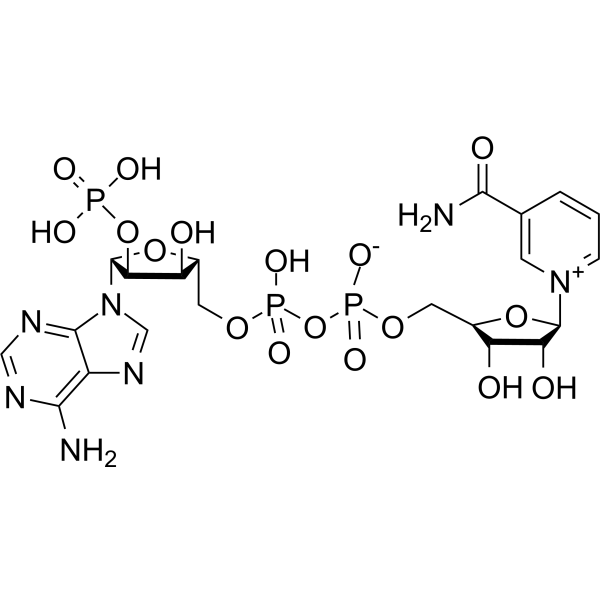
Glucose-6-phosphate dehydrogenase, Bacillus sp. (G6PD, Bacillus sp.) (EC 1.1.1.49) is an NADP-dependent antioxidant metabolic enzyme. Glucose-6-phosphate dehydrogenase, Bacillus sp. is induced by sublethal doses of Menadione (HY-B0332) and increasing concentrations of NaCl in Bacillus sp. F26. Glucose-6-phosphate dehydrogenase, Bacillus sp. catalyzes the oxidation of glucose-6-phosphate (G6P) to 6-phosphoglucono-δ-lactone, while reducing NADP+ to NADPH, providing reducing power for the antioxidant defense system and cellular redox balance of Bacillus sp. F26. Glucose-6-phosphate dehydrogenase, Bacillus sp. is used in research related to diabetic complications.
For research use only. We do not sell to patients.
- CAS No.: 9001-40-5
-
Storage:
Please store the product under the recommended conditions in the Certificate of Analysis.


To place orders, for customer services and technical support, please contact: MedChemExpress USA
Tel: 609-228-6898 E-mail: [email protected] [email protected]


-
 Biological Activity
-
Chemical Information
- Protocols
- Purity & Documentation
- References
-
 Help & FAQs


-
HY-113325
NADPRedox Coenzyme -
HY-B2176
ATPEndogenous Metabolite -
HY-125863
Glucose-6-phosphate dehydrogenase, MicroorganismEndogenous Metabolite -

HY-P2776A
Hexokinase, YeastHexokinase -

HY-P2761
GlucokinaseBiochemical Reagent -

HY-125863B
Glucose 6-phosphate dehydrogenase (yeast, recombinant)Recombinant Enzyme -
HY-P2902
Glucose oxidaseOxidoreductase Enzyme -

HY-125863A
Glucose-6-phosphate dehydrogenase (Leuconostoc sp., recombinant)Endogenous Metabolite -
HY-P2802
α-Glucosidase, YeastCarbohydrate Hydrolyzing Enzyme -
HY-P2733
Glycerol-3-phosphate oxidase, E. coliOxidase -

HY-P3186A
NAD-dependent Glucose dehydrogenaseDehydrogenase -
HY-135849
Catalase, Aspergillus nigerAntioxidant Enzyme


Biological Activity
Description
In Vitro
Glucose-6-phosphate dehydrogenase from Bacillus sp. is induced approximately 2-fold in log-phase Bacillus sp. F26 cells pretreated with Menadione (HY-B0332), reaching 24.89 U mg protein-1, whereas pretreatment with 600 μM H2O2 has little effect on G6PD activity[3].
Glucose-6-phosphate dehydrogenase, Bacillus sp. activity is progressively induced during exponential growth of Bacillus sp. F26 cells in medium with stepwise increasing NaCl concentrations[3].
MedChemExpress (MCE) has not independently confirmed the accuracy of these methods. They are for reference only. Further protocols information, click here.
Clinical Trial
| NCT Number | Sponsor | Condition | Start Date |
Phase

|
|---|---|---|---|---|
| NCT01329991 | Plexxikon| | 2011-05 | PHASE1 |


Chemical Information
-
CAS No. 9001-40-5
-
Appearance Solid
-
Color White to off-white
-
SMILES
[Glucose-6-phosphate dehydrogenase, Bacillus sp.]
-
Synonyms
G6PD, Bacillus sp.
-
Shipping
Room temperature in continental US; may vary elsewhere.
-
Storage
Please store the product under the recommended conditions in the Certificate of Analysis.

Protocols
-
ROS/oxidative-stress fluorescent staining
ROS/oxidative-stress fluorescent staining uses cell-permeant fluorogenic probes that become fluorescent after oxidation inside cells or tissues; commonly used examples include DCFH-DA/DCFDA for broad cellular oxidant detection, DHE for superoxide-related signal detection, MitoSOX for mitochondrial superoxide-related signal detection, and CellROX probes for oxidative-stress-associated fluorescence readouts. The assay detects probe oxidation rather than a single ROS species unless the probe and analysis method have been chemically validated for that species. DCFH-DA enters cells, is deacetylated by intracellular esterases to DCFH, and produces fluorescent DCF after oxidation, so the readout is used as an operational measure of total cellular oxidative stress rather than a species-specific ROS measurement. DHE and MitoSOX can report superoxide-related oxidation, but red fluorescence alone can include non-specific ethidium-like oxidation products; HPLC or optimized spectral approaches are


Purity & Documentation
-
Data Sheet (268 KB)
-
SDS (251 KB)
- English - EN (251 KB)
- Français - FR (251 KB)
- Deutsch - DE (251 KB)
- Norwegian - NO (251 KB)
- Español - ES (251 KB)
- Swedish - SV (251 KB)
- Italian - IT (251 KB)
- Korean - KR (251 KB)
- Portuguese - PT (251 KB)
-
Handling Instructions (2659 KB)
References

Calculators
Concentration (start) × Volume (start) = Concentration (final) × Volume (final)


Glucose-6-phosphate dehydrogenase, Bacillus sp. Related Classifications
HY-125863C Related Classifications
 Powered by Bioz