



(Gly14)-Humanin (human)
Based on 1 publication(s) in Google Scholar
(Gly14)-Humanin (human) (14-Glycine-Humanin (human)) is an analog of Humanin in which the 14th amino acid serine was replaced with glycine (Gly). (Gly14)-Humanin (human) has anti-apoptotic and neuroprotective functions.
Nur für Forschungszwecke. Wir verkaufen nicht an Patienten.
- Reinheit : 95.39%
- CAS. Nr.: 330936-70-4
- Formel: C118H202N34O31S2
- Molecular Weight:2657.21
-
Speicherung:
Sealed storage, away from moisture.
Powder -80°C, 2 years , -20°C, 1 year* In solvent : -80°C, 6 months; -20°C, 1 month (sealed storage, away from moisture)

To place orders, for customer services and technical support, please contact: MedChemExpress USA
Tel: 609-228-6898 E-mail: [email protected] [email protected]


-
 Biologische Aktivität
-
Chemical Information
- Protokoll
- Reinheit & Dokumentation
- Verweise
-
 Help & FAQs


Publications Citing Use of MedChemExpress (MCE) (Gly14)-Humanin (human)
More

Biologische Aktivität
Beschreibung
In Vitro
(Gly14)-Humanin (human) (0.1-10 μM; 72 hours) significantly increases cell viability, reduced nuclear fluorescence of HUVECs, the levels of cleaved PARP, ROS formation and the ratio of bax/bcl-2 compared with treatment with high glucose (HG) for 72h. And reduces mRNA level of bax and increases mRNA level of bcl-2[1].
MedChemExpress (MCE) has not independently confirmed the accuracy of these methods. They are for reference only. Further protocols information, click here.
-
Cell Line:Human umbilical vein endothelial cells (HUVECs)
-
Concentration:100 nM, 1 μM and 10 μM
-
Incubation Time:Pretreatment 3 hours and then treated with 72 hours
-
Result:Significantly increased cell viability.
-
Cell Line:Human umbilical vein endothelial cells (HUVECs)
-
Concentration:1 μM
-
Incubation Time:Pretreatment 3 hours and then treated with 72 hours
-
Result:Reduced the ratio of bax/bcl-2.
In Vivo
MedChemExpress (MCE) has not independently confirmed the accuracy of these methods. They are for reference only.
-
Animal Model:Adult male CD-1 mice (25-30 g; 10-12-week-old) bearing traumatic brain injury (TBI)[2]
-
Dosage:0.1 μg/5 μL
-
Administration:Intracerebroventricularly (i.c.v.); once
-
Result:Decreased cells with plasmalemma permeability in the injured cortex and hippocampus, reduced brain lesion volume, improved motor performance.


Chemical Information
-
CAS. Nr. 330936-70-4
-
Appearance Solid
-
Molecular Weight 2657.21
-
Formel C118H202N34O31S2
-
Color White to off-white
-
Synonyms
14-Glycine-Humanin (human)
-
Sequence Shortening
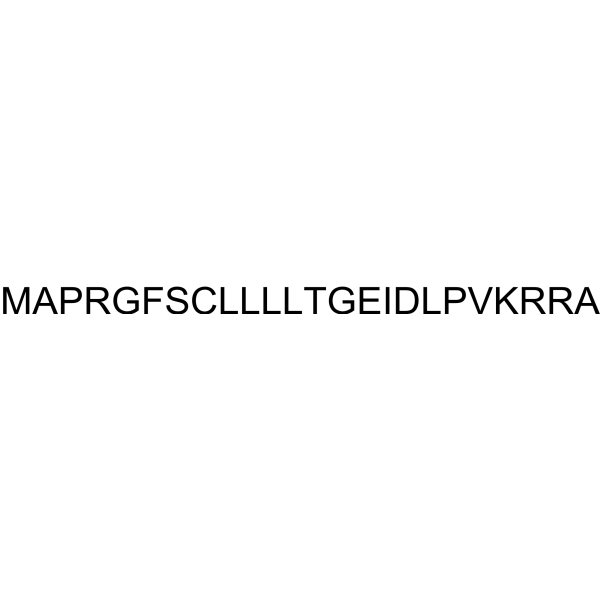
MAPRGFSCLLLLTGEIDLPVKRRA
-
Versand
Room temperature in continental US; may vary elsewhere.
-
Speicherung
Sealed storage, away from moisture
Powder -80°C 2 years -20°C 1 year * In solvent : -80°C, 6 months; -20°C, 1 month (sealed storage, away from moisture)


Publications (1)
-
Journal Impact Factor
-
Most Recent
-
Biomedicines
Humanin and MOTS-c Attenuate Atrial Fibrillation by Suppressing Fibrosis and Mitochondrial Dysfunction. [Abstract]2026 May 5;14(5):1048. PMID: 42193373

Protokoll
-
Apoptosis
Apoptosis, also called programmed cell death, is generally characterized by distinct morphological characteristics.
-
Apoptosis Solutions
Apoptosis is a regulated, generally non-lytic cell-death pathway that removes unwanted, damaged, infected, or abnormal cells through coordinated morphological changes, caspase activation, DNA fragmentation, and membrane remodeling. The intrinsic apoptosis pathway is controlled mainly by mitochondrial outer membrane permeabilization, BCL-2 family proteins, cytochrome c release, apoptosome formation, caspase-9 activation, and downstream executioner caspase-3/7 activation. The extrinsic apoptosis pathway is initiated by death receptors such as Fas, TNFR, and TRAIL receptors, which recruit adaptor proteins and activate caspase-8 before engaging executioner caspases or mitochondrial amplification through BID cleavage. Apoptosis is linked to many phenotypes, including cancer cell killing, tissue homeostasis, immune regulation, neurodegeneration, infection response, and treatment-induced cytotoxicity; unresolved questions include how apoptosis interacts with necroptosis, pyroptosis, ferroptos


Reinheit & Dokumentation
-
Data Sheet (262 KB)
-
SDS (252 KB)
- English - EN (252 KB)
- Français - FR (252 KB)
- Deutsch - DE (252 KB)
- Norwegian - NO (252 KB)
- Español - ES (252 KB)
- Swedish - SV (252 KB)
- Italian - IT (252 KB)
- Korean - KR (252 KB)
- Portuguese - PT (252 KB)
-
Handling Instructions (2659 KB)
Verweise
[1]. Ying Xie, et al. Protection effect of [Gly14]-Humanin from apoptosis induced by high glucose in human umbilical vein endothelial cells. Diabetes Res Clin Pract. 2014 Dec;106(3):560-6. [Content Brief]
[2]. T Wang, et al. [Gly14]-Humanin reduces histopathology and improves functional outcome after traumatic brain injury in mice. Neuroscience. 2013 Feb 12;231:70-81. [Content Brief]

Calculators
Konzentration (Stammlösung) × Volumen (Stammlösung) = Konzentration (Ziellösung) × Volumen (Ziellösung)


(Gly14)-Humanin (human) Related Classifications
HY-P3993 Related Classifications
 Powered by Bioz