



Hydroxylapatite (<50 nm)

Based on 1 Customer Validation
Hydroxylapatite (Hydroxyapatite) (<50 nm) is a natural form of calcium phosphate and is the main mineral component of bones and teeth. Hydroxylapatite (<50 nm) can stimulate the expression and secretion of collagen in primary human dermal fibroblasts. Hydroxylapatite (<50 nm) has good biocompatibility, bioactivity, and bone conductivity, making it suitable for targeted drug or nucleic acid delivery. Hydroxylapatite (<50 nm) can be used in research on osteoarthritis, gout, and atherosclerosis.
For research use only. We do not sell to patients.
- Purity : 99.05%
- CAS No.: 1306-06-5
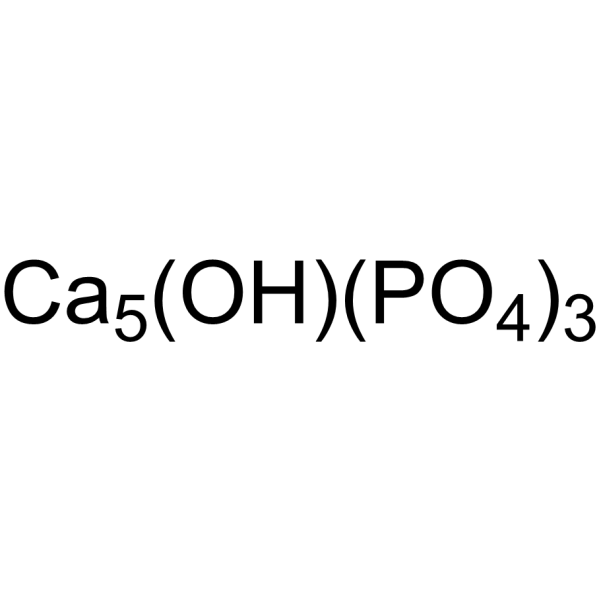
- Formula: Ca5HO13P3
- Molecular Weight:502.31
-
Storage:
4°C, sealed storage, away from moisture and light
* In solvent : -80°C, 6 months; -20°C, 1 month (sealed storage, away from moisture and light)


To place orders, for customer services and technical support, please contact: MedChemExpress USA
Tel: 609-228-6898 E-mail: [email protected] [email protected]


-
 Biological Activity
-
Chemical Information
- Protocols
- Purity & Documentation
- References
-
 Help & FAQs


-
HY-D0835
Hydroxylapatite (25-45 μm)Calcium Phosphate -

HY-W115786
KaolinKaolinitic Clay -
HY-W051271
Titanium(IV) oxidePhotocatalyst -

HY-W116336B
Zinc oxide, 99.99% metals basisBiochemical Assay Reagents -

HY-W116336D
Zinc oxide, <100 nm particle sizeNitrate Reductase Activator -

HY-Y0498
Aluminum oxideAdjuvant -
HY-W019972
Calcium pyrophosphateBiochemical Reagent -

HY-W111403
Calcium oxideHeterogeneous Base Catalyst -

HY-W096178B
Silica sand, 1-2mmBiochemical Assay Reagent -

HY-Y1213
CarbonPharmaceutical Excipient


Biological Activity
Description
In Vitro
Hydroxylapatite is suspended in 0.2 μm filtered purified water, sonicated and vortexed for 5 min and collected by centrifugation at 16,000 g for 1 min. The procedure was repeated five times to wash the Hydroxylapatite particles and a 40 mg/mL stock suspension was prepared in 0.1 M NaCl before administering to cells[1].
MedChemExpress (MCE) has not independently confirmed the accuracy of these methods. They are for reference only. Further protocols information, click here.


Chemical Information
-
CAS No. 1306-06-5
-
Appearance Solid
-
Molecular Weight 502.31
-
Formula Ca5HO13P3
-
Color White to off-white
-
SMILES
O[Ca][Ca][Ca][Ca][Ca]P1(OOO1)=O.O=P2(P3(OOO3)=O)OOO2
-
Synonyms
Hydroxyapatite (<50 nm)
-
Shipping
Room temperature in continental US; may vary elsewhere.
-
Storage
4°C, sealed storage, away from moisture and light
* In solvent : -80°C, 6 months; -20°C, 1 month (sealed storage, away from moisture and light)

Protocols
-
Research Protocol for Cardiovascular Diseases
Cardiovascular disease can be modeled as maladaptive cardiac remodeling, where ischemic injury or pressure overload activates inflammatory signaling, fibroblast activation, extracellular-matrix deposition, cardiomyocyte hypertrophy, vascular remodeling, and progressive ventricular dysfunction. The TGF-β/SMAD axis is a central profibrotic pathway after myocardial injury and pressure overload, while innate immune and cytokine pathways regulate leukocyte recruitment, scar formation, and adverse remodeling. Key unresolved questions include which inflammatory signals are reparative versus harmful, when fibrosis is protective versus maladaptive, and whether pathway inhibition improves function without weakening necessary infarct healing or compensatory remodeling.


Purity & Documentation
-
Data Sheet (268 KB)
-
SDS (252 KB)
- English - EN (252 KB)
- Français - FR (252 KB)
- Deutsch - DE (252 KB)
- Norwegian - NO (252 KB)
- Español - ES (252 KB)
- Swedish - SV (252 KB)
- Italian - IT (252 KB)
- Korean - KR (252 KB)
- Portuguese - PT (252 KB)
-
Handling Instructions (2659 KB)
References
[1]. Rakshit M, et al. Hydroxyapatite Particles Induced Modulation of Collagen Expression and Secretion in Primary Human Dermal Fibroblasts. Int J Nanomedicine. 2020 Jul 13;15:4943-4956. [Content Brief]
[2]. Yongjia Liu, et al. Hydroxyapatite-Bovine Serum Albumin-Paclitaxel Nanoparticles for Locoregional Treatment of Osteosarcoma. Adv Healthc Mater. 2020 Nov 9;e2000573. [Content Brief]

Calculators
Concentration (start) × Volume (start) = Concentration (final) × Volume (final)


Hydroxylapatite (<50 nm) Related Classifications
HY-D0835A Related Classifications
 Powered by Bioz