



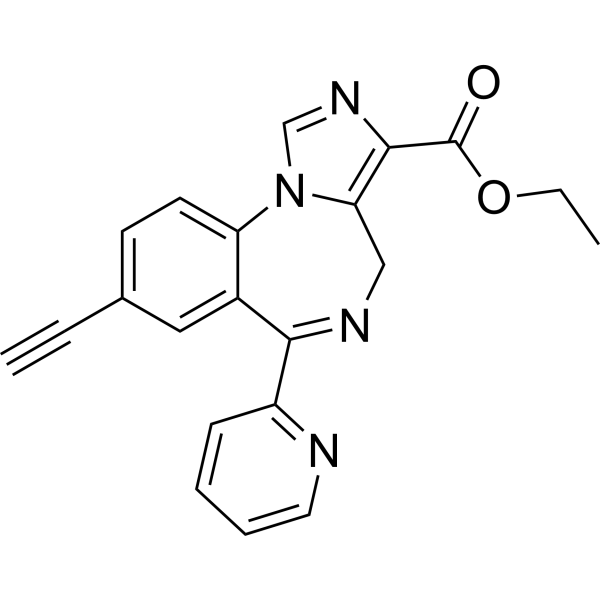
HZ166
HZ166 is a GABAA receptor subtype-selective benzodiazepine site agonist with preferential activity at α2- and α3-GABAA receptors. HZ166 shows anti-hyperalgesic effects. HZ166 is a click chemistry reagent, it contains an Alkyne group and can undergo copper-catalyzed azide-alkyne cycloaddition (CuAAc) with molecules containing Azide groups.
For research use only. We do not sell to patients.
- CAS No.: 612527-56-7
- Formula: C21H16N4O2
- Molecular Weight:356.38
-
Storage:
Please store the product under the recommended conditions in the Certificate of Analysis.

To place orders, for customer services and technical support, please contact: MedChemExpress USA
Tel: 609-228-6898 E-mail: [email protected] [email protected]


-
 Biological Activity
-
Chemical Information
- Protocols
- Purity & Documentation
- References
-
 Help & FAQs




Biological Activity
Description
Cellular Effect
|
Cell Line

|
Type | Value | Description | References |
|---|---|---|---|---|
| HEK293 | EC50 |
>20 μM
Compound: 2; HZ-166
|
Binding affinity to human GABAA alpha1beta3gamma2 receptor expressed in HEK293 cells assessed as GABA-induced membrane potential change preincubated for 3 mins followed by addition of GABA measured after 3 mins by FLIPR assay
Binding affinity to human GABAA alpha1beta3gamma2 receptor expressed in HEK293 cells assessed as GABA-induced membrane potential change preincubated for 3 mins followed by addition of GABA measured after 3 mins by FLIPR assay
|
[PMID: 27933953] |
| HEK293 | EC50 |
0.844 μM
Compound: 2; HZ-166
|
Binding affinity to human GABAA alpha3beta3gamma2 receptor expressed in HEK293 cells assessed as GABA-induced membrane potential change preincubated for 3 mins followed by addition of GABA measured after 3 mins by FLIPR assay
Binding affinity to human GABAA alpha3beta3gamma2 receptor expressed in HEK293 cells assessed as GABA-induced membrane potential change preincubated for 3 mins followed by addition of GABA measured after 3 mins by FLIPR assay
|
[PMID: 27933953] |


Chemical Information
-
CAS No. 612527-56-7
-
Molecular Weight 356.38
-
Formula C21H16N4O2
-
SMILES
O=C(OCC)C1=C2N(C3=CC=C(C=C3C(C4=NC=CC=C4)=NC2)C#C)C=N1
-
Shipping
Room temperature in continental US; may vary elsewhere.
-
Storage
Please store the product under the recommended conditions in the Certificate of Analysis.


Purity & Documentation
References

Calculators
Concentration (start) × Volume (start) = Concentration (final) × Volume (final)


HZ166 Related Classifications
HY-123249 Related Classifications
 Powered by Bioz