



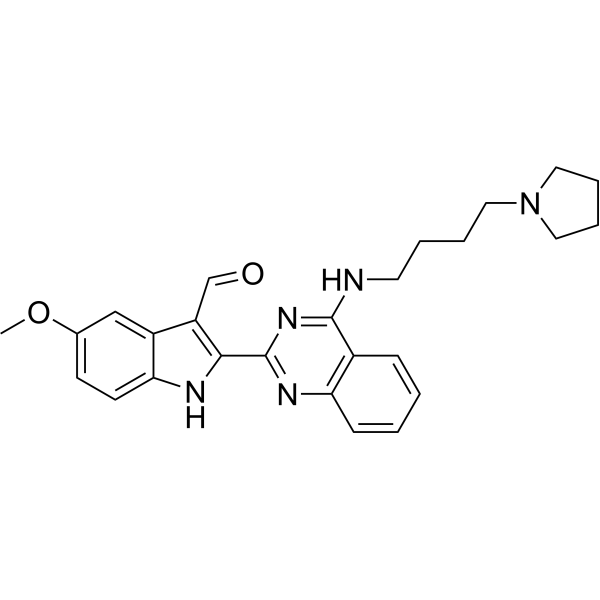
IQZ23
IQZ23 inhibits adipocyte differentiation via AMPK pathway activation. IQZ23 exerts a high efficacy in decreasing the triglyceride level (EC50=0.033 μM) in 3T3-L1 adipocytes. IQZ23 could be used for the research of obesity and related metabolic disorders.
For research use only. We do not sell to patients.
- CAS No.: 2415643-79-5
- Formula: C26H29N5O2
- Molecular Weight:443.54
-
Storage:
Please store the product under the recommended conditions in the Certificate of Analysis.

To place orders, for customer services and technical support, please contact: MedChemExpress USA
Tel: 609-228-6898 E-mail: [email protected] [email protected]


-
 Biological Activity
-
Chemical Information
- Protocols
- Purity & Documentation
- References
-
 Help & FAQs


All AMPK Isoforms
More

Biological Activity
Description
IC50 & Target
|
AMPK |
Cellular Effect
|
Cell Line

|
Type | Value | Description | References |
|---|---|---|---|---|
| 3T3-L1 | EC50 |
0.033 μM
Compound: 23
|
Lipid lowering activity in mouse 3T3-L1 cells assessed as reduction in adipogenic cocktail-induced triglyceride levels incubated for 6 days by GPO-POD assay
Lipid lowering activity in mouse 3T3-L1 cells assessed as reduction in adipogenic cocktail-induced triglyceride levels incubated for 6 days by GPO-POD assay
|
[PMID: 32163815] |
In Vitro
IQZ23 activates AMPK pathway by modulating ATP synthase activity[1].
IQZ23 (0.3 and 1.0 μM) markedly decreases the protein level of adipogenic factors C/EBPα, PPARγ, and sterol regulatory element-binding protein 1c (SREBP-1c)) after 24 h treatment as well as the level of fatty acid synthesis related proteins fatty acid synthase (FAS), acetyl CoA carboxylase (ACC), stearoyl-CoA desaturase 1 (SCD1) after 6 days of treatment in 3T3-L1 adipocytes[1].
MedChemExpress (MCE) has not independently confirmed the accuracy of these methods. They are for reference only.
-
Cell Line:3T3-L1 adipocytes
-
Concentration:0.3 and 1.0 μM
-
Incubation Time:24 hours
-
Result:Decreased the protein level of adipogenic factors C/EBPα, PPARγ, and SREBP-1c.
In Vivo
IQZ23 exhibits moderate terminal elimination half-lives (rat 4.2±0.3 h) and Cmax (rat 37.1±7.0 ng/mL) following oral administration (rat 5 mg/kg)[1].
IQZ23 exhibits terminal elimination half-lives (rat 4.4±0.4 h) following intravenous administration (rat 2 mg/kg)[1].
MedChemExpress (MCE) has not independently confirmed the accuracy of these methods. They are for reference only.


Chemical Information
-
CAS No. 2415643-79-5
-
Molecular Weight 443.54
-
Formula C26H29N5O2
-
SMILES
COC1=CC=C(NC(C2=NC(C=CC=C3)=C3C(NCCCCN4CCCC4)=N2)=C5C=O)C5=C1
-
Shipping
Room temperature in continental US; may vary elsewhere.
-
Storage
Please store the product under the recommended conditions in the Certificate of Analysis.


Purity & Documentation
References

Calculators
Concentration (start) × Volume (start) = Concentration (final) × Volume (final)


IQZ23 Related Classifications
HY-133556 Related Classifications
 Powered by Bioz