



Isogosferol
Based on 1 publication(s) in Google Scholar
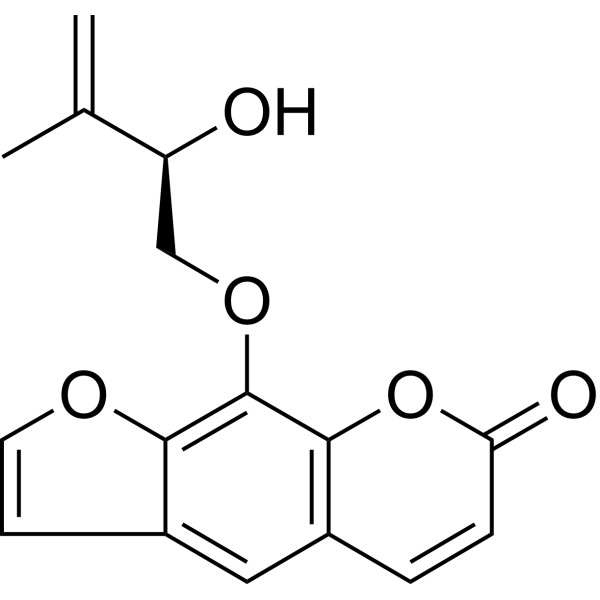
Isogosferol ((+)-Isogospherol; Isogospherol) is a potent anti-inflammatory agent. Isogosferol decreases LPS (HY-D1056)-stimulated NO and IL-1β expression. Isogosferol decreases the LPS (HY-D1056)-stimulated expression of iNOS, COX-2, NF-κB, and pERK1/2.
Nos produits utilisent uniquement pour la recherche. Nous ne vendons pas aux patients.
- CAS No.: 53319-52-1
- Formule: C16H14O5
- Masse moléculaire:286.28
-
Stockage:
Please store the product under the recommended conditions in the Certificate of Analysis.

To place orders, for customer services and technical support, please contact: MedChemExpress USA
Tel: 609-228-6898 E-mail: [email protected] [email protected]


-
 Activité biologique
-
Chemical Information
- Protocole
- Pureté et documentation
- Références
-
 Help & FAQs


Publications Citing Use of MedChemExpress (MCE) Isogosferol
More

Activité biologique
Description
In Vitro
Isogosferol (100, 200 µM; 1+16 h) decreases LPS (HY-D1056)-stimulated NO expression in RAW 264.7 cells[1].
Isogosferol (0, 25, 50, 100, 200 µM; 1+16 h) decreases LPS-stimulated expression of iNOS, COX-2 protein in a dose-dependent manner[1].
Isogosferol (0, 25, 50, 100, 200 µM; 1+1 h) decreases the LPS-stimulated expression of NF-κB and pERK1/2 in a dose-dependentmanner[1].
Isogosferol (50, 100, 200 µM µM; 1+16 h) decreases LPS-stimulated release of the pro-inflammatory cytokine, IL-1β[1].
MedChemExpress (MCE) has not independently confirmed the accuracy of these methods. They are for reference only.
-
Cell Line:RAW 264.7 cells
-
Concentration:100, 200 µM (stimulated with LPS (1 µg/mL))
-
Incubation Time:1+16
-
Result:Remarkably down-regulated the LPS-stimulated NO expression with an IC50 of 148 μM and shows no effect on cell viability.
-
Cell Line:0, 25, 50, 100, 200 µM
-
Concentration:1+16
-
Incubation Time:1+16
-
Result:Decreased the expression of iNOS, COX-2 protein in a dose-dependent manner.


Chemical Information
-
CAS No. 53319-52-1
-
Masse moléculaire 286.28
-
Formule C16H14O5
-
SMILES
CC([C@@H](O)COC1=C(OC=C2)C2=CC(C=C3)=C1OC3=O)=C
-
Synonyms
(+)-Isogospherol; Isogospherol
-
Structure Classification
-
Initial Source
-
Livraison
Room temperature in continental US; may vary elsewhere.
-
Stockage
Please store the product under the recommended conditions in the Certificate of Analysis.


Publications (1)
-
Journal Impact Factor
-
Most Recent


Pureté et documentation
Références

Calculators
Concentration (start) × Volume (start) = Concentration (final) × Volume (final)


Isogosferol Related Classifications
HY-N3480 Related Classifications
 Powered by Bioz