



Copper(I) oxide

Based on 1 Customer Validation
Copper(I) oxide is a weak inorganic base, oxidative stress inducer and cytotoxic agent. Copper(I) oxide generates ROS by impairing the activities of Catalase (HY-135849) and glutathione reductase. Copper(I) oxide can be used to activate halides for nucleophilic substitution reactions, and is also suitable for decarboxylation and ring condensation reactions.
商品は「研究用試薬」です。人や動物の医療用・臨床診断用・食品用の製品ではありません。
研究用途以外に使用した場合、当社は一切の責任を負いかねます。
- CAS 番号: 1317-39-1
- 分子式: Cu2O
- 分子量:143.09
-
保管条件:
Store at room temperature, keep dry and cool.
In solvent -80°C, 1 year , -20°C, 6 months


To place orders, for customer services and technical support, please contact: MedChemExpress USA
Tel: 609-228-6898 E-mail: [email protected] [email protected]


-
 生物活性
生物活性
-
化学情報
- プロトコル
- 純度とドキュメンテーション
- 参考文献
-
 Help & FAQs


-

HY-W088074A
Chromium(III)oxide, 99.9% trace metals basisBiochemical Assay Reagent -

HY-Y1102A
Copper(II) acetate, 99.99% trace metals basisBiochemical Assay Reagent -

HY-W051271
Titanium(IV) oxidePhotocatalyst -

HY-Y1878
Copper(Ⅱ) sulfateBiochemical Reagent -

HY-W116336B
Zinc oxide, 99.99% metals basisBiochemical Assay Reagents -

HY-Y1878C
Copper sulfate anhydrous, 99%Bactericide -

HY-W116336D
Zinc oxide, <100 nm particle sizeNitrate Reductase Activator -

HY-W111403
Calcium oxideHeterogeneous Base Catalyst -
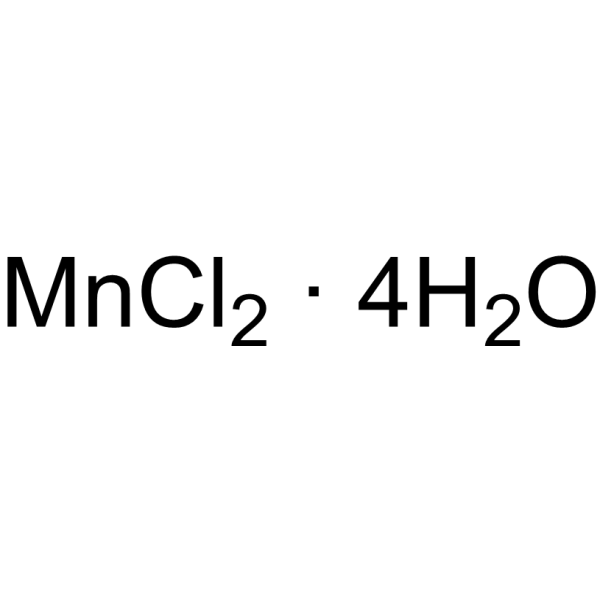
HY-109521A
Manganese chloride tetrahydrate, molecular biology grade,≥99.0% (KT)Biochemical Assay Reagent -

HY-W115786
KaolinKaolinitic Clay


生物活性
製品説明
体内実験
Copper(I) oxide (aqueous exposure; continuous exposure; 48 h) exhibits acute aquatic toxicity to water fleas, with a 48-h EC50 of 42 μg/L in freshwater[2].
Copper(I) oxide (aqueous exposure; continuous exposure; 48 h) exhibits acute aquatic toxicity to snails, with a 48-h LC50 of 179 μg/L in freshwater[2].
Copper(I) oxide (1800 μg/L; aqueous exposure; continuous exposure) exhibits acute aquatic toxicity to haddock, with an LT50 of 4.5-5.7 h[2].
Copper(I) oxide (following continuous aqueous exposure for 96 h) exhibits acute aquatic toxicity to mysid shrimp, with an LC50 of 69.7 μg/L in saltwater[2].
Copper(I) oxide (aqueous exposure; continuous exposure; 12-96 h) exhibits time-dependent acute aquatic toxicity to barnacles in seawater, with its LC50 value decreasing from 700 μg/L at 12 h to 20 μg/L at 96 h[2].
MedChemExpress (MCE) has not independently confirmed the accuracy of these methods. They are for reference only.
-
Animal Model:Melanogrammus aeglefinus (Haddock)[2]
-
Dosage:1800 μg/L
-
Administration:aqueous exposure; continuous; up to 5.7 hours
-
Result:Resulted in an LT50 of 4.5-5.7 hours based on mortality.


化学情報
-
CAS 番号 1317-39-1
-
性状 Solid
-
分子量 143.09
-
分子式 Cu2O
-
Color Brown to reddish brown
-
SMILES
[Cu]O[Cu]
-
輸送条件
Room temperature in continental US; may vary elsewhere.
-
保管条件
Store at room temperature, keep dry and cool
In solvent -80°C 1 year -20°C 6 months

プロトコル
-
ROS/oxidative-stress fluorescent staining
ROS/oxidative-stress fluorescent staining uses cell-permeant fluorogenic probes that become fluorescent after oxidation inside cells or tissues; commonly used examples include DCFH-DA/DCFDA for broad cellular oxidant detection, DHE for superoxide-related signal detection, MitoSOX for mitochondrial superoxide-related signal detection, and CellROX probes for oxidative-stress-associated fluorescence readouts. The assay detects probe oxidation rather than a single ROS species unless the probe and analysis method have been chemically validated for that species. DCFH-DA enters cells, is deacetylated by intracellular esterases to DCFH, and produces fluorescent DCF after oxidation, so the readout is used as an operational measure of total cellular oxidative stress rather than a species-specific ROS measurement. DHE and MitoSOX can report superoxide-related oxidation, but red fluorescence alone can include non-specific ethidium-like oxidation products; HPLC or optimized spectral approaches are
-
Cell Viability Determination by MTT Colorimetric Assay
The following protocol uses the MTT colorimetric assay as a classic literature-established method for assessing cell viability/metabolic activity in cultured mammalian cells. MTT[3-(4,5-dimethylthiazol-2-yl)-2,5-diphenyltetrazolium bromide] is reduced by metabolically active cells to a colored formazan product; the amount of formazan is quantified spectrophotometrically and provides an indirect measure of metabolically active viable cells. Importantly, MTT reduction reflects cellular oxidoreductase/metabolic activity rather than an absolute direct count of living cells, so changes in cellular metabolism can alter the signal independently of cell number.


純度とドキュメンテーション
-
データシート (269 KB)
-
SDS (758 KB)
- English - EN (758 KB)
- Français - FR (758 KB)
- Deutsch - DE (758 KB)
- Norwegian - NO (758 KB)
- Español - ES (758 KB)
- Swedish - SV (758 KB)
- Italian - IT (758 KB)
- Korean - KR (758 KB)
- Portuguese - PT (758 KB)
-
取扱説明書 (2659 KB)
参考文献
[1]. Fahmy B, et al. Copper oxide nanoparticles induce oxidative stress and cytotoxicity in airway epithelial cells. Toxicology in vitro : an international journal published in association with BIBRA. 2009 Oct;23(7):1365-71. [Content Brief]
[2]. Kiaune L, et al. Pesticidal copper (I) oxide: environmental fate and aquatic toxicity. Reviews of environmental contamination and toxicology. 2011;213:1-26. [Content Brief]

Calculators
濃度 (開始) × 体積 (開始) = 濃度 (終了) × 体積 (終了)


Copper(I) oxide 関連分類
HY-Y0590 関連分類
 Powered by Bioz