



CYMAL-5, 98% (TLC)

Based on 1 Customer Validation
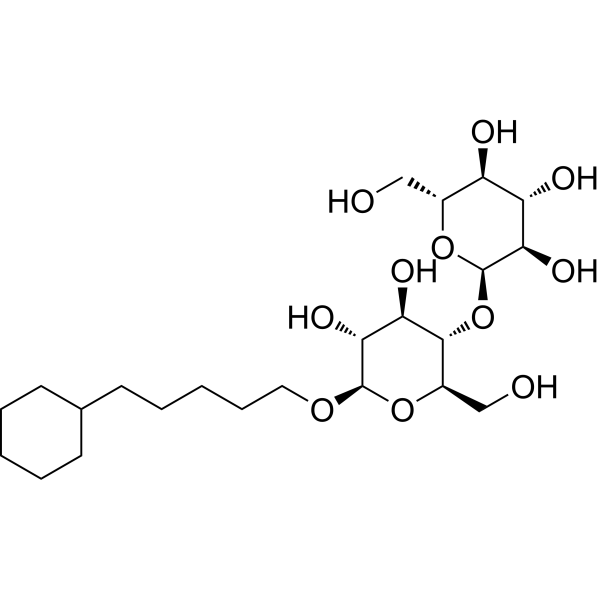
CYMAL-5, 98% (TLC) is a cycloalkyl aliphatic saccharide. CYMAL-5, 98% (TLC) is a glycosidic surfactant (GS) with a chiral maltose polar head group and a cyclohexyl-pentyl hydrophobic tail. CYMAL-5, 98% (TLC) is a non-ionic detergent that has a tenfold lower critical micelle concentration (CMC) in comparison with OG, and has previously been used for membrane protein extraction or crystallization of membrane proteins for X-ray crystallographic studies.
商品は「研究用試薬」です。人や動物の医療用・臨床診断用・食品用の製品ではありません。
研究用途以外に使用した場合、当社は一切の責任を負いかねます。
- 純度 : 99.95%
- CAS 番号: 250692-65-0
- 分子式: C23H42O11
- 分子量:494.57
-
保管条件:Powder -20°C, 3 years ; In solvent -80°C, 6 months , -20°C, 1 month

To place orders, for customer services and technical support, please contact: MedChemExpress USA
Tel: 609-228-6898 E-mail: [email protected] [email protected]


-
 生物活性
生物活性
-
化学情報
-
溶剤 & 溶解度
- プロトコル
- 純度とドキュメンテーション
- 参考文献
-
 Help & FAQs




生物活性
製品説明


化学情報
-
CAS 番号 250692-65-0
-
性状 Solid
-
分子量 494.57
-
分子式 C23H42O11
-
Color White to off-white
-
SMILES
OC[C@H]1O[C@@H]([C@@H]([C@H]([C@@H]1O)O)O)O[C@H]2[C@@H]([C@H]([C@@H](O[C@@H]2CO)OCCCCCC3CCCCC3)O)O
-
輸送条件
Room temperature in continental US; may vary elsewhere.
-
保管条件
Powder -20°C 3 years In solvent -80°C 6 months -20°C 1 month


溶剤 & 溶解度
体外:
H2O : 50 mg/mL (101.10 mM; Need ultrasonic)
Please refer to the solubility information to select the appropriate solvent. Once prepared, please aliquot and store the solution to prevent product inactivation from repeated freeze-thaw cycles.
Storage method and period of stock solution: -80°C, 6 months; -20°C, 1 month. When stored at -80°C, please use it within 6 months. When stored at -20°C, please use it within 1 month.
* Note: If you choose water as the stock solution, please dilute it to the working solution, then filter and sterilize it with a 0.22 μm filter before use.
Please refer to the solubility information to select the appropriate solvent. Once prepared, please aliquot and store the solution to prevent product inactivation from repeated freeze-thaw cycles.
Storage method and period of stock solution: -80°C, 6 months; -20°C, 1 month. When stored at -80°C, please use it within 6 months. When stored at -20°C, please use it within 1 month.
* Note: If you choose water as the stock solution, please dilute it to the working solution, then filter and sterilize it with a 0.22 μm filter before use.
濃度 (開始) × 体積 (開始) = 濃度 (終了) × 体積 (終了)

プロトコル
-
Membrane Protein Extraction Using Detergents and Chaotropes
Membrane protein extraction with detergents and chaotropes solubilizes lipid-bilayer-associated proteins by disrupting protein-lipid and protein-protein interactions while maintaining proteins in a soluble state for downstream electrophoresis, purification, or mass spectrometry. Chaotropes such as urea and thiourea improve solubilization of difficult proteins, while nonionic and zwitterionic detergents such as CHAPS, ASB-14, SB 3-10, MEGA-10, dodecyl maltoside, and Triton X-100 differ in extraction efficiency depending on sample type and membrane protein properties.
-
Protein Extraction
Protein extraction uses physical, chemical or biological methods, such as ultrasonic disruption, salting out, cell lysis, electrophoresis, etc., to destroy the cell membrane structure and to separate the proteins from different components according to their characteristics.
-
Detergent-Based Total Protein Extraction from Cultured Mammalian Cells (RIPA/NP-40/Triton Lysis)
Detergent-based total protein extraction lyses cultured mammalian cells by using amphipathic detergents to disrupt lipid membranes and solubilize proteins into aqueous lysate; RIPA combines non-ionic detergent with ionic detergents, whereas NP-40/Triton buffers are milder non-ionic lysis conditions. The readout is the recovered clarified protein lysate, which is commonly quantified by detergent-compatible protein assays and then used for downstream protein analysis such as SDS-PAGE and Western blotting.


純度とドキュメンテーション
-
データシート (272 KB)
-
SDS (251 KB)
- English - EN (251 KB)
- Français - FR (251 KB)
- Deutsch - DE (251 KB)
- Norwegian - NO (251 KB)
- Español - ES (251 KB)
- Swedish - SV (251 KB)
- Italian - IT (251 KB)
- Korean - KR (251 KB)
- Portuguese - PT (251 KB)
-
取扱説明書 (2659 KB)
参考文献
[1]. Ju M, et al. Enantioseparations by capillary electrophoresis using chiral glycosidic surfactants. I. Evaluation of cyclohexyl-pentyl-beta-D-maltoside surfactant. Electrophoresis. 1999;20(13):2766-2771. [Content Brief]
[2]. Katayama H, et al. Efficient in-gel digestion procedure using 5-cyclohexyl-1-pentyl-beta-D-maltoside as an additive for gel-based membrane proteomics. Rapid Commun Mass Spectrom. 2004;18(20):2388-2394. [Content Brief]


Complete Stock Solution Preparation Table
Please refer to the solubility information to select the appropriate solvent. Once prepared, please aliquot and store the solution to prevent product inactivation from repeated freeze-thaw cycles.
Storage method and period of stock solution: -80°C, 6 months; -20°C, 1 month. When stored at -80°C, please use it within 6 months. When stored at -20°C, please use it within 1 month.
| Optional Solvent | Concentration Solvent Mass | 1 mg | 5 mg | 10 mg | 25 mg |
|---|---|---|---|---|---|
| H2O | 1 mM | 2.0220 mL | 10.1098 mL | 20.2196 mL | 50.5490 mL |
| 5 mM | 0.4044 mL | 2.0220 mL | 4.0439 mL | 10.1098 mL | |
| 10 mM | 0.2022 mL | 1.0110 mL | 2.0220 mL | 5.0549 mL | |
| 15 mM | 0.1348 mL | 0.6740 mL | 1.3480 mL | 3.3699 mL | |
| 20 mM | 0.1011 mL | 0.5055 mL | 1.0110 mL | 2.5274 mL | |
| 25 mM | 0.0809 mL | 0.4044 mL | 0.8088 mL | 2.0220 mL | |
| 30 mM | 0.0674 mL | 0.3370 mL | 0.6740 mL | 1.6850 mL | |
| 40 mM | 0.0505 mL | 0.2527 mL | 0.5055 mL | 1.2637 mL | |
| 50 mM | 0.0404 mL | 0.2022 mL | 0.4044 mL | 1.0110 mL | |
| 60 mM | 0.0337 mL | 0.1685 mL | 0.3370 mL | 0.8425 mL | |
| 80 mM | 0.0253 mL | 0.1264 mL | 0.2527 mL | 0.6319 mL | |
| 100 mM | 0.0202 mL | 0.1011 mL | 0.2022 mL | 0.5055 mL |
* Note: If you choose water as the stock solution, please dilute it to the working solution, then filter and sterilize it with a 0.22 μm filter before use.


CYMAL-5, 98% (TLC) 関連分類
HY-123622 関連分類
 Powered by Bioz