



Difelikefalin
Based on 1 publication(s) in Google Scholar
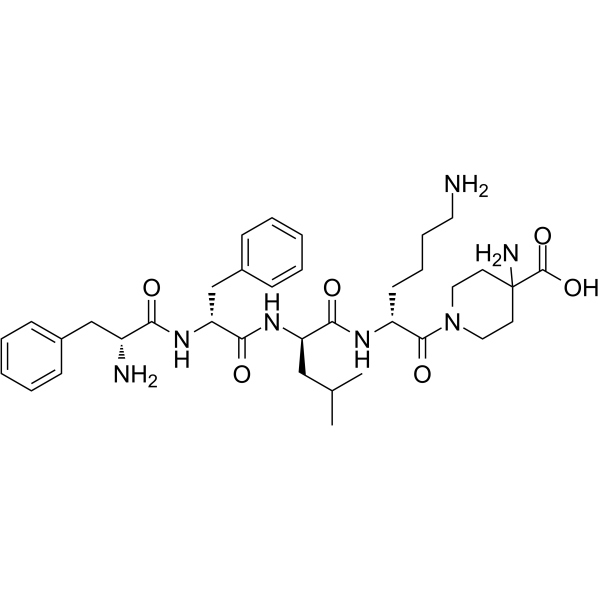
Difelikefalin (CR-845; FE-202845) is an orally active peripherally acting kappa opioid receptor agonist. Difelikefalin reduces acute kidney injury, decreases oliguria, maintains urine flow, inhibits cytokine expression, and improves survival in endotoxemia after ischemia/reperfusion. Difelikefalin suppresses pruritus signals and exhibits neuromodulatory antipruritic activity. Difelikefalin can be used in research related to acute kidney injury, chronic kidney disease-associated pruritus, and atopic dermatitis.
商品は「研究用試薬」です。人や動物の医療用・臨床診断用・食品用の製品ではありません。
研究用途以外に使用した場合、当社は一切の責任を負いかねます。
- 純度 : 99.95%
- CAS 番号: 1024828-77-0
- 分子式: C36H53N7O6
- 分子量:679.85
-
保管条件:
Sealed storage, away from moisture.
Powder -80°C, 2 years , -20°C, 1 year* In solvent : -80°C, 6 months; -20°C, 1 month (sealed storage, away from moisture)

To place orders, for customer services and technical support, please contact: MedChemExpress USA
Tel: 609-228-6898 E-mail: [email protected] [email protected]


-
 生物活性
生物活性
-
化学情報
-
溶剤 & 溶解度
- プロトコル
- 純度とドキュメンテーション
- 参考文献
-
 Help & FAQs


MedChemExpress(MCE)の使用を引用している文献 Difelikefalin
MoreOpioid Receptor アイソフォーム固有の製品をすべて表示
More

生物活性
製品説明
IC50 & Target
|
κ Opioid Receptor/KOR |
IL-10 |
体外実験
MedChemExpress (MCE) has not independently confirmed the accuracy of these methods. They are for reference only.
体内実験
Difelikefalin (0.3-1.0 mg/kg; i.v.; single injection; 1 hour pre-CLP) hydrochloride improves tubular flow rate in CLP-induced polymicrobial sepsis-associated acute kidney injury in mice[1].
Difelikefalin (0.3 mg/kg; i.v.; single injections; days 1-5 post-ischemia/reperfusion) hydrochloride increases survival rate to over 80% in subsequent LPS-induced septic acute kidney injury in mice[1].
Difelikefalin (1.0 mg/kg; i.v.; single injection; 1 hour pre-LPS) hydrochloride improves tubular flow rate in LPS-induced septic acute kidney injury in mice, independent of renal innervation[1].
MedChemExpress (MCE) has not independently confirmed the accuracy of these methods. They are for reference only.
-
Animal Model:Sprague-Dawley (male, 7-10 weeks old, 250-350 g)[1]
-
Dosage:1 mg/kg
-
Administration:i.v.; continuous infusion; 2 hours
-
Result:Rapidly increased hourly urine volume.
Gradually subsided and became statistically insignificant 3 hours post-administration.
Showed no changes to blood pressure or pulse rate relative to baseline.
-
Animal Model:C57Bl/6J (male, 7-10 weeks old, 20-25 g)[1]
-
Dosage:0.3, 1.0 mg/kg
-
Administration:i.v.; single injection; 1 hour pre-LPS
-
Result:Elevated the 150-second Lucifer Yellow distal nephron delivery ratio from 0% to 64% at 0.3 mg/kg, and cut the proportion of unreached nephrons after 300 s from 95% to 21% at the same dose.
Raised the 0-150 s delivery percentage to 46% at 1.0 mg/kg while lowering the > 300 s unreached nephron fraction to 22%.
Mitigated LPS-triggered 6-hour urine volume decline significantly at 1.0 mg/kg.
-
Animal Model:C57Bl/6J (male, 7-10 weeks old, 20-25 g)[1]
-
Dosage:0.3, 1.0 mg/kg
-
Administration:i.v.; single injection; 1 hour pre-CLP
-
Result:Increased the percentage of distal nephrons reached by Lucifer Yellow within 150 s from 25% to a higher level at 1.0 mg/kg.
Reduced the percentage of nephrons unreached after 300 s from 71% at 1.0 mg/kg.
Did not improve tubular flow rate at 0.3 mg/kg.
-
Animal Model:C57Bl/6J (male, 7-10 weeks old, 20-25 g)[1]
-
Dosage:0.3 mg/kg
-
Administration:i.v.; single injections; days 1, 3, and 5 post-ischemia/reperfusion
-
Result:Increased the median survival time from 54 hours (control) to over 80% survival in the acute phase.
Enabled 5 of 8 surviving mice to live for more than 2 years with no visible abnormalities.
-
Animal Model:C57Bl/6J (male, 7-10 weeks old, 20-25 g)[1]
-
Dosage:1.0 mg/kg
-
Administration:i.v.; single injection; 1 hour pre-LPS
-
Result:Improved urine flow rate in both non-denervated and denervated mice, demonstrating the effect was independent of renal nerve input/output.
-
Animal Model:C57BL/6 (wild-type, aged 8-12 weeks, atopic dermatitis model via topical MC903 (HY-10001) treatment)[3]
-
Dosage:0.5 mg/kg
-
Administration:i.p.; twice daily; 14 days
-
Result:Markedly inhibited scratching behavior across day 0, day 4, day 8 and day 12.
Exerted no modulatory impact on AD-associated skin inflammation, with unaltered skin macroscopic morphology, ear thickness variation and abundance/activation of CD45+ immune cells, CD4+ T cells and group 2 innate lymphoid cells confirmed by histopathology.
Induced marginal transcriptomic alterations in ear skin identified by bulk RNA-sequencing.
-
Animal Model:C57BL/6 (wild-type, aged 8-12 weeks, atopic dermatitis model via topical MC903 (HY-10001) treatment)[3]
-
Dosage:1.0 mg/kg
-
Administration:i.p.; single dose
-
Result:Significantly reduced scratching bouts per 15 minutes 30 minutes after injection.
臨床実験
| NCT Number | Sponsor | Condition | Start Date |
Phase

|
|---|---|---|---|---|
| NCT01329991 | 2011-05 | PHASE1 |


化学情報
-
CAS 番号 1024828-77-0
-
性状 Solid
-
分子量 679.85
-
分子式 C36H53N7O6
-
Color White to off-white
-
別名
CR-845; FE-202845
-
配列
D(Phe-Phe-Leu-Lys)-{4-aminonipecotic acid}
-
シーケンスの短縮
D(FFLK)-{4-aminonipecotic acid}
-
輸送条件
Room temperature in continental US; may vary elsewhere.
-
保管条件
Sealed storage, away from moisture
Powder -80°C 2 years -20°C 1 year * In solvent : -80°C, 6 months; -20°C, 1 month (sealed storage, away from moisture)


Publications (1)
-
Journal Impact Factor
-
Most Recent
-
Cell
In vivo transcriptomic, functional, circuit-based, and translational analyses of enteric neurons. [Abstract]2025 Dec 24;188(26):7547-7570.e45 PMID: 41406962


溶剤 & 溶解度
体外:
DMSO : 100 mg/mL (147.09 mM; Need ultrasonic; Hygroscopic DMSO has a significant impact on the solubility of product, please use newly opened DMSO)
H2O : ≥ 100 mg/mL (147.09 mM)
* "≥" means soluble, but saturation unknown.
Please refer to the solubility information to select the appropriate solvent. Once prepared, please aliquot and store the solution to prevent product inactivation from repeated freeze-thaw cycles.
Storage method and period of stock solution: -80°C, 6 months; -20°C, 1 month (sealed storage, away from moisture). When stored at -80°C, please use it within 6 months. When stored at -20°C, please use it within 1 month.
* Note: If you choose water as the stock solution, please dilute it to the working solution, then filter and sterilize it with a 0.22 μm filter before use.
Please refer to the solubility information to select the appropriate solvent. Once prepared, please aliquot and store the solution to prevent product inactivation from repeated freeze-thaw cycles.
Storage method and period of stock solution: -80°C, 6 months; -20°C, 1 month (sealed storage, away from moisture). When stored at -80°C, please use it within 6 months. When stored at -20°C, please use it within 1 month.
* Note: If you choose water as the stock solution, please dilute it to the working solution, then filter and sterilize it with a 0.22 μm filter before use.
濃度 (開始) × 体積 (開始) = 濃度 (終了) × 体積 (終了)
体内:
Select the appropriate dissolution method based on your experimental animal and administration route.
- For the following dissolution methods, please ensure to first prepare a clear stock solution using an In Vitro approach and then sequentially add co-solvents:
- To ensure reliable experimental results, the clarified stock solution can be appropriately stored based on storage conditions. As for the working solution for In Vivo experiments, it is recommended to prepare freshly and use it on the same day.
- The percentages shown for the solvents indicate their volumetric ratio in the final prepared solution. If precipitation or phase separation occurs during preparation, heat and/or sonication can be used to aid dissolution.
Add each solvent one by one: 10% DMSO 40% PEG300 5% Tween-80 45% Saline
Solubility: ≥ 2.5 mg/mL (3.68 mM); Clear solution
This protocol yields a clear solution of ≥ 2.5 mg/mL (saturation unknown).
Taking 1 mL working solution as an example, add 100 μL DMSO stock solution (25.0 mg/mL) to 400 μL PEG300, and mix evenly; then add 50 μL Tween-80 and mix evenly; then add 450 μL Saline to adjust the volume to 1 mL.
Preparation of Saline: Dissolve 0.9 g sodium chloride in ddH₂O and dilute to 100 mL to obtain a clear Saline solution.
Add each solvent one by one: 10% DMSO 90% (20% SBE-β-CD in Saline)
Solubility: ≥ 2.5 mg/mL (3.68 mM); Clear solution
This protocol yields a clear solution of ≥ 2.5 mg/mL (saturation unknown).
Taking 1 mL working solution as an example, add 100 μL DMSO stock solution (25.0 mg/mL) to 900 μL 20% SBE-β-CD in Saline, and mix evenly.
Preparation of 20% SBE-β-CD in Saline (4°C, storage for one week): 2 g SBE-β-CD powder is dissolved in 10 mL Saline, completely dissolve until clear.
In Vivo Dissolution Calculator
Please enter the basic information of animal experiments:
-
-
-
-
Recommended: Prepare an additional quantity of animals to account for potential losses during experiments.
Working solution concentration: 0.22 mg/mL
This product has good water solubility, please refer to the measured solubility data in water/PBS/Saline for details.


純度とドキュメンテーション
-
データシート (295 KB)
-
SDS (394 KB)
- English - EN (394 KB)
- Français - FR (394 KB)
- Deutsch - DE (394 KB)
- Norwegian - NO (394 KB)
- Español - ES (394 KB)
- Swedish - SV (394 KB)
- Italian - IT (394 KB)
- Korean - KR (394 KB)
- Portuguese - PT (394 KB)
-
取扱説明書 (2659 KB)
参考文献
[1]. Sawanobori Y, et al. A kappa opioid receptor agonist, difelikefalin, improves acute kidney injury in experimental sepsis models. PloS one. 2026;21(4):e0343693. [Content Brief]
[2]. Viscusi ER, et al. Effect of difelikefalin, a selective kappa opioid receptor agonist, on respiratory depression: A randomized, double-blind, placebo-controlled trial. Clinical and translational science. 2021 Sep;14(5):1886-1893. [Content Brief]
[3]. Tamari M, et al. Difelikefalin suppresses itch and reduces scratching independent of inflammation in a murine model of atopic dermatitis. The Journal of allergy and clinical immunology. 2023 Oct;152(4):927-932. [Content Brief]


Complete Stock Solution Preparation Table
Please refer to the solubility information to select the appropriate solvent. Once prepared, please aliquot and store the solution to prevent product inactivation from repeated freeze-thaw cycles.
Storage method and period of stock solution: -80°C, 6 months; -20°C, 1 month (sealed storage, away from moisture). When stored at -80°C, please use it within 6 months. When stored at -20°C, please use it within 1 month.
| Optional Solvent | Concentration Solvent Mass | 1 mg | 5 mg | 10 mg | 25 mg |
|---|---|---|---|---|---|
| DMSO / H2O | 1 mM | 1.4709 mL | 7.3546 mL | 14.7091 mL | 36.7728 mL |
| 5 mM | 0.2942 mL | 1.4709 mL | 2.9418 mL | 7.3546 mL | |
| 10 mM | 0.1471 mL | 0.7355 mL | 1.4709 mL | 3.6773 mL | |
| 15 mM | 0.0981 mL | 0.4903 mL | 0.9806 mL | 2.4515 mL | |
| 20 mM | 0.0735 mL | 0.3677 mL | 0.7355 mL | 1.8386 mL | |
| 25 mM | 0.0588 mL | 0.2942 mL | 0.5884 mL | 1.4709 mL | |
| 30 mM | 0.0490 mL | 0.2452 mL | 0.4903 mL | 1.2258 mL | |
| 40 mM | 0.0368 mL | 0.1839 mL | 0.3677 mL | 0.9193 mL | |
| 50 mM | 0.0294 mL | 0.1471 mL | 0.2942 mL | 0.7355 mL | |
| 60 mM | 0.0245 mL | 0.1226 mL | 0.2452 mL | 0.6129 mL | |
| 80 mM | 0.0184 mL | 0.0919 mL | 0.1839 mL | 0.4597 mL | |
| 100 mM | 0.0147 mL | 0.0735 mL | 0.1471 mL | 0.3677 mL |
* Note: If you choose water as the stock solution, please dilute it to the working solution, then filter and sterilize it with a 0.22 μm filter before use.


Difelikefalin 関連分類
HY-17609 関連分類
 Powered by Bioz
Keywords
- Difelikefalin
- 1024828-77-0
- CR-845
- FE-202845
- CR845
- CR 845
- FE202845
- FE 202845
- FE-202845
- Opioid Receptor
- Interleukin Related
- dorsal root ganglia neurons
- histamine
- atopic dermatitis
- renal interstitial cells
- C57Bl/6J mouse
- chloroquine
- acute kidney injury
- chronic kidney disease-associated pruritus
- central nervous system
- kappa opioid receptor
- Inhibitor
- inhibitor
- inhibit