



Gresonitamab
Based on 1 publication(s) in Google Scholar
Gresonitamab (AMG 910) is a half-life extended (HLE) bispecific T-cell engager (BiTE) antibody targets CD3-positive T cells and CLDN18.2-expressing tumor cells. Gresonitamab can be used for the research of adenocarcinoma.
商品は「研究用試薬」です。人や動物の医療用・臨床診断用・食品用の製品ではありません。
研究用途以外に使用した場合、当社は一切の責任を負いかねます。
- 純度 : 99.44%
- CAS 番号: 2413817-97-5
- 分子量:106 kDa
-
保管条件:
Please store the product under the recommended conditions in the Certificate of Analysis.


To place orders, for customer services and technical support, please contact: MedChemExpress USA
Tel: 609-228-6898 E-mail: [email protected] [email protected]


-
 生物活性
生物活性
-
化学情報
- プロトコル
- 純度とドキュメンテーション
- 参考文献
-
 Help & FAQs


-

HY-P9977
AmivantamabEGFR-MET Dual Antibody -

HY-P9909
Ustekinumab -

HY-P99575
Tarlatamabanti-DLL3/CD3 BiTE antibody -
HY-P99592
SolitomabAnti-CD3/EpCAM Antibody -

HY-P99392
TeclistamabBCMA/CD3 Dual Antibodies -

HY-P99814
PavurutamabBispecific T-cell Engager -

HY-P99394
TalquetamabAnti-GPRC5D/CD3 Antibody -

HY-P99222
TeplizumabAnti-human CD3 Antibody -
HY-P99152
MuromonabCD3 Monoclonal Antibody -

HY-P99199
ForalumabCD3 Inhibitor -

HY-P99211
OtelixizumabAnti-CD3 Antibody -

HY-P99802
PasotuxizumabAnti-PSMA/CD3 mAb
MedChemExpress(MCE)の使用を引用している文献 Gresonitamab
More

生物活性
製品説明
Isotype
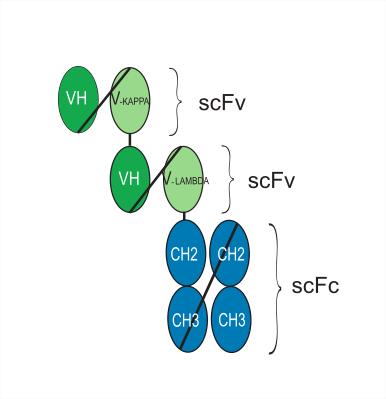
(scFv-heavy-kappa)-(scFv-heavy-lambda)-scFc
Species Reactivity
Human
IC50 & Target
CD3E & CLDN18
体外実験
Gresonitamab redirects tumor cell lysis to kill tumor cells[1].
MedChemExpress (MCE) has not independently confirmed the accuracy of these methods. They are for reference only. Further protocols information, click here.
臨床実験
| NCT Number | Sponsor | Condition | Start Date |
Phase

|
|---|---|---|---|---|
| NCT01329991 | Plexxikon| | 2011-05 | PHASE1 |
遺伝子ID
アクセッション番号
Conjugated
Unconjugated
Reconsititution
The product can be reconstituted/diluted with sterile PBS or saline.
Format
-
(scFv-heavy-kappa)-(scFv-heavy-lambda)-scFc
アプリケーション
ELISA, FACS, Functional assay
Verified Bioactivity
-
 Immobilized Gresonitamab can bind Human CD3 epsilon/CD3e Protein (ECD, His Tag). The EC50 for this effect is 3.97 ng/mL.
 -
 Flow cytometric analysis of 1×10⁶ Jurkat cells labelling CD3E (red) with Gresonitamab (HY-P99350). Cells were fixed with 4% paraformaldehyde and permeabilised with 90% methanol. Then stained with the primary antibody at 1/200 dilution for an hour at 4℃. Alexa Goat Anti-Human IgG H&L (AF488) (HY-P83776) was used as the secondary antibody at 1/1,000 dilution for 30 minutes at 4℃. Human IgG1 kappa Isotype Control (HY-P99001, blue) was used as the isotype control.


化学情報
-
CAS 番号 2413817-97-5
-
性状 Liquid
-
分子量 106 kDa
-
Color Colorless to light yellow
-
SMILES
[Gresonitamab]
-
別名
AMG 910; Anti-Human CD3xClaudin18 2
-
輸送条件
Shipping with dry ice.
-
Formulation
Please refer to the lot-specific COA for specific buffer information.
-
保管条件
Please store the product under the recommended conditions in the Certificate of Analysis.


Publications (1)
-
Journal Impact Factor
-
Most Recent

プロトコル
-
Protocol for Pharmacokinetic Study
Pharmacokinetic studies quantify how an organism handles a drug over time through absorption, distribution, metabolism, and excretion, and the core experimental readout is the concentration-time profile of parent drug and, when relevant, metabolites in biological matrices such as plasma, whole blood, urine, bile, or tissue. Pharmacokinetic analysis links dose, route, exposure, clearance, half-life, distribution, bioavailability, and systemic exposure to drug efficacy and toxicity hypotheses rather than measuring a signaling pathway directly. The literature links pharmacokinetics to drug-development phenotypes by showing that drug metabolism and pharmacokinetics influence compound progression, exposure-response interpretation, safety margins, dosing strategy, and failure risk during discovery and development. DMPK science contributes to compound optimization by integrating physicochemical properties, in vitro metabolism, transporter behavior, in vivo exposure, and pharmacodynamic contex


純度とドキュメンテーション
-
データシート (257 KB)
-
SDS (252 KB)
- English - EN (252 KB)
- Français - FR (252 KB)
- Deutsch - DE (252 KB)
- Norwegian - NO (252 KB)
- Español - ES (252 KB)
- Swedish - SV (252 KB)
- Italian - IT (252 KB)
- Korean - KR (252 KB)
- Portuguese - PT (252 KB)
-
Inhibitory Antibodies User Guide (603 KB)
参考文献

Calculators
濃度 (開始) × 体積 (開始) = 濃度 (終了) × 体積 (終了)


Gresonitamab 関連分類
HY-P99350 関連分類
 Powered by Bioz