



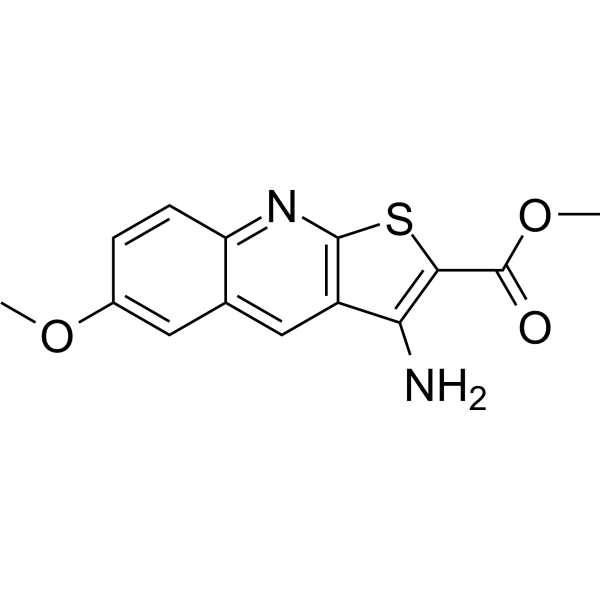
PU-48

Based on 1 Customer Validation
PU-48 is a blood-brain barrier-permeable urea transporter (UT) inhibitor with an IC50 of 0.32 μM against rat UT-A. By functionally inhibiting urea transporters (including UT-A subtypes) in the renal inner medullary collecting ducts, PU-48 induces urea-selective diuresis. PU-48 does not alter blood levels of sodium, potassium or chloride ions, nor does it affect the excretion of non-urea solutes. PU-48 shows no significant toxicity in cell or animal models and can be used in edema-related research.
商品は「研究用試薬」です。人や動物の医療用・臨床診断用・食品用の製品ではありません。
研究用途以外に使用した場合、当社は一切の責任を負いかねます。
- 純度 : 99.76%
- CAS 番号: 335394-78-0
- 分子式: C14H12N2O3S
- 分子量:288.32
-
保管条件:
4°C, protect from light, stored under nitrogen
* In solvent : -80°C, 6 months; -20°C, 1 month (protect from light, stored under nitrogen)

To place orders, for customer services and technical support, please contact: MedChemExpress USA
Tel: 609-228-6898 E-mail: [email protected] [email protected]


-
 生物活性
生物活性
-
化学情報
-
溶剤 & 溶解度
- プロトコル
- 純度とドキュメンテーション
- 参考文献
-
 Help & FAQs




生物活性
製品説明
体外実験
PU-48 (0.25-4 µg/mL; 24 h) exhibits high plasma protein binding (over 89%) in human plasma, with no concentration-dependent differences across the tested concentrations[2].
PU-48 (10-9-10-4 M; 6 min) potently and specifically inhibits UT-B-mediated urea transport in human, rat, and mouse erythrocytes with IC50 values of 0.21 μM, 0.33 μM, and 2.1 μM, respectively[3].
PU-48 (4 μM; 60 min) inhibits UT-A1-mediated urea transport in UT-A1-expressing Type I MDCK cells with an IC50 of 0.32 μM, which is ~2.8-fold more potent than its inhibition of UT-B-mediated transport in UT-B-expressing Type I MDCK cells (IC50=0.90 μM)[3].
PU-48 (5-80 μM; 72 h) does not exhibit cytotoxicity in Type I MDCK cells at concentrations up to 80 μM after 72 h incubation[3].
PU-48 (10 μM) does not inhibit hERG, NaV1.5, or CaV1.2 channel activity in stably transfected HEK293 cells[3].
MedChemExpress (MCE) has not independently confirmed the accuracy of these methods. They are for reference only.
-
Cell Line:Type I MDCK cells
-
Concentration:5-80 μM
-
Incubation Time:72 h
-
Result:Did not significantly reduce MDCK cell viability at concentrations up to 80 μM, with viability remaining near 100% relative to controls.
Parmacokinetics
体内実験
PU-48 (100 mg/kg; s.c.; single dose) induces urea-selective diuresis in both UT-B null and wild-type male C57BL/6 mice without altering electrolyte excretion[3].
PU-48 (3.125-50 mg/kg; s.c.; single dose) induces dose-dependent diuresis in male SD rats at subcutaneous doses of 12.5 and 50 mg/kg, with peak efficacy at 2 h post-administration[3].
PU-48 (50-100 mg/kg; s.c.; every 8 h; 6 days) induces sustained diuresis in male SD rats with twice-daily subcutaneous dosing of 50 mg/kg (first dose 100 mg/kg) for 6 days, without causing electrolyte imbalance or altering renal transporter/aquaporin protein expression[3].
PU-48 (14 g/kg; p.o.; single dose) shows no acute toxicity in 4-week-old male and female CD-ICR mice[3].
MedChemExpress (MCE) has not independently confirmed the accuracy of these methods. They are for reference only.
-
Animal Model:C57BL/6 UT-B null mice (10-week-old male, ~25 g); C57BL/6 wild-type mice (10-week-old male, ~25 g)[3]
-
Dosage:100 mg/kg
-
Administration:s.c.; single dose
-
Result:Significantly increased urine output in both UT-B null and wild-type mice.
Decreased urinary osmolality in both UT-B null and wild-type mice.
Decreased urinary urea concentration in both UT-B null and wild-type mice.
Decreased urinary non-urea solute concentration in both UT-B null and wild-type mice.
Increased urea excretion in both UT-B null and wild-type mice.
Did not change excretion of non-urea solutes (including Na+, K+, Cl-) in either group.
Reached peak changes at 2 h post-administration, with values returning to basal levels by 10 h.
-
Animal Model:Sprague-Dawley (SD) rats (male, 200~220 g)[3]
-
Dosage:3.125 mg/kg; 12.5 mg/kg; 50 mg/kg
-
Administration:s.c.; single dose
-
Result:Caused a dose-dependent increase in urine output at doses of 12.5 and 50 mg/kg.
Significantly reduced urinary osmolality at doses of 12.5 and 50 mg/kg (P<0.05).
Significantly reduced urinary urea concentration at doses of 12.5 and 50 mg/kg (P<0.05).
Showed no significant effect at the 3.125 mg/kg dose.
Reached peak changes at 2 h post-administration, with values returning to basal levels by 10 h.
-
Animal Model:Sprague-Dawley (SD) rats (male, 200~220 g)[3]
-
Dosage:50 mg/kg; 100 mg/kg (first dose)
-
Administration:s.c.; every 8 h; 6 days
-
Result:Caused continuous diuresis over the 6-day treatment period, with diuretic efficacy similar to that of hydrochlorothiazide (HCTZ).
Reduced urinary osmolality over the 6-day treatment period.
Reduced urinary urea concentration over the 6-day treatment period.
Did not significantly alter blood levels of Na+, K+, Cl-, urea, glucose, cholesterol, or triglycerides compared to vehicle controls.
Significantly reduced inner medullary tissue osmolality.
Significantly reduced inner medullary urea concentration.
Did not affect inner medullary Na+ or Cl- concentrations.
Caused no significant changes in renal protein expression levels of UT-A1, UT-A2, UT-A3, UT-B, AQP1, AQP2, AQP3, AQP4, NCC, or NKCC2.


化学情報
-
CAS 番号 335394-78-0
-
性状 Solid
-
分子量 288.32
-
分子式 C14H12N2O3S
-
Color Light yellow to yellow
-
SMILES
O=C(C1=C(N)C2=C(N=C3C=CC(OC)=CC3=C2)S1)OC
-
輸送条件
Room temperature in continental US; may vary elsewhere.
-
保管条件
4°C, protect from light, stored under nitrogen
* In solvent : -80°C, 6 months; -20°C, 1 month (protect from light, stored under nitrogen)


溶剤 & 溶解度
体外:
DMSO : 6.67 mg/mL (23.13 mM; ultrasonic and warming and heat to 60°C; Hygroscopic DMSO has a significant impact on the solubility of product, please use newly opened DMSO)
Please refer to the solubility information to select the appropriate solvent. Once prepared, please aliquot and store the solution to prevent product inactivation from repeated freeze-thaw cycles.
Storage method and period of stock solution: -80°C, 6 months; -20°C, 1 month (protect from light, stored under nitrogen). When stored at -80°C, please use it within 6 months. When stored at -20°C, please use it within 1 month.
Please refer to the solubility information to select the appropriate solvent. Once prepared, please aliquot and store the solution to prevent product inactivation from repeated freeze-thaw cycles.
Storage method and period of stock solution: -80°C, 6 months; -20°C, 1 month (protect from light, stored under nitrogen). When stored at -80°C, please use it within 6 months. When stored at -20°C, please use it within 1 month.
濃度 (開始) × 体積 (開始) = 濃度 (終了) × 体積 (終了)


純度とドキュメンテーション
-
データシート (280 KB)
-
SDS (252 KB)
- English - EN (252 KB)
- Français - FR (252 KB)
- Deutsch - DE (252 KB)
- Norwegian - NO (252 KB)
- Español - ES (252 KB)
- Swedish - SV (252 KB)
- Italian - IT (252 KB)
- Korean - KR (252 KB)
- Portuguese - PT (252 KB)
-
取扱説明書 (2659 KB)
参考文献
[1]. Zhang ZY, et al. Development and validation of an LC-MS/MS method for the determination of a novel thienoquinolin urea transporter inhibitor PU-48 in rat plasma and its application to a pharmacokinetic study. Biomed Chromatogr. 2018;32(4):10.1002/bmc.4157. [Content Brief]
[2]. Zhang ZY, et al. Pharmacokinetics, Tissue Distribution and Excretion of a Novel Diuretic (PU-48) in Rats. Pharmaceutics. 2018;10(3):124. Published 2018 Aug 8. [Content Brief]


Complete Stock Solution Preparation Table
Please refer to the solubility information to select the appropriate solvent. Once prepared, please aliquot and store the solution to prevent product inactivation from repeated freeze-thaw cycles.
Storage method and period of stock solution: -80°C, 6 months; -20°C, 1 month (protect from light, stored under nitrogen). When stored at -80°C, please use it within 6 months. When stored at -20°C, please use it within 1 month.
| Optional Solvent | Concentration Solvent Mass | 1 mg | 5 mg | 10 mg | 25 mg |
|---|---|---|---|---|---|
| DMSO | 1 mM | 3.4684 mL | 17.3418 mL | 34.6837 mL | 86.7092 mL |
| 5 mM | 0.6937 mL | 3.4684 mL | 6.9367 mL | 17.3418 mL | |
| 10 mM | 0.3468 mL | 1.7342 mL | 3.4684 mL | 8.6709 mL | |
| 15 mM | 0.2312 mL | 1.1561 mL | 2.3122 mL | 5.7806 mL | |
| 20 mM | 0.1734 mL | 0.8671 mL | 1.7342 mL | 4.3355 mL |


PU-48 関連分類
HY-155642 関連分類
 Powered by Bioz