



RNA Aptamer Broccoli sodium

Based on 1 Customer Validation
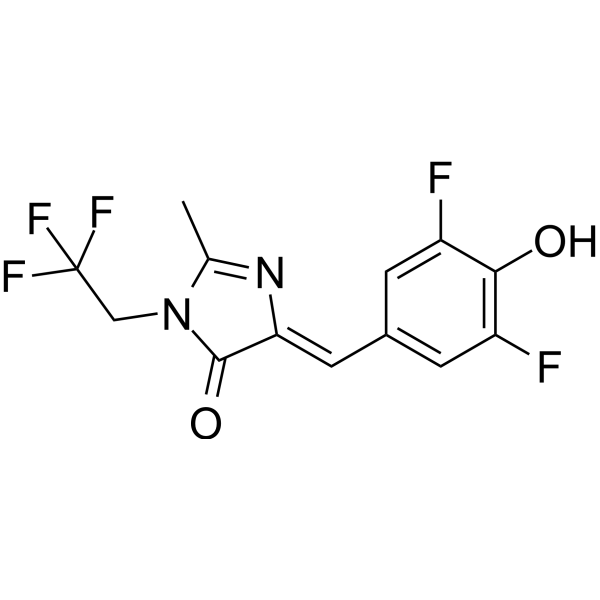
RNA Aptamer Broccoli sodium is a 49-nucleotide nucleic acid aptamer that is much shorter than Spinach and Spinach2. It exhibits bright green fluorescence when binding to DFHBI or DFHBI-1T (a soluble analog of the green fluorescent protein label). RNA Aptamer Broccoli sodium can be used for RNA expression or localization in living cells.
商品は「研究用試薬」です。人や動物の医療用・臨床診断用・食品用の製品ではありません。
研究用途以外に使用した場合、当社は一切の責任を負いかねます。
- 純度 : 92.79%
- 分子量:15841.54 (free acid)
-
保管条件:
4°C, sealed storage, away from moisture
* In solvent : -80°C, 6 months; -20°C, 1 month (sealed storage, away from moisture)


To place orders, for customer services and technical support, please contact: MedChemExpress USA
Tel: 609-228-6898 E-mail: [email protected] [email protected]


-
 生物活性
生物活性
-
化学情報
- プロトコル
- 純度とドキュメンテーション
- 参考文献
-
 Help & FAQs




生物活性
製品説明
体外実験
RNA Aptamer Broccoli sodium exhibited a similar high folding efficiency to Spinach2 in vitro, but its dependence on magnesium was significantly reduced and its thermal stability was improved. Moreover, unlike Spinach2, Broccoli does not require the use of tRNA scaffolds to facilitate its folding in vivo[1].
MedChemExpress (MCE) has not independently confirmed the accuracy of these methods. They are for reference only. Further protocols information, click here.


化学情報
-
性状 Solid
-
分子量 15841.54 (free acid)
-
Color White to off-white
-
SMILES
[RNA Aptamer Broccoli (sodium)]
-
輸送条件
Room temperature in continental US; may vary elsewhere.
-
保管条件
4°C, sealed storage, away from moisture
* In solvent : -80°C, 6 months; -20°C, 1 month (sealed storage, away from moisture)

プロトコル
-
RT-PCR
Reverse transcription technology uses RNA as a template to synthesize DNA. RT-PCR is simple, specific and sensitive, and can be used to detect gene expression levels and expression differences in cells; detect RNA virus content; clone cDNA sequences of specific genes.
-
RNA extraction experimental
By lysing cells, releasing RNA, and removing impurities such as proteins and DNA, high-purity RNA products are finally obtained. The commonly used traditional method is the guanidine isothiocyanate/phenol/chloroform method (Trizol), which is suitable for a variety of animal materials including animal tissues, microorganisms, cultured cells, etc., and most plant materials.
-
Protocol for Northern Blot
Northern blot detects a defined RNA species by separating denatured RNA by size, transferring RNA to a membrane, hybridizing with a complementary labeled DNA or RNA probe, and detecting probe-bound RNA by autoradiography, phosphorimaging, or validated nonradioactive detection. The readout is both RNA size and abundance: band migration estimates transcript length or RNA-processing state, while band intensity reflects relative target RNA amount after normalization to total RNA, rRNA, or another validated loading control. In cancer cells, primary neurons, mouse tumor samples, intestinal organoids, inflammatory macrophages, or drug-screening studies, Northern blot is most appropriate when transcript size, isoform pattern, RNA processing, or small-RNA detection is important; qPCR or RNA-seq can complement it when higher sensitivity or global profiling is needed.
-
Real Time qPCR (Q-PCR)
Real-time quantitative PCR (qPCR) quantifies an amplifiable nucleic-acid target by monitoring fluorescence during PCR cycling rather than measuring product only after amplification. The increase in fluorescence tracks accumulation of PCR product, and the quantification cycle (Cq; historically also Ct/CP) is related to the initial amount of target: samples containing more starting target generally reach the defined fluorescence threshold in fewer cycles.


純度とドキュメンテーション
-
データシート (264 KB)
-
SDS (252 KB)
- English - EN (252 KB)
- Français - FR (252 KB)
- Deutsch - DE (252 KB)
- Norwegian - NO (252 KB)
- Español - ES (252 KB)
- Swedish - SV (252 KB)
- Italian - IT (252 KB)
- Korean - KR (252 KB)
- Portuguese - PT (252 KB)
-
取扱説明書 (1518 KB)
参考文献

Calculators
濃度 (開始) × 体積 (開始) = 濃度 (終了) × 体積 (終了)


RNA Aptamer Broccoli sodium 関連分類
HY-153845 関連分類
 Powered by Bioz