



SEN177
Based on 1 publication(s) in Google Scholar
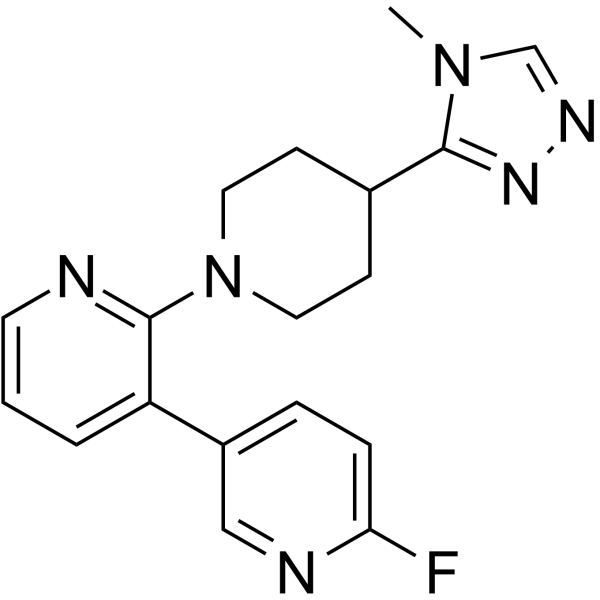
SEN177 is an orally effect glutamine cyclase (QC) inhibitor. The Ki of SEN177 for human glutamine cyclase (hQC) is 20 nM, and the IC50 is 13 nM. SEN177 interferes with the interaction between CD47 and SIRRPα, and has anti-tumor activity. SEN177 reduces aggregation and apoptosis caused by HTT mutation in Huntington model, and can be used in the study of neurodegenerative diseases.
商品は「研究用試薬」です。人や動物の医療用・臨床診断用・食品用の製品ではありません。
研究用途以外に使用した場合、当社は一切の責任を負いかねます。
- 純度 : 98.76%
- CAS 番号: 2117405-13-5
- 分子式: C18H19FN6
- 分子量:338.38
-
保管条件:Powder -20°C, 3 years ; In solvent -80°C, 6 months , -20°C, 1 month

To place orders, for customer services and technical support, please contact: MedChemExpress USA
Tel: 609-228-6898 E-mail: [email protected] [email protected]


-
 生物活性
生物活性
-
化学情報
-
溶剤 & 溶解度
- プロトコル
- 純度とドキュメンテーション
- 参考文献
-
 Help & FAQs


MedChemExpress(MCE)の使用を引用している文献 SEN177
More

生物活性
製品説明
Cellular Effect
|
Cell Line

|
Type | Value | Description | References |
|---|---|---|---|---|
| Sf21 | IC50 |
16.7 nM
Compound: 4; SEN177
|
Inhibition of recombinant human N-terminal His6-tagged glutaminyl cyclase (Ala33 to Leu361 residues) expressed in baculovirus infected Sf21 insect cells using H-Gln-AMC hydrobromide as substrate measured in presence of pGAPase by fluorometric assay
Inhibition of recombinant human N-terminal His6-tagged glutaminyl cyclase (Ala33 to Leu361 residues) expressed in baculovirus infected Sf21 insect cells using H-Gln-AMC hydrobromide as substrate measured in presence of pGAPase by fluorometric assay
|
[PMID: 31411468] |
体外実験
SEN177 (0-50 μM; 0-96 h) effectively blocks the interaction between CD47 and SIRRPα in breast cancer cell line MDA-MB-468[2].
SEN177 (10 μM; 3 days) significantly enhances the ability of EGFR antibody to induce ADCP in esophageal squamous cell carcinoma (Kyse-30) and breast cancer cell line (MDA-MB-468)[2].
SEN177 (50 μM; 24 h) decreases mutant HTT aggregate ratio and apoptosis in HeLa cells expressing HTT (Q74)[3].
MedChemExpress (MCE) has not independently confirmed the accuracy of these methods. They are for reference only.
体内実験
MedChemExpress (MCE) has not independently confirmed the accuracy of these methods. They are for reference only.
-
Animal Model:Drosophila expressing Httex1Q46 in the eye[3]
-
Dosage:50 μM
-
Administration:Oral administration (p.o.); Change every two days
-
Result:Reduced the number of aggregates.
Rescued the number of visible rhabdomeres.
Prevented neurodegeneration.


化学情報
-
CAS 番号 2117405-13-5
-
性状 Solid
-
分子量 338.38
-
分子式 C18H19FN6
-
Color Brown to gray
-
SMILES
CN1C(C2CCN(C3=NC=CC=C3C4=CC=C(F)N=C4)CC2)=NN=C1
-
輸送条件
Room temperature in continental US; may vary elsewhere.
-
保管条件
Powder -20°C 3 years In solvent -80°C 6 months -20°C 1 month


Publications (1)
-
Journal Impact Factor
-
Most Recent
-
Nat Commun
2026 Jun 9. PMID: 42265113


溶剤 & 溶解度
体外:
DMSO : 31.25 mg/mL (92.35 mM; Need ultrasonic; Hygroscopic DMSO has a significant impact on the solubility of product, please use newly opened DMSO)
Please refer to the solubility information to select the appropriate solvent. Once prepared, please aliquot and store the solution to prevent product inactivation from repeated freeze-thaw cycles.
Storage method and period of stock solution: -80°C, 6 months; -20°C, 1 month. When stored at -80°C, please use it within 6 months. When stored at -20°C, please use it within 1 month.
Please refer to the solubility information to select the appropriate solvent. Once prepared, please aliquot and store the solution to prevent product inactivation from repeated freeze-thaw cycles.
Storage method and period of stock solution: -80°C, 6 months; -20°C, 1 month. When stored at -80°C, please use it within 6 months. When stored at -20°C, please use it within 1 month.
濃度 (開始) × 体積 (開始) = 濃度 (終了) × 体積 (終了)


純度とドキュメンテーション
-
データシート (278 KB)
-
SDS (480 KB)
- English - EN (480 KB)
- Français - FR (480 KB)
- Deutsch - DE (480 KB)
- Norwegian - NO (480 KB)
- Español - ES (480 KB)
- Swedish - SV (480 KB)
- Italian - IT (480 KB)
- Korean - KR (480 KB)
- Portuguese - PT (480 KB)
-
取扱説明書 (2659 KB)
参考文献
[1]. Cecilia Pozzi, et al. The structure of the human glutaminyl cyclase-SEN177 complex indicates routes for developing new potent inhibitors as possible agents for the treatment of neurological disorders. J Biol Inorg Chem. 2018 Dec;23(8):1219-1226. [Content Brief]
[2]. Baumann N, et al. Enhancement of epidermal growth factor receptor antibody tumor immunotherapy by glutaminyl cyclase inhibition to interfere with CD47/signal regulatory protein alpha interactions. Cancer Sci. 2021 Aug;112(8):3029-3040. [Content Brief]
[3]. Maria Jimenez-Sanchez, et al. siRNA screen identifies QPCT as a druggable target for Huntington's disease. Nat Chem Biol. 2015 May;11(5):347-354. [Content Brief]


Complete Stock Solution Preparation Table
Please refer to the solubility information to select the appropriate solvent. Once prepared, please aliquot and store the solution to prevent product inactivation from repeated freeze-thaw cycles.
Storage method and period of stock solution: -80°C, 6 months; -20°C, 1 month. When stored at -80°C, please use it within 6 months. When stored at -20°C, please use it within 1 month.
| Optional Solvent | Concentration Solvent Mass | 1 mg | 5 mg | 10 mg | 25 mg |
|---|---|---|---|---|---|
| DMSO | 1 mM | 2.9553 mL | 14.7763 mL | 29.5526 mL | 73.8814 mL |
| 5 mM | 0.5911 mL | 2.9553 mL | 5.9105 mL | 14.7763 mL | |
| 10 mM | 0.2955 mL | 1.4776 mL | 2.9553 mL | 7.3881 mL | |
| 15 mM | 0.1970 mL | 0.9851 mL | 1.9702 mL | 4.9254 mL | |
| 20 mM | 0.1478 mL | 0.7388 mL | 1.4776 mL | 3.6941 mL | |
| 25 mM | 0.1182 mL | 0.5911 mL | 1.1821 mL | 2.9553 mL | |
| 30 mM | 0.0985 mL | 0.4925 mL | 0.9851 mL | 2.4627 mL | |
| 40 mM | 0.0739 mL | 0.3694 mL | 0.7388 mL | 1.8470 mL | |
| 50 mM | 0.0591 mL | 0.2955 mL | 0.5911 mL | 1.4776 mL | |
| 60 mM | 0.0493 mL | 0.2463 mL | 0.4925 mL | 1.2314 mL | |
| 80 mM | 0.0369 mL | 0.1847 mL | 0.3694 mL | 0.9235 mL |


SEN177 関連分類
HY-136780 関連分類
 Powered by Bioz