



CJ-42794
Based on 4 publication(s) in Google Scholar
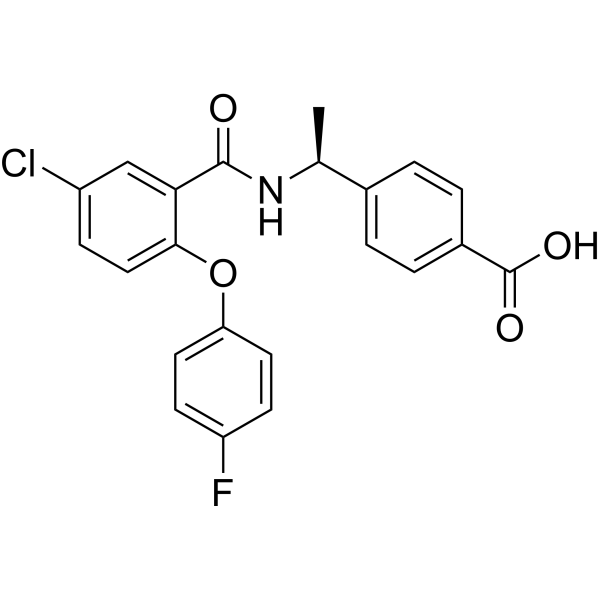
CJ-42794 (CJ-042794) is a potent, orally active, selective prostaglandin E receptor 4 (EP4) antagonist with an IC50 value of 10 nM, which is 200-fold more selective than EP1, EP2 and EP3. CJ-42794 can be used in research of gastric ulcers.
연구목적의 판매만을 진행합니다. 환자를 대상으로 한 판매는 하지 않습니다.
- Purity: 98.53%
- CAS No.: 847728-01-2
- 화학식: C22H17ClFNO4
- 분자량:413.83
-
보관:Powder -20°C, 3 years , 4°C, 2 years ; In solvent -80°C, 2 years , -20°C, 1 year

To place orders, for customer services and technical support, please contact: MedChemExpress USA
Tel: 609-228-6898 E-mail: [email protected] [email protected]


-
 Biological Activity
-
Chemical Information
-
용액&용해도
- 순도&문서
- References
-
 Help & FAQs



Publications Citing Use of MedChemExpress (MCE) CJ-42794
More

Biological Activity
|
EP 10 nM (EC50) |
|
Cell Line

|
Type | Value | Description | References |
|---|---|---|---|---|
| HEK293 | IC50 |
10 nM
Compound: CJ-42794
|
Displacement of [3H]-PGE2 from human EP4 receptor expressed in HEK293 cells
Displacement of [3H]-PGE2 from human EP4 receptor expressed in HEK293 cells
|
[PMID: 21930381] |
| HEK293 | IC50 |
13 nM
Compound: CJ-42794
|
Antagonist activity at human EP4 receptor expressed in HEK293 cells assessed as inhibition of PGE2-induced cAMP accumulation by bead-based proximity assay
Antagonist activity at human EP4 receptor expressed in HEK293 cells assessed as inhibition of PGE2-induced cAMP accumulation by bead-based proximity assay
|
[PMID: 21930381] |
| HEK293 | IC50 |
>1000 nM
Compound: CJ-42794
|
Displacement of [3H]-PGE2 from human EP2 receptor expressed in HEK293 cells
Displacement of [3H]-PGE2 from human EP2 receptor expressed in HEK293 cells
|
[PMID: 21930381] |
| HEK293 | IC50 |
38.2 nM
Compound: 11c
|
Antagonist activity at human EP4 receptor expressed in HEK293 cells assessed as inhibition of PGE2-induced cAMP level by HTS assay
Antagonist activity at human EP4 receptor expressed in HEK293 cells assessed as inhibition of PGE2-induced cAMP level by HTS assay
|
[PMID: 28169162] |
| HEK293 | IC50 |
6.59 nM
Compound: 11c
|
Displacement of [3H]PGE from human EP4 receptor expressed in HEK293 cell membranes
Displacement of [3H]PGE from human EP4 receptor expressed in HEK293 cell membranes
|
[PMID: 28169162] |
CJ-042794 (CJ-042794, 0.3-5000 nM; 10 min; hEP4/HEK293 cells) inhibits the PGE2-induced elevation of cAMP in a concentration-dependent manner with a pIC50 value of 7.5[1].
CJ-042794 (3-3000 nM; 24 h) reverses the inhibitory effects of PGE2 (10 nM) on the LPS-induced TNFα production in human whole blood (HWB) in a concentration-dependent manner with a pIC50 value of 6.4[1].
MedChemExpress (MCE) has not independently confirmed the accuracy of these methods. They are for reference only.
CJ-042794 (30 and 50 mg/kg; p.o.; once) does not cause any damage to the gastric mucosa of normal rats and has no gastric ulcerogenic response to cold-restraint stress[1].
CJ-042794 (30 and 50 mg/kg; p.o.; once) does not damage the stomach and small intestine of helper arthritis rats[1].
CJ-042794 (3-45 mg/kg; p.o.; twice daily for 14 d; Sprague-Dawley rats) promotes spontaneous healing of gastric ulcers[1].
CJ-042794 (10 mg/kg; p.o.; daily, for 7 d) repeats administration impairs the healing of chronic gastric ulcers with a down-regulation of vascular endothelial growth factor expression in the ulcerated mucosa[1].
MedChemExpress (MCE) has not independently confirmed the accuracy of these methods. They are for reference only.
-
Animal Model:Male Sprague-Dawley rats (200-230 g)[1]
-
Dosage:0.3, 1, and 3 mg/kg
-
Administration:intradermal injection; once
-
Result:Attenuated the PGE2-stimulated HCO3 secretion in a dose-dependent manner and had the inhibition being 68.9% at 1 mg/kg.
-
Animal Model:Male Sprague-Dawley rats (200-230 g)[1]
-
Dosage:30 and 50 mg/kg
-
Administration:Oral administration; once
-
Result:Did not produce any damage in the gastrointestinal mucosa.
Did not produce gastric ulcerogenic response induced by cold-restraint stress.
-
Animal Model:Dark Agouti (DA) rats (140-160 g)[1]
-
Dosage:30 and 50 mg/kg
-
Administration:Oral administration; once
-
Result:Caused any visible damage in the gastric mucosa of normal rats.
Had little injurious effect on the small intestine of arthritic rats.
-
Animal Model:Male Sprague-Dawley rats (200-230 g)[1]
-
Dosage:3, 10, and 45 mg/kg
-
Administration:Oral administration; twice daily for 14 days
-
Result:Healed ulcers gradually within 14 days, and the ulcer score on day 17 was 1.6 mm2.
-
Animal Model:Male Sprague-Dawley rats (200-230 g)[1]
-
Dosage:10 mg/kg
-
Administration:Oral administration; daily for 7 days
-
Result:Down-regulates the expression of VEGF and decreased the angiogenic response.


Chemical Information
-
CAS No. 847728-01-2
-
Appearance Solid
-
분자량 413.83
-
화학식 C22H17ClFNO4
-
Color White to off-white
-
SMILES
ClC1=CC=C(OC2=CC=C(F)C=C2)C(C(N[C@H](C3=CC=C(C(O)=O)C=C3)C)=O)=C1
-
Synonyms
CJ-042794
-
선적
Room temperature in continental US; may vary elsewhere.
-
보관
Powder -20°C 3 years 4°C 2 years In solvent -80°C 2 years -20°C 1 year


Publications (4)
-
Journal Impact Factor
-
Most Recent
-
Nat Commun
2023 Dec 6;14(1):8067. PMID: 38057319 -
J Orthop Translat
Sensory nerve EP4 facilitates heterotopic ossification by regulating angiogenesis-coupled bone formation. [Abstract]2024 Nov 5:49:325-338. PMID: 39568804 -
Int J Mol Sci
2025 Oct 18;26(20):10132. PMID: 41155424 -
Genes Immun
MTA1-mediated transcriptional repression of Cox2 confers resistance against neutrophil infiltration in endometritis. [Abstract]2026 Mar 10. PMID: 41807815


용액&용해도
DMSO : ≥ 28 mg/mL (67.66 mM; Hygroscopic DMSO has a significant impact on the solubility of product, please use newly opened DMSO)
* "≥" means soluble, but saturation unknown.
Please refer to the solubility information to select the appropriate solvent. Once prepared, please aliquot and store the solution to prevent product inactivation from repeated freeze-thaw cycles.
Storage method and period of stock solution: -80°C, 2 years; -20°C, 1 year. When stored at -80°C, please use it within 2 years. When stored at -20°C, please use it within 1 year.
Please refer to the solubility information to select the appropriate solvent. Once prepared, please aliquot and store the solution to prevent product inactivation from repeated freeze-thaw cycles.
Storage method and period of stock solution: -80°C, 2 years; -20°C, 1 year. When stored at -80°C, please use it within 2 years. When stored at -20°C, please use it within 1 year.
Concentration (start) × Volume (start) = Concentration (final) × Volume (final)
Select the appropriate dissolution method based on your experimental animal and administration route.
- For the following dissolution methods, please ensure to first prepare a clear stock solution using an In Vitro approach and then sequentially add co-solvents:
- To ensure reliable experimental results, the clarified stock solution can be appropriately stored based on storage conditions. As for the working solution for In Vivo experiments, it is recommended to prepare freshly and use it on the same day.
- The percentages shown for the solvents indicate their volumetric ratio in the final prepared solution. If precipitation or phase separation occurs during preparation, heat and/or sonication can be used to aid dissolution.
Add each solvent one by one: 10% DMSO 40% PEG300 5% Tween-80 45% Saline
Solubility: ≥ 2.5 mg/mL (6.04 mM); Clear solution
This protocol yields a clear solution of ≥ 2.5 mg/mL (saturation unknown).
Taking 1 mL working solution as an example, add 100 μL DMSO stock solution (25.0 mg/mL) to 400 μL PEG300, and mix evenly; then add 50 μL Tween-80 and mix evenly; then add 450 μL Saline to adjust the volume to 1 mL.
Preparation of Saline: Dissolve 0.9 g sodium chloride in ddH₂O and dilute to 100 mL to obtain a clear Saline solution.
Add each solvent one by one: 10% DMSO 90% (20% SBE-β-CD in Saline)
Solubility: 2.5 mg/mL (6.04 mM); Suspended solution; Need ultrasonic
This protocol yields a suspended solution of 2.5 mg/mL. Suspended solution can be used for oral and intraperitoneal injection.
Taking 1 mL working solution as an example, add 100 μL DMSO stock solution (25.0 mg/mL) to 900 μL 20% SBE-β-CD in Saline, and mix evenly.
Preparation of 20% SBE-β-CD in Saline (4°C, storage for one week): 2 g SBE-β-CD powder is dissolved in 10 mL Saline, completely dissolve until clear.
Please enter the basic information of animal experiments:
-
-
-
-
Recommended: Prepare an additional quantity of animals to account for potential losses during experiments.
Please enter your animal formula composition:
-
%DMSO +
Recommended: Keep the proportion of DMSO in working solution below 2% if your animal is weak.
-
%+
-
+%Tween-80 + +
-
%Saline +
The co-solvents required include: DMSO, . All of co-solvents are available by MedChemExpress (MCE). , Tween 80. All of co-solvents are available by MedChemExpress (MCE).
Working solution concentration: 0.22 mg/mL
Method for preparing stock solution: mg drug dissolved in μL DMSO. Stock solution concentration: mg/mL.
1. Take μL DMSO stock solution;
2. Add μL .
μL , mix evenly;
3. Then add μL Tween 80, mix evenly;
4. Then add μL
Please ensure that the stock solution in the first step is dissolved to a clear state, and add co-solvents in sequence. You can use ultrasonic heating (ultrasonic cleaner, recommended frequency 20-40 kHz), vortexing, etc. to assist dissolution.


순도&문서
-
Data Sheet (280 KB)
-
SDS (393 KB)
- English - EN (393 KB)
- Français - FR (393 KB)
- Deutsch - DE (393 KB)
- Norwegian - NO (393 KB)
- Español - ES (393 KB)
- Swedish - SV (393 KB)
- Italian - IT (393 KB)
- Korean - KR (393 KB)
- Portuguese - PT (393 KB)
-
Handling Instructions (2659 KB)
References
[1]. Murase A, et, al. In vitro pharmacological characterization of CJ-042794, a novel, potent, and selective prostaglandin EP(4) receptor antagonist. Life Sci. 2008 Jan 16;82(3-4):226-32. [Content Brief]
[2]. Takeuchi K, et, al. Effect of (S)-4-(1-(5-chloro-2-(4-fluorophenyoxy)benzamido)ethyl) benzoic acid (CJ-42794), a selective antagonist of prostaglandin E receptor subtype 4, on ulcerogenic and healing responses in rat gastrointestinal mucosa. J Pharmacol Exp Ther. 2007 Sep;322(3):903-12. [Content Brief]


Complete Stock Solution Preparation Table
Please refer to the solubility information to select the appropriate solvent. Once prepared, please aliquot and store the solution to prevent product inactivation from repeated freeze-thaw cycles.
Storage method and period of stock solution: -80°C, 2 years; -20°C, 1 year. When stored at -80°C, please use it within 2 years. When stored at -20°C, please use it within 1 year.
| Optional Solvent | Concentration Solvent Mass | 1 mg | 5 mg | 10 mg | 25 mg |
|---|---|---|---|---|---|
| DMSO | 1 mM | 2.4165 mL | 12.0823 mL | 24.1645 mL | 60.4113 mL |
| 5 mM | 0.4833 mL | 2.4165 mL | 4.8329 mL | 12.0823 mL | |
| 10 mM | 0.2416 mL | 1.2082 mL | 2.4165 mL | 6.0411 mL | |
| 15 mM | 0.1611 mL | 0.8055 mL | 1.6110 mL | 4.0274 mL | |
| 20 mM | 0.1208 mL | 0.6041 mL | 1.2082 mL | 3.0206 mL | |
| 25 mM | 0.0967 mL | 0.4833 mL | 0.9666 mL | 2.4165 mL | |
| 30 mM | 0.0805 mL | 0.4027 mL | 0.8055 mL | 2.0137 mL | |
| 40 mM | 0.0604 mL | 0.3021 mL | 0.6041 mL | 1.5103 mL | |
| 50 mM | 0.0483 mL | 0.2416 mL | 0.4833 mL | 1.2082 mL | |
| 60 mM | 0.0403 mL | 0.2014 mL | 0.4027 mL | 1.0069 mL |


CJ-42794 Related Classifications
HY-10797 Related Classifications
 Powered by Bioz