



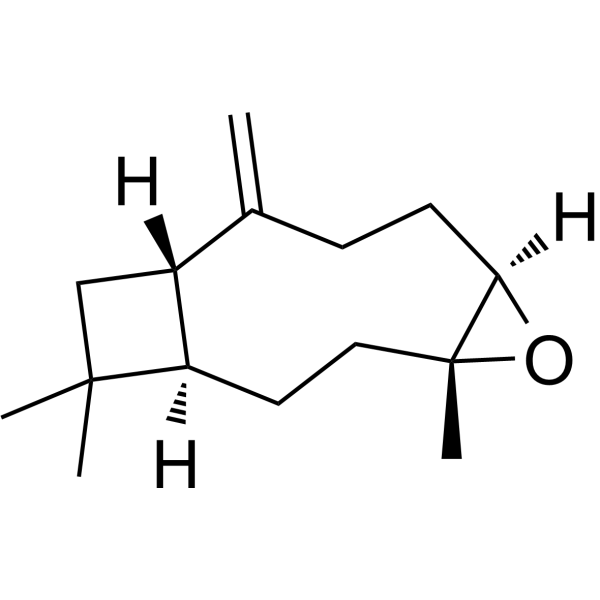
Caryophyllene oxide

Based on 1 Customer Validation
Caryophyllene oxide ((-)-Caryophyllene oxide) is a bicyclic sesquiterpene with anticancer effects. Caryophyllene oxide induces apoptosis of PC-3 cells. Caryophyllene oxide shows analgesic and anti-inflammatory activities. Caryophyllene oxide has insecticidal, antioxidant, antimicrobial, antifungal, and antiparasitic properties.
연구목적의 판매만을 진행합니다. 환자를 대상으로 한 판매는 하지 않습니다.
- Purity: 99.71%
- CAS No.: 1139-30-6
- 화학식: C15H24O
- 분자량:220.35
-
보관:Powder -20°C, 3 years , 4°C, 2 years ; In solvent -80°C, 2 years , -20°C, 1 year

To place orders, for customer services and technical support, please contact: MedChemExpress USA
Tel: 609-228-6898 E-mail: [email protected] [email protected]


-
 Biological Activity
-
Chemical Information
-
용액&용해도
- 순도&문서
- References
-
 Help & FAQs
-

Anti-Infection Compound Library
HY-L002
-
Apoptosis Compound Library
HY-L003
-
Immunology/Inflammation Compound Library
HY-L007
-
Natural Product Library
HY-L021
-
Anti-Cancer Compound Library
HY-L025
-
Covalent Screening Library
HY-L036
-
Antioxidant Compound Library
HY-L037
-
Antifungal Compound Library
HY-L048
-
Antibacterial Compound Library
HY-L049
-
Medicine Food Homology Compound Library
HY-L055
-
Terpenoids Library
HY-L056
-
Traditional Chinese Medicine Active Compound Library
HY-L065
-
FDA Approved & Pharmacopeial Drug Library
HY-L066
-
Antiparasitic Compound library
HY-L082
-
Food Additive Library
HY-L093
-
Food-Sourced Compound Library
HY-L094
-
Anti-Cancer Natural Product Library
HY-L107
-
Anti-inflammatory Traditional Chinese Medicine Active Compound Library
HY-L114
-
Plant-Sourced Natural Product Library
HY-L115
-
Human Metabolite Library
HY-L123
-
Cysteine Targeted Covalent Library
HY-L153
-
Cell Death Library
HY-L162
-
Multi-Target Compound Library
HY-L176
-
Radioprotector Library
HY-L178
-
Bioactive Compound Library Max
HY-L181
-
MCE Bioactive Compound Library
HY-L001V
-
Covalent Screening Library Plus
HY-L036P
-
Natural Product Library Plus
HY-L021P
-
Natural Product and Natural Product-Like Compound Library
HY-L021M
-
Bioactive Compound Library
HY-L001
-
Anti-Fibrosis Compound Library
HY-L185
-
Miao Ethnicity Medicine Compound Library
HY-L190
-
Tibetan Medicine Compound Library
HY-L191
-
PBCRBS Traditional Chinese Medicine Compound Library
HY-L193
-
Heat-Clearing and Detoxification Traditional Chinese Medicine Compound Library
HY-L194
-
Non-Alcoholic Fatty Liver Disease (NAFLD) Compound Library
HY-L199
-
RO5 Drug-like Natural Product Library
HY-L200
-
Flavor Compound Library
HY-L202
-
High-Throughput Bioactive Compound Library
HY-L205
-
High-Throughput Natural Product Library
HY-L206
-
Ancient Chinese Classical Formulas Traditional Chinese Medicine Active Compound Library
HY-L209
-
Mass Spectrometry Human Metabolite Library
HY-L215
-
Antitussive and Antiasthmatic Traditional Chinese Medicine Active Compound Library
HY-L223
-
Diarrhea-Related Traditional Chinese Medicine Active Compound Library
HY-L224
-
Mongolian Medicine Compound Library
HY-L238
-
Chinese Baijiu Compound Library
HY-L241
-
Flavors and Fragrances Compound Library
HY-L242
-
Natural Product Diversity Scaffold Library
HY-L245
-
Tonifying Traditional Chinese Medicine Monomer Compound Library
HY-L246
-
Environmental Pollutant Compound Library
HY-L247
-
Mass Spectrometry Natural Product Library
HY-L262


All Parasite Isoforms
More

Biological Activity
Caryophyllene oxide shows IC50 values of 22.86 µg/mL and 44.78 µg/mL in PC-3 and MRC5 normal cells, respectively[2].
Caryophyllene oxide (103.7 μM; 24 h) induces early and late apoptosis, and blocks the cell in the G2/M phase[2].
Caryophyllene oxide (103.7 μM; 6-48 h) depolarizes the mitochondrial membrane. Depolarization of the mitochondrial membrane releases the pro-apoptotic protein Bax from Bcl-xL. The apoptosis process is caspase-7 activation-dependent[2].
Caryophyllene oxide inhibits Escherichia coli and Staphylococcus aureus[3].
Caryophyllene oxide shows moderately cytotoxic against A-549, DLD-1, and WS1[3].
Caryophyllene oxide also inhibits NO production induced by Lipopolysaccharides (HY-D1056) (LPS) with an IC50 of 183 µg/mL[3].
MedChemExpress (MCE) has not independently confirmed the accuracy of these methods. They are for reference only.
-
Cell Line:PC3 cells
-
Concentration:103.7 μM
-
Incubation Time:24 h
-
Result:Blocked the cell in the G2/M phase. The dense and compact damage around the nuclei, which were undergoing abnormal formations, which were undergoing abnormal formations.
-
Cell Line:PC3 cells
-
Concentration:103.7 μM
-
Incubation Time:24 h
-
Result:The early apoptotic population increased from 13.02% (at 8 h) to 15.61% and the late apoptosis population from 6.14% to 28.02%.
Induced cell death through the mitochondrial-dependent apoptotic pathway.
-
Cell Line:PC3 cells
-
Concentration:103.7 μM
-
Incubation Time:6, 16, 24, and 48 h
-
Result:The Bax protein expression level increased at 24 h.
Induced a Bcl-2 protein decrease in a time-dependent manner, but Bcl-xL protein remained constant until 48 h.
Increased the cleaved-Caspase-7 in a time-dependent manner.
MedChemExpress (MCE) has not independently confirmed the accuracy of these methods. They are for reference only.
-
Animal Model:Male Swiss albino mice (20-25 g) bearing hot plate test or Acetic acid-induced writhing test[1].
-
Dosage:12.5 mg/kg and 25 mg/kg
-
Administration:i.p.; once
-
Result:Did not produce any significant changes of paw licking time in the early phase of pain.
In the late phase, a dose-dependent and significant increase in licking time was observed in mice.
Significantly reduced the number of writhes.
-
Animal Model:Albino rats of Wistar strain (150-200 g) by sub plantar injection of 0.1 ml of 1% suspension of carrageenan with 2% gum acacia in normal saline, in the right hind paw of rats[1].
-
Dosage:12.5 mg/kg and 25 mg/kg
-
Administration:i.p.; once
-
Result:Showed significant inhibition of inflammatory edema at the first and second hours after the carrageenan treatment.


Chemical Information
-
CAS No. 1139-30-6
-
Appearance Solid
-
분자량 220.35
-
화학식 C15H24O
-
Color White to off-white
-
SMILES
C=C1CC[C@@]2([H])O[C@]2(C)CC[C@@]3([H])C(C)(C)C[C@]13[H]
-
Synonyms
(-)-Caryophyllene oxide
-
Structure Classification
-
Initial Source
-
선적
Room temperature in continental US; may vary elsewhere.
-
보관
Powder -20°C 3 years 4°C 2 years In solvent -80°C 2 years -20°C 1 year


용액&용해도
DMSO : 100 mg/mL (453.82 mM; Need ultrasonic; Hygroscopic DMSO has a significant impact on the solubility of product, please use newly opened DMSO)
H2O : 1 mg/mL (4.54 mM; ultrasonic and warming and heat to 80°C)
Please refer to the solubility information to select the appropriate solvent. Once prepared, please aliquot and store the solution to prevent product inactivation from repeated freeze-thaw cycles.
Storage method and period of stock solution: -80°C, 2 years; -20°C, 1 year. When stored at -80°C, please use it within 2 years. When stored at -20°C, please use it within 1 year.
* Note: If you choose water as the stock solution, please dilute it to the working solution, then filter and sterilize it with a 0.22 μm filter before use.
Please refer to the solubility information to select the appropriate solvent. Once prepared, please aliquot and store the solution to prevent product inactivation from repeated freeze-thaw cycles.
Storage method and period of stock solution: -80°C, 2 years; -20°C, 1 year. When stored at -80°C, please use it within 2 years. When stored at -20°C, please use it within 1 year.
* Note: If you choose water as the stock solution, please dilute it to the working solution, then filter and sterilize it with a 0.22 μm filter before use.
Concentration (start) × Volume (start) = Concentration (final) × Volume (final)
Select the appropriate dissolution method based on your experimental animal and administration route.
- For the following dissolution methods, please ensure to first prepare a clear stock solution using an In Vitro approach and then sequentially add co-solvents:
- To ensure reliable experimental results, the clarified stock solution can be appropriately stored based on storage conditions. As for the working solution for In Vivo experiments, it is recommended to prepare freshly and use it on the same day.
- The percentages shown for the solvents indicate their volumetric ratio in the final prepared solution. If precipitation or phase separation occurs during preparation, heat and/or sonication can be used to aid dissolution.
Add each solvent one by one: 10% DMSO 40% PEG300 5% Tween-80 45% Saline
Solubility: ≥ 2.5 mg/mL (11.35 mM); Clear solution
This protocol yields a clear solution of ≥ 2.5 mg/mL (saturation unknown).
Taking 1 mL working solution as an example, add 100 μL DMSO stock solution (25.0 mg/mL) to 400 μL PEG300, and mix evenly; then add 50 μL Tween-80 and mix evenly; then add 450 μL Saline to adjust the volume to 1 mL.
Preparation of Saline: Dissolve 0.9 g sodium chloride in ddH₂O and dilute to 100 mL to obtain a clear Saline solution.
Add each solvent one by one: 10% DMSO 90% (20% SBE-β-CD in Saline)
Solubility: ≥ 2.5 mg/mL (11.35 mM); Clear solution
This protocol yields a clear solution of ≥ 2.5 mg/mL (saturation unknown).
Taking 1 mL working solution as an example, add 100 μL DMSO stock solution (25.0 mg/mL) to 900 μL 20% SBE-β-CD in Saline, and mix evenly.
Preparation of 20% SBE-β-CD in Saline (4°C, storage for one week): 2 g SBE-β-CD powder is dissolved in 10 mL Saline, completely dissolve until clear.
Please enter the basic information of animal experiments:
-
-
-
-
Recommended: Prepare an additional quantity of animals to account for potential losses during experiments.
Please enter your animal formula composition:
-
%DMSO +
Recommended: Keep the proportion of DMSO in working solution below 2% if your animal is weak.
-
%+
-
+%Tween-80 + +
-
%Saline +
The co-solvents required include: DMSO, . All of co-solvents are available by MedChemExpress (MCE). , Tween 80. All of co-solvents are available by MedChemExpress (MCE).
Working solution concentration: 0.22 mg/mL
Method for preparing stock solution: mg drug dissolved in μL DMSO. Stock solution concentration: mg/mL.
1. Take μL DMSO stock solution;
2. Add μL .
μL , mix evenly;
3. Then add μL Tween 80, mix evenly;
4. Then add μL
Please ensure that the stock solution in the first step is dissolved to a clear state, and add co-solvents in sequence. You can use ultrasonic heating (ultrasonic cleaner, recommended frequency 20-40 kHz), vortexing, etc. to assist dissolution.


순도&문서
-
Data Sheet (282 KB)
-
SDS (536 KB)
- English - EN (536 KB)
- Français - FR (536 KB)
- Deutsch - DE (536 KB)
- Norwegian - NO (536 KB)
- Español - ES (536 KB)
- Swedish - SV (536 KB)
- Italian - IT (536 KB)
- Korean - KR (536 KB)
- Portuguese - PT (536 KB)
-
Handling Instructions (2659 KB)
References
[1]. Chavan MJ, et al. Analgesic and anti-inflammatory activity of Caryophyllene oxide from Annona squamosa L. bark. Phytomedicine. 2010 Feb;17(2):149-51. [Content Brief]
[2]. Delgado C, et al. Caryophyllene Oxide, the Active Compound Isolated from Leaves of Hymenaea courbaril L. (Fabaceae) with Antiproliferative and Apoptotic Effects on PC-3 Androgen-Independent Prostate Cancer Cell Line. Molecules. 2021 Oct 12;26(20):6142. [Content Brief]
[3]. Coté H, et al. Anti-Inflammatory, Antioxidant, Antibiotic, and Cytotoxic Activities of Tanacetum vulgare L. Essential Oil and Its Constituents. Medicines (Basel). 2017 May 25;4(2):34. [Content Brief]


Complete Stock Solution Preparation Table
Please refer to the solubility information to select the appropriate solvent. Once prepared, please aliquot and store the solution to prevent product inactivation from repeated freeze-thaw cycles.
Storage method and period of stock solution: -80°C, 2 years; -20°C, 1 year. When stored at -80°C, please use it within 2 years. When stored at -20°C, please use it within 1 year.
| Optional Solvent | Concentration Solvent Mass | 1 mg | 5 mg | 10 mg | 25 mg |
|---|---|---|---|---|---|
| H2O / DMSO | 1 mM | 4.5382 mL | 22.6912 mL | 45.3823 mL | 113.4559 mL |
| DMSO | 5 mM | 0.9076 mL | 4.5382 mL | 9.0765 mL | 22.6912 mL |
| 10 mM | 0.4538 mL | 2.2691 mL | 4.5382 mL | 11.3456 mL | |
| 15 mM | 0.3025 mL | 1.5127 mL | 3.0255 mL | 7.5637 mL | |
| 20 mM | 0.2269 mL | 1.1346 mL | 2.2691 mL | 5.6728 mL | |
| 25 mM | 0.1815 mL | 0.9076 mL | 1.8153 mL | 4.5382 mL | |
| 30 mM | 0.1513 mL | 0.7564 mL | 1.5127 mL | 3.7819 mL | |
| 40 mM | 0.1135 mL | 0.5673 mL | 1.1346 mL | 2.8364 mL | |
| 50 mM | 0.0908 mL | 0.4538 mL | 0.9076 mL | 2.2691 mL | |
| 60 mM | 0.0756 mL | 0.3782 mL | 0.7564 mL | 1.8909 mL | |
| 80 mM | 0.0567 mL | 0.2836 mL | 0.5673 mL | 1.4182 mL | |
| 100 mM | 0.0454 mL | 0.2269 mL | 0.4538 mL | 1.1346 mL |
* Note: If you choose water as the stock solution, please dilute it to the working solution, then filter and sterilize it with a 0.22 μm filter before use.


Caryophyllene oxide Related Classifications
HY-N3544 Related Classifications
 Powered by Bioz