



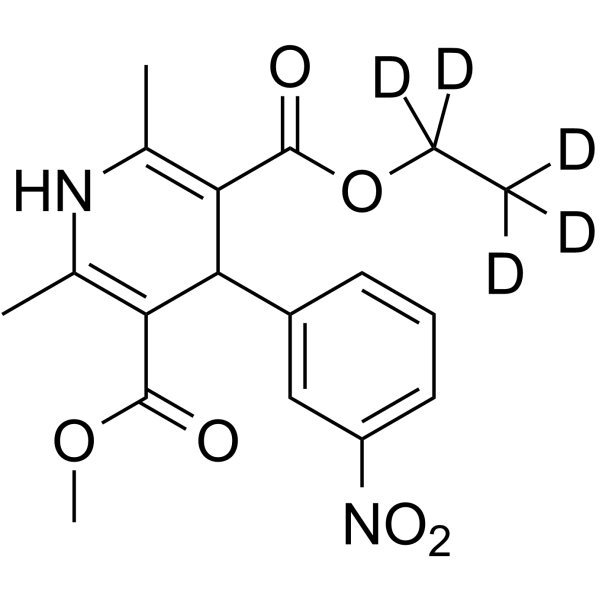
Nitrendipine-d5

Based on 1 Customer Validation
Nitrendipine-d5 is the deuterium labeled Nitrendipine (HY-B0424). Nitrendipine (BAY-E-5009) is an orally active analog of Nifedipine (HY-B0284) and dihydropyridine calcium channel blocker. Nitrendipine induces Apoptosis. Nitrendipine has antihypertensive effects. Nitrendipine blocks alcohol and Morphine withdrawal symptoms. Nitrendipine reduces right ventricular hypertrophy and pulmonary vascular changes induced by intermittent hypoxia. Nitrendipine has anticancer effects on neuroblastoma.
연구목적의 판매만을 진행합니다. 환자를 대상으로 한 판매는 하지 않습니다.
- Purity : 99.77%
- CAS No.: 2469554-26-3
- 화학식: C18H15D5N2O6
- 분자량:365.39
-
보관:
4°C, protect from light
* In solvent : -80°C, 6 months; -20°C, 1 month (protect from light)

To place orders, for customer services and technical support, please contact: MedChemExpress USA
Tel: 609-228-6898 E-mail: [email protected] [email protected]


-
 Biological Activity
-
Chemical Information
-
용액&용해도
- Protocol
- 순도&문서
- References
-
 Help & FAQs


All Calcium Channel Isoforms
More

Biological Activity
제품 설명
In Vitro
Stable heavy isotopes of hydrogen, carbon, and other elements have been incorporated into drug molecules, largely as tracers for quantitation during the drug development process. Deuteration has gained attention because of its potential to affect the pharmacokinetic and metabolic profiles of drugs[1].
MedChemExpress (MCE) has not independently confirmed the accuracy of these methods. They are for reference only.
신청
1. This compound can be used as a tracer
2. This compound can be used as an internal standard for quantitative analysis by NMR, GC-MS, or LC-MS.


Chemical Information
-
CAS No. 2469554-26-3
-
Unlabeled CAS 39562-70-4
-
Appearance Solid
-
분자량 365.39
-
화학식 C18H15D5N2O6
-
Color Off-white to yellow
-
SMILES
O=C(C1=C(C)NC(C)=C(C1C2=CC([N+]([O-])=O)=CC=C2)C(OC([2H])([2H])C([2H])([2H])[2H])=O)OC
-
Synonyms
AY-E-5009-d5
-
선적
Room temperature in continental US; may vary elsewhere.
-
보관
4°C, protect from light
* In solvent : -80°C, 6 months; -20°C, 1 month (protect from light)


용액&용해도
In Vitro:
DMSO : 125 mg/mL (342.10 mM; Need ultrasonic; Hygroscopic DMSO has a significant impact on the solubility of product, please use newly opened DMSO)
Please refer to the solubility information to select the appropriate solvent. Once prepared, please aliquot and store the solution to prevent product inactivation from repeated freeze-thaw cycles.
Storage method and period of stock solution: -80°C, 6 months; -20°C, 1 month (protect from light). When stored at -80°C, please use it within 6 months. When stored at -20°C, please use it within 1 month.
Please refer to the solubility information to select the appropriate solvent. Once prepared, please aliquot and store the solution to prevent product inactivation from repeated freeze-thaw cycles.
Storage method and period of stock solution: -80°C, 6 months; -20°C, 1 month (protect from light). When stored at -80°C, please use it within 6 months. When stored at -20°C, please use it within 1 month.
Concentration (start) × Volume (start) = Concentration (final) × Volume (final)


순도&문서
-
Data Sheet (282 KB)
-
SDS (252 KB)
- English - EN (252 KB)
- Français - FR (252 KB)
- Deutsch - DE (252 KB)
- Norwegian - NO (252 KB)
- Español - ES (252 KB)
- Swedish - SV (252 KB)
- Italian - IT (252 KB)
- Korean - KR (252 KB)
- Portuguese - PT (252 KB)
-
Handling Instructions (2659 KB)
References
[2]. Watson WP, et al. The differential effects of felodipine and nitrendipine on cerebral dihydropyridine binding ex vivo and the ethanol withdrawal syndrome in mice. Br J Pharmacol. 1994 Aug;112(4):1017-24. [Content Brief]
[4]. Gatch MB. Nitrendipine blocks the nociceptive effects of chronically administered ethanol. Alcohol Clin Exp Res. 2002 Aug;26(8):1181-7. [Content Brief]
[6]. Michael JR, et al. Nitrendipine attenuates the pulmonary vascular remodeling and right ventricular hypertrophy caused by intermittent hypoxia in rats. Am Rev Respir Dis. 1986 Mar;133(3):375-9. [Content Brief]
[7]. Han P, et al. Synergism of hydrochlorothiazide and nitrendipine on reduction of blood pressure and blood pressure variability in spontaneously hypertensive rats. Acta Pharmacol Sin. 2006 Dec;27(12):1575-9. [Content Brief]
[8]. M Bursztyn, et al. Nitrendipine improves glucose tolerance and deoxyglucose uptake in hypertensive rats. Hypertension. 1994 Jun;23(6 Pt 2):1051-3. [Content Brief]
[9]. He-Hui Xie, et al. Synergism of atenolol and nitrendipine on hemodynamic amelioration and organ protection in hypertensive rats. J Hypertens. 2005 Jan;23(1):193-201. [Content Brief]
[10]. S Kazda, et al. Diuretic effect of nitrendipine contributes to its antihypertensive efficacy: a review. J Cardiovasc Pharmacol. 1988;12 Suppl 4:S1-5. [Content Brief]
[11]. Bellemann, P., et al., [3H]-Nitrendipine, a potent calcium antagonist, binds with high affinity to cardiac membranes. Arzneimittelforschung, 1981. 31(12): p. 2064-7. [Content Brief]


Complete Stock Solution Preparation Table
Please refer to the solubility information to select the appropriate solvent. Once prepared, please aliquot and store the solution to prevent product inactivation from repeated freeze-thaw cycles.
Storage method and period of stock solution: -80°C, 6 months; -20°C, 1 month (protect from light). When stored at -80°C, please use it within 6 months. When stored at -20°C, please use it within 1 month.
| Optional Solvent | Concentration Solvent Mass | 1 mg | 5 mg | 10 mg | 25 mg |
|---|---|---|---|---|---|
| DMSO | 1 mM | 2.7368 mL | 13.6840 mL | 27.3680 mL | 68.4200 mL |
| 5 mM | 0.5474 mL | 2.7368 mL | 5.4736 mL | 13.6840 mL | |
| 10 mM | 0.2737 mL | 1.3684 mL | 2.7368 mL | 6.8420 mL | |
| 15 mM | 0.1825 mL | 0.9123 mL | 1.8245 mL | 4.5613 mL | |
| 20 mM | 0.1368 mL | 0.6842 mL | 1.3684 mL | 3.4210 mL | |
| 25 mM | 0.1095 mL | 0.5474 mL | 1.0947 mL | 2.7368 mL | |
| 30 mM | 0.0912 mL | 0.4561 mL | 0.9123 mL | 2.2807 mL | |
| 40 mM | 0.0684 mL | 0.3421 mL | 0.6842 mL | 1.7105 mL | |
| 50 mM | 0.0547 mL | 0.2737 mL | 0.5474 mL | 1.3684 mL | |
| 60 mM | 0.0456 mL | 0.2281 mL | 0.4561 mL | 1.1403 mL | |
| 80 mM | 0.0342 mL | 0.1711 mL | 0.3421 mL | 0.8553 mL | |
| 100 mM | 0.0274 mL | 0.1368 mL | 0.2737 mL | 0.6842 mL |


Nitrendipine-d5 Related Classifications
HY-B0424S Related Classifications
 Powered by Bioz