



Lentztrehalose B
Lentztrehalose B is a dehydroxylated analog of trehalose A, possessing antioxidant properties that can be used in research on neurodegenerative diseases and other autophagy-related conditions.
For research use only. We do not sell to patients.
- CAS No.: 1808096-67-4
- Formula: C17H30O11
- Molecular Weight:410.41
-
Storage:
Please store the product under the recommended conditions in the Certificate of Analysis.


To place orders, for customer services and technical support, please contact: MedChemExpress USA
Tel: 609-228-6898 E-mail: [email protected] [email protected]


-
 Biological Activity
-
Chemical Information
- Protocols
- Purity & Documentation
- References
-
 Help & FAQs


-
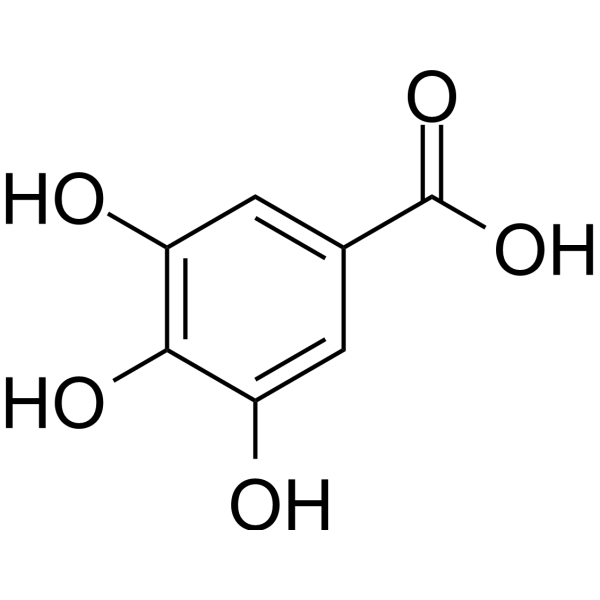
HY-N0523
Gallic acidBioactive Polyhydroxyphenolic Compound -
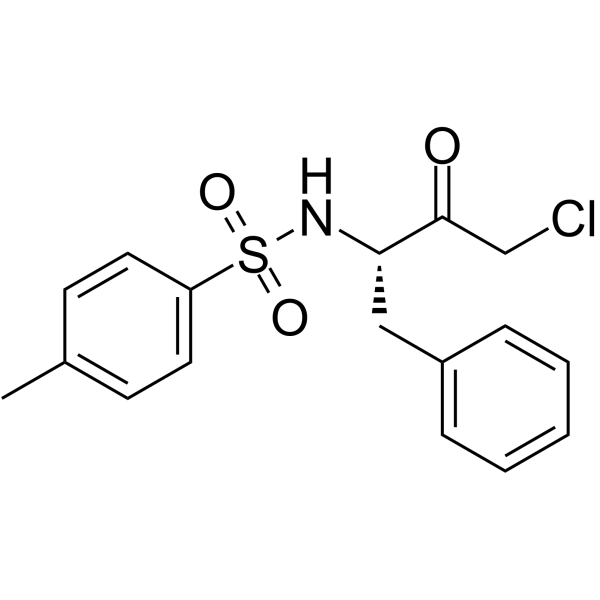
HY-124379
TPCKSerine Protease Inhibitor -

HY-N0523R
Gallic acid (Standard)Bioactive Polyhydroxyphenolic Compound -
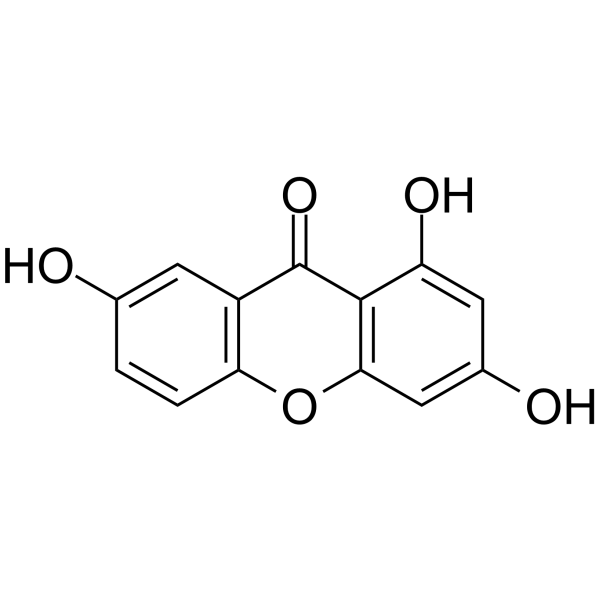
HY-118166
GentiseinSerotonin Transporter Inhibitor -

HY-118166R
Gentisein (Standard)Reference Standard -

HY-W747504
TAN-420EAntibiotic -

HY-125576
GriselimycinBacterial Inhibitor -

HY-158793
Lentztrehalose AEndogenous Metabolite


Biological Activity
Description


Chemical Information
-
CAS No. 1808096-67-4
-
Molecular Weight 410.41
-
Formula C17H30O11
-
SMILES
C/C(C)=C/CO[C@@H]1[C@H](O[C@@H]([C@@H]([C@H]1O)O)O[C@H]2O[C@@H]([C@H]([C@@H]([C@H]2O)O)O)CO)CO
-
Shipping
Room temperature in continental US; may vary elsewhere.
-
Storage
Please store the product under the recommended conditions in the Certificate of Analysis.

Protocols
-
Autophagy
Autophagy is a process in which eukaryotic cells use lysosomes to degrade their own cytoplasmic proteins and damaged organelles under the regulation of autophagy related gene (Atg). Microtubule-associated proteins light chain 3 (LC3) is recognized as autophagy marker, which transfers from cytoplasmic LC3 (LC3-I) to membrane type (LC3-II). LC3-II/I ratio could be detected by Western Blot and fluorescence microscopy.
-
Lysosome and acidic-vesicle live-cell staining
Lysosome and acidic-vesicle live-cell staining detects acidic intracellular compartments by using membrane-permeant acidotropic probes that accumulate in low-pH vesicles, including lysosomes, late endosomes, autolysosomes, and acidic phagosomes. LysoTracker staining is commonly used as an intensity-based readout of acidic lysosomal compartment abundance or enlargement, while acridine orange produces green fluorescence in less concentrated compartments and red fluorescence after concentration-dependent accumulation in acidic vesicular organelles. Loss or reduction of acridine-orange red signal can be used as a readout of lysosomal membrane permeabilization or reduced acidic-vesicle integrity. This protocol is designed for live cultured cells and can be adapted for fluorescence microscopy, high-content imaging, plate-reader readout, or flow cytometry when the selected literature supports the readout. Because these dyes report acidotropic accumulation rather than lysosome identity alone,
-
Macroautophagy Solutions
Macroautophagy is a conserved lysosome-dependent degradation pathway in which cytoplasmic material is sequestered into double-membrane autophagosomes and delivered to lysosomes for degradation and recycling. The pathway supports cellular homeostasis during nutrient limitation, organelle stress, protein-aggregate accumulation, infection, differentiation, and tissue remodeling by coupling cargo sequestration, autophagosome maturation, lysosomal fusion, and degradation of cargo-derived macromolecules. The core molecular sequence includes initiation by nutrient- and stress-regulated autophagy machinery, autophagosome nucleation, LC3/ATG8-family conjugation to autophagosomal membranes, cargo selection through receptors such as SQSTM1/p62, autophagosome-lysosome fusion, and lysosomal degradation. LC3 was identified as a mammalian homolog of yeast Atg8 that localizes to autophagosomal membranes after processing, and p62/SQSTM1 was shown to connect ubiquitinated cargo with autophagic degradati


Purity & Documentation
References

Calculators
Concentration (start) × Volume (start) = Concentration (final) × Volume (final)


Lentztrehalose B Related Classifications
HY-158794 Related Classifications
 Powered by Bioz